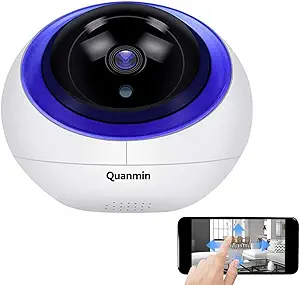
Ctronics vs Quanmin: Overview
Comparing Ctronics and Quanmin helps you determine which brand is best suited for your needs in Security Cameras. Both brands offer strong choices depending on your budget and key feature requirements.
Key Features & Comparison
Evaluate factors such as build quality, warranty, customer satisfaction, and total value before making your final purchase choice between Ctronics and Quanmin.
Picture Quality
When evaluating picture quality, Ctronics demonstrates a consumer-first engineering focus by prioritizing balanced exposure, vibrant color rendition, and dependable clarity across varied lighting conditions. Many Ctronics models feature sensors ranging from 2.5K to 4K resolution, paired with well-tuned image signal processors that handle dynamic range competently. Their outdoor pan-tilt-zoom (PTZ) lineup particularly benefits from dual-lens architectures or integrated hybrid illumination, utilizing white light LEDs alongside infrared diodes to offer crisp, full-color night vision. Digital noise reduction algorithms are tuned to maintain smooth frame rates and suppress artifacting in low-light scenarios, making motion tracking legible and facial details recognizable at reasonable perimeter distances.
In contrast, Quanmin generally approaches imaging from an industrial and niche surveillance standpoint, frequently employing raw Sony Starvis sensors or specialized monochrome infrared setups in specialized housings. While Quanmin cameras can achieve impressive low-light lux sensitivity and high native sharpness without aggressive post-processing smoothing, their out-of-the-box color science can appear clinical or washed out. The dynamic range often requires manual fine-tuning within configuration interfaces to avoid blown highlights in direct sunlight. However, for specialized commercial applications, covert deployments, or long-range monitoring requiring precise optical setups, Quanmin delivers an authentic, uncompressed visual stream that technical users often prefer over Ctronics' consumer-optimized, saturation-boosted footage.
Smart Features & Connectivity
Ctronics excels in consumer-oriented smart automation, offering out-of-the-box edge intelligence powered by dedicated NPU chips. Most modern Ctronics units provide reliable human and vehicle shape detection, automatic pan-and-tilt tracking, and customizable audio-visual sirens directly configured through intuitive mobile applications like Ctronics Pro. Connectivity is anchored by dual-band Wi-Fi (2.4GHz and 5GHz) or 4G LTE options designed for off-grid operations. The setup process is streamlined via QR code pairing and P2P protocols, ensuring that non-technical users can achieve fluid remote access, two-way audio communication, and push alerts with minimal network configuration hurdles.
Quanmin, conversely, leans heavily into standardized network architecture and custom system integrations, catering primarily to installers and DIY enthusiasts. Rather than relying on proprietary AI alerts, Quanmin cameras emphasize robust integration with third-party software ecosystems like Blue Iris, Synology Surveillance Station, and generic ONVIF-compliant Network Video Recorders (NVRs). Connectivity is predominantly built around Power over Ethernet (PoE) and wired RTSP streaming, yielding rock-solid network stability that surpasses Ctronics' wireless designs in interference-heavy environments. The trade-off is a lack of polished mobile apps or built-in, plug-and-play AI tracking, shifting the computational burden of smart detection and event triggering to the user's host server or central management software.
Privacy & Data Control
Privacy and data sovereignty represent a fundamental divergence in design philosophies between these two manufacturers. Ctronics balances cloud convenience with local storage options, offering standard onboard MicroSD card slots up to 128GB or 256GB alongside optional cloud backups. While Ctronics employs encrypted P2P tunnels to facilitate remote viewing, communication still touches regional relay servers, which may concern strict privacy advocates. Firmware updates are pushed automatically or easily via the mobile app, ensuring consumer-level security patches are applied, yet the reliance on proprietary cloud handshake mechanisms inherently limits complete isolation from external networks without losing core functionality.
Quanmin offers superior architectural data control for security-conscious professionals by adhering to open IP camera conventions. Because Quanmin cameras are typically devoid of mandatory vendor cloud ecosystems, users can easily isolate them on local VLANs without internet access, routing streams entirely through localized firewalls, VPNs, and on-premises NVRs. This eliminates telemetry transmission to offshore third-party servers and grants the user absolute ownership of their video metadata. However, this level of control shifts the security burden entirely to the consumer; Quanmin does not routinely push automated security patches, requiring users to manually manage port configurations, strong password hygiene, and network isolation to prevent vulnerabilities.
Subscription Plans
In terms of ongoing ownership costs, Ctronics adopts a flexible hybrid model that combines free standalone functionality with optional cloud subscription tiers. Users can entirely bypass ongoing fees by utilizing local MicroSD storage, which supports continuous recording and event-based playback directly in the app. For those seeking off-site redundancy, Ctronics offers cloud subscription plans that provide encrypted rolling video storage (typically 7 to 30 days) and rich push notifications with thumbnail previews. These plans are competitively priced within the consumer market, offering an accessible fallback for users worried about physical camera theft or SD card corruption, without rendering the hardware unusable if a subscription is declined.
Quanmin stands out by offering a completely subscription-free paradigm, aligning with traditional surveillance and commercial CCTV practices. There are no native Quanmin cloud storage plans, recurring feature paywalls, or locked-down capabilities. All features embedded in the camera's firmware—such as continuous recording, custom motion zones, and resolution adjustments—are fully unlocked from day one. While this eliminates monthly operational costs entirely, users must factor in the upfront investment for their own storage infrastructure, such as dedicated hard drives, an NVR, or a private NAS. Quanmin is the more economical long-term choice for multi-camera deployments, whereas Ctronics offers lower initial infrastructure overhead with the option of cloud convenience.