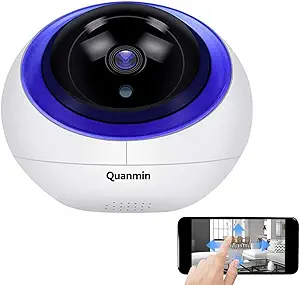








Blink vs Quanmin: Overview
Comparing Blink and Quanmin helps you determine which brand is best suited for your needs in Security Cameras. Both brands offer strong choices depending on your budget and key feature requirements.
Key Features & Comparison
Evaluate factors such as build quality, warranty, customer satisfaction, and total value before making your final purchase choice between Blink and Quanmin.
Picture Quality
When evaluating picture quality, Blink emphasizes power-efficient imaging suited for battery-operated devices, delivering a standard 1080p Full HD resolution across its lineup, including the Blink Outdoor and Mini series. Blink utilizes advanced CMOS sensors optimized for daylight clarity, producing natural color rendition and sufficient dynamic range for residential monitoring. However, its nocturnal performance relies heavily on single-diode infrared (IR) night vision, which can suffer from a relatively narrow illumination cone and slight motion blur when subjects move briskly past the lens. The priority on conserving energy restricts sustained high-bitrate streaming, resulting in noticeable compression artifacts during complex, high-motion events.
In contrast, Quanmin targets specialized, commercial, and enthusiast niches by offering robust hardware configurations that frequently feature true 2K, 4K, or high-definition optical zoom capabilities, such as multi-megapixel PTZ and varifocal domes. Because Quanmin cameras are typically line-powered via Power over Ethernet (PoE) or DC mains, their image signal processors (ISPs) operate without aggressive power throttles, allowing for higher bitrates, enhanced digital noise reduction (3D-DNR), and broad dynamic range (WDR) that handles harsh backlighting effectively. Night imaging on Quanmin units is often superior due to high-power array LEDs or ultra-low-light Starlight sensors, rendering sharper, high-contrast monochrome or full-color nocturnal footage that outclasses Blink's conservative, battery-oriented hardware.
Smart Features & Connectivity
Blink delivers a cohesive, consumer-centric smart ecosystem tightly bound to the Amazon Alexa infrastructure. Connectivity centers around 2.4 GHz Wi-Fi bridged via the proprietary Blink Sync Module, a hub that offloads low-power radio communication to maximize peripheral battery longevity. Smart functionality includes customizable activity zones, basic computer vision for person detection (available on select newer models with a plan), and seamless voice integration with Echo Show devices for hands-free live feeds. However, the ecosystem remains distinctly walled; there is no native support for Apple HomeKit, Google Assistant, or third-party Network Video Recorders (NVRs), and streaming latency can occasionally lag due to the intermediary cloud relay.
Quanmin takes a professional-grade, protocol-agnostic approach to connectivity and intelligence. Instead of proprietary clouds, Quanmin cameras universally adopt industry standards such as ONVIF profiles (S/G/T) and RTSP, enabling direct integration into third-party smart home platforms like Home Assistant, Blue Iris, and dedicated NVR hardware. Smart features are processed on-edge, often encompassing advanced algorithmic video analytics such as line crossing, perimeter intrusion detection, and vehicle-versus-pedestrian classification. While Quanmin lacks an out-of-the-box, plug-and-play voice assistant bridge comparable to Blink, its open network architecture and robust Ethernet interfaces ensure superior transmission stability, lower packet loss, and immense modular flexibility for advanced users.
Privacy & Data Control
Privacy within the Blink ecosystem is governed by Amazon's overarching data management policies, meaning user footage routinely transits through and resides on Amazon Web Services (AWS) servers when cloud recording is utilized. Blink employs end-to-end transport encryption (TLS) and AES-256 bit encryption at rest to safeguard video payloads, accompanied by mandatory two-factor authentication (2FA) for account security. While Blink offers local storage via a USB flash drive connected to the Sync Module 2, the system still demands an active internet connection to initialize feeds and verify device tokens, meaning users never completely sever ties with the centralized cloud infrastructure.
Conversely, Quanmin offers virtually absolute data autonomy due to its deployment model as standalone IP hardware. Because Quanmin cameras do not inherently force registration with a centralized foreign cloud, administrators can isolate these devices on a localized Virtual Local Area Network (VLAN) without WAN internet access, effectively mitigating outbound surveillance risks and remote server vulnerabilities. Footage is retained locally on high-capacity internal MicroSD cards, network-attached storage (NAS), or localized NVRs. The trade-off lies in consumer-facing security enforcement: users must actively manage their own network perimeter, update firmware manually, and configure robust router firewalls, as unmanaged open ports on IP cameras can introduce distinct cybersecurity exposures.
Subscription Plans
Blink operates on a tiered software-as-a-service model, dividing functionality between local functionality and cloud subscription tiers. The Blink Basic Plan covers a single camera for a low monthly fee, while the Blink Plus Plan offers unlimited cameras, extended warranties, and advanced video sharing features. While it is technically possible to operate Blink cameras without a subscription by utilizing the Sync Module 2’s local USB storage, the experience is deliberately hamstrung: users lose access to automated cloud backups, rapid thumbnail scrubbing, extended live view recording, and prioritized server bandwidth. Over time, these cumulative subscription fees can significantly inflate the total cost of ownership.
Quanmin represents a traditional hardware-first investment characterized by a complete absence of mandatory recurring subscription fees. All core features—such as continuous 24/7 recording, high-resolution edge analytics, local video playback, and alert dispatching—remain fully accessible right out of the box. Users invest upfront in physical storage, such as surveillance-grade hard drives or high-endurance SD media, which incurs an initial hardware cost but eliminates ongoing monthly overhead. For property owners seeking a deterministic budget without recurring operational fees or feature paywalls, Quanmin provides a vastly more cost-effective financial proposition over an extended operational lifecycle.