BenQ vs Sony: Overview
Comparing BenQ and Sony helps you determine which brand is best suited for your needs in Projectors. Both brands offer strong choices depending on your budget and key feature requirements.
Key Features & Comparison
Evaluate factors such as build quality, warranty, customer satisfaction, and total value before making your final purchase choice between BenQ and Sony.
Product Selection
BenQ offers one of the most comprehensive and diverse projector catalogs in the consumer and commercial electronics market. Their portfolio spans entry-level portable lifestyle units, high-refresh-rate gaming projectors, dedicated 4K home theater systems, classroom interactive displays, and high-lumen commercial installation rigs. BenQ particularly excels in identifying distinct consumer niches, producing specialized lineups such as the X-Series engineered specifically for low-latency console and PC gaming, and the CinePrime series calibrated for critical film viewing in ambient light or dark rooms. This broad horizontal segmentation ensures that regardless of room size, throw distance, or budget, buyers can find an DLP-based optical engine tailored to their specific use case.
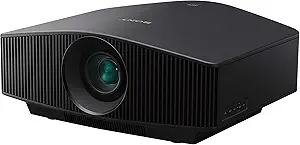
Conversely, Sony operates with a strictly curated, high-end strategy focused almost exclusively on premium home cinema and top-tier commercial laser projection. Rather than attempting to serve budget-conscious hobbyists or casual backyard viewers, Sony directs its engineering prowess toward dedicated theater spaces with its reference-grade native 4K SXRD (Silicon X-tal Reflective Display) projectors, branded under the BRAVIA Projector and ES lines. While this narrow focus results in a catalog with far fewer SKUs and a complete absence of ultra-portable or entry-level models, it guarantees that every Sony projector represents the upper echelon of cinematic performance, optical precision, and professional-grade engineering.
Affordability
When analyzing total cost of ownership and initial capital outlay, BenQ is significantly more accessible to mainstream consumers. BenQ leverages single-chip DLP technology to drive down manufacturing costs while maintaining impressive 4K pixel-shifting resolution and accurate color reproduction. Buyers can acquire a capable 1080p gaming projector or an entry-level 4K HDR home theater model for well under $1,500, with top-tier consumer laser units topping out in the $3,000 to $5,000 range. BenQ's pricing strategy democratizes modern projection features like high refresh rates, eARC connectivity, and factory color calibration, making high-end visual experiences attainable without requiring a dedicated luxury budget.
Sony, in contrast, positions itself as an ultra-premium luxury brand where affordability takes a back seat to uncompromising reference performance. A consumer entering the Sony ecosystem can expect baseline retail pricing to start in the mid-thousands, with flagship native 4K laser models extending past $25,000 to $30,000. Sony makes no concessions for the sub-$3,000 market, justifying its elevated price tag through bespoke native 4K SXRD imaging chips, premium motorized glass lens assemblies with extreme zoom and shift capabilities, and proprietary video processing silicon derived from their professional broadcast monitors. Consequently, Sony is designed for dedicated custom-installation budgets, whereas BenQ delivers unmatched price-to-performance value across consumer tiers.
Quality/Durability
BenQ's hardware design prioritizes rugged utilitarian durability and robust operational longevity, largely due to its commitment to Texas Instruments' Digital Light Processing (DLP) architecture. Single-chip DLP systems inherently resist optical degradation over time because the digital micromirror device (DMD) does not suffer from organic panel breakdown, color fading, or optical alignment drift. Furthermore, BenQ equips its modern LED and laser light sources with sealed optical engines rated for up to 20,000 to 30,000 hours of virtually maintenance-free operation. While their chassis designs rely heavily on molded structural plastics that lack the luxury feel of costlier competitors, the internal thermal management, cooling fans, and dust filters are engineered for exceptional reliability in diverse, real-world environments.
Sony demonstrates world-class engineering through its chassis construction, whisper-quiet thermal architectures, and heavy-duty motorized optics. Using high-grade metals and composite stabilization frames, Sony projectors feel every bit like professional architectural equipment. The brand's Z-Phosphor laser light engines deliver tens of thousands of hours of consistent luminescence with gradual, predictable decay curves. Historically, some earlier generations of SXRD panels faced scrutiny regarding potential contrast degradation and gamma drift over extended operational years in high-humidity settings; however, Sony's modern laser platforms have made substantial strides in environmental sealing and thermal regulation, ensuring the internal liquid-crystal-on-silicon panels remain stable under standard operating parameters.
Customer Support & Warranty
BenQ provides a consumer-friendly warranty structure that aligns with its retail and direct-to-consumer footprint. Most BenQ home theater and gaming projectors are backed by a standard three-year limited warranty, covering parts and labor, with specific coverage windows provided for lamp-based modules or integrated solid-state laser engines. BenQ's online support infrastructure is comprehensive, offering straightforward access to firmware updates, optical throw calculators, and responsive regional service centers. While RMA turnaround times can occasionally fluctuate during peak periods, BenQ consistently earns praise for accessible, transparent customer service that adequately supports DIY home theater enthusiasts and commercial AV installers alike.
Sony supports its luxury positioning with white-glove warranty programs designed to meet the rigorous demands of custom integrators and high-net-worth clients. Sony's ES (Elevated Standard) projector series typically includes an industry-leading three-to-five-year limited warranty that often incorporates advanced hardware exchange programs, minimizing downtime should a hardware defect occur. Because Sony projectors are frequently sold and integrated through certified CI (Custom Integration) networks and CEDIA installers, end-users benefit from professional localized support, remote diagnostics, and expert calibration services. This specialized infrastructure provides immense peace of mind, though resolving issues outside of authorized integration channels can sometimes prove more rigid compared to consumer-focused brands.
Picture Quality
Picture quality from BenQ is defined by exceptional ANSI contrast, pin-sharp edge-to-edge optical clarity, and strict adherence to industry color standards. Leveraging single-chip DLP technology, BenQ units are completely free from the panel convergence errors that can soften three-chip designs, delivering tack-sharp text and intricate detail that excels for both gaming and cinema. BenQ's proprietary CinematicColor technology achieves wide color gamuts up to 100% DCI-P3 with factory-calibrated Delta E < 3 certification. However, due to the native limitations of consumer DLP micro-mirrors, BenQ projectors exhibit elevated black levels and modest native on/off contrast, which can cause deep space or dark night scenes to appear somewhat gray in pitch-black viewing environments.
Sony stands as the benchmark for cinematic immersion, distinguished by class-leading native contrast, deep velvety black levels, and industry-standard image processing. Sony's three-chip native 4K SXRD panels provide true 4096x2160 or 3840x2160 resolution without relying on pixel shifting, producing an organic, filmic texture devoid of digital artifacts or DLP color-wheel rainbow effects. Powered by the proprietary Cognitive Processor XR or X1 for Projector, Sony hardware performs real-time frame-by-frame HDR tone mapping, dynamic contrast enhancement, and unmatched motion interpolation. In a light-controlled dedicated room, Sony delivers an unmistakably superior cinematic image with staggering three-dimensional depth, nuanced shadow detail, and lush, perfectly saturated highlights.