MSI vs Samsung: Overview
Comparing MSI and Samsung helps you determine which brand is best suited for your needs in Laptops. Both brands offer strong choices depending on your budget and key feature requirements.
Key Features & Comparison
Evaluate factors such as build quality, warranty, customer satisfaction, and total value before making your final purchase choice between MSI and Samsung.
Affordability
When analyzing affordability, MSI and Samsung address vastly different consumer segments with contrasting engineering trade-offs. MSI focuses heavily on delivering maximum raw performance per dollar, dominating the budget-to-midrange gaming and creator markets with lines like the Thin, Katana, and Modern series. MSI's lower-priced tiers achieve competitive price points by prioritizing critical internal compute components—such as discrete GPUs and high-wattage CPUs—while cutting costs on chassis materials, trackpads, and thermal acoustic dampening. For budget-conscious gamers, power users, and engineering students who prioritize performance-per-dollar over refined ergonomics, MSI offers an undeniably accessible entry into dedicated computing hardware.
Conversely, Samsung approaches affordability through a premium lifestyle lens, targeting the ultraportable productivity space with its Galaxy Book series. Samsung generally lacks an entry-level presence under the mid-tier price bracket, requiring a higher minimum investment from buyers. However, their value proposition centers on build quality, high-grade finishes, lightweight aluminum chassis designs, and seamless software integration within the broader Samsung Galaxy mobile ecosystem. While an entry-tier Samsung Galaxy Book may feature lower graphical processing power compared to a similarly priced MSI machine, it delivers superior structural rigidity, superior peripherals, and better long-term aesthetic durability, appealing to professionals rather than spec-sheet maximizers.
Battery Life
Battery endurance represents a fundamental philosophical split between MSI's heavy-draw architectures and Samsung's efficiency-oriented ultraportables. MSI laptops, even within their productivity-focused Prestige or Creator lines, frequently struggle to achieve all-day untethered usage. Because many MSI configurations feature performance-tier Intel Core or AMD Ryzen H-series processors coupled with discrete NVIDIA GeForce GPUs, baseline power consumption remains relatively high. Additionally, MSI’s cooling systems and dynamic display refresh rates impose a noticeable parasitic drain on the battery, often resulting in real-world productivity times ranging between 3 to 6 hours on gaming lines and around 7 to 9 hours on their optimized ultrabooks.
Samsung fundamentally excels in battery endurance, engineering its Galaxy Book lineup specifically for mobile professionals who require true full-day performance. Utilizing low-TDP Intel U-series or P-series silicon, dynamic AMOLED refresh rate scaling, and aggressive firmware-level power management, Samsung consistently yields between 10 to 16 hours of real-world office productivity or media streaming on a single charge. Furthermore, Samsung utilizes compact, universal USB-C Power Delivery charging bricks shared across its mobile devices, eliminating the need to haul proprietary, heavy power bricks typical of MSI's high-draw adapters, making Samsung the decisive victor for travel and untethered reliability.
Display
The display comparison between MSI and Samsung showcases two distinct engineering priorities: speed versus visual fidelity. MSI designs its display panels primarily for high-speed gaming and technical responsiveness. Across its catalogue, MSI emphasizes ultra-high refresh rates ranging from 144Hz up to 360Hz, minimal gray-to-gray response times, and adaptive sync technologies like NVIDIA G-Sync to eliminate tearing and ghosting. While MSI's higher-end Creator and Raider lines offer capable Mini-LED or factory-calibrated IPS panels with broad DCI-P3 coverage, their budget and mid-tier models often employ cost-compromised IPS-level panels that suffer from muted color saturation and lower peak nit brightness.
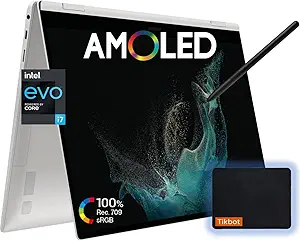
Samsung leverages its vertical integration and industry-leading panel manufacturing to deliver arguably the best overall visual experience in the portable computing space. The hallmark of the Galaxy Book line is Samsung’s Dynamic AMOLED 2X technology, which provides infinite contrast ratios, true inky blacks (VESA DisplayHDR 500/600 True Black certified), and exceptional color accuracy covering 120% of the DCI-P3 spectrum. While Samsung's refresh rates top out at a modest 120Hz, the pixel response times of OLED panels, combined with superior anti-reflective coatings and breathtaking dynamic range, make Samsung displays unequivocally superior for content consumption, graphic design, and media editing.
Performance
In raw compute capability and thermal headroom, MSI stands as an industry powerhouse. MSI's engineering is tuned for sustained high-wattage workloads, utilizing robust thermal architectures featuring dual or triple fans, shared and dedicated heat pipes, and vapor chambers in flagship models like the Titan and Raider. This hardware infrastructure allows MSI laptops to operate CPUs and GPUs at or near their maximum Thermal Design Power (TDP) limits. Whether executing 3D rendering pipelines, running physics simulations, or rendering AAA video games at high frame rates, MSI consistently outclasses Samsung in heavy, sustained compute operations due to superior heat dissipation and higher power allocations.
Samsung approaches performance with an emphasis on burst efficiency, thermal silence, and thin-and-light chassis thermal constraints. While upper-tier Galaxy Book Ultra configurations do offer discrete NVIDIA GPUs, the chassis designs strictly constrain total system wattage to maintain thin profiles and low fan noise. As a result, Samsung devices experience thermal throttling under heavy, sustained load much sooner than their MSI counterparts, yielding lower prolonged benchmarks. For everyday multitasking, complex spreadsheets, software development, and photo editing, Samsung offers brisk and seamless execution, but it cannot match MSI's sustained brute-force horsepower for heavy engineering or hardcore gaming tasks.
Compare current retail pricing, active promotions, and verified stock availability directly from authorized stores: