Lenovo vs Alienware: Overview
Comparing Lenovo and Alienware helps you determine which brand is best suited for your needs in Laptops. Both brands offer strong choices depending on your budget and key feature requirements.
Key Features & Comparison
Evaluate factors such as build quality, warranty, customer satisfaction, and total value before making your final purchase choice between Lenovo and Alienware.
Affordability
When evaluating affordability, Lenovo holds an undeniable advantage over Alienware due to its vastly broader market scope and diversified product architecture. Lenovo manufactures machines across the entire economic spectrum, from budget-friendly IdeaPads and competitively priced LOQ gaming rigs to standard ThinkPads and mid-tier Legion systems. By leveraging massive supply chain economies of scale, Lenovo optimizes component costs, offering modern processors and dedicated GPUs at entry-level and midrange price thresholds. This accessibility allows budget-conscious gamers, enterprise clients, and students to acquire competent, future-proof hardware without bearing the financial penalty commonly associated with specialized gaming marques.
Alienware, operating exclusively as Dell's premier luxury gaming imprint, occupies the high-end enthusiast tier where affordability is fundamentally subordinated to prestige and extreme industrial design. Alienware notebooks, such as the x-series and m-series, command significant price premiums driven by bespoke magnesium-alloy chassis, complex vapor-chamber cooling apparatuses, and proprietary mechanical keyboard options. While entry-level Alienware models exist, they routinely cost hundreds of dollars more than comparably specced Lenovo Legion or LOQ laptops without delivering an equivalent uplift in core computing throughput. Consequently, Alienware remains an investment in luxury aesthetics and halo-tier cachet, whereas Lenovo delivers unmatched price-to-performance value across every commercial segment.
Battery Life
Battery performance reveals fundamentally divergent engineering objectives between the versatile utilitarianism of Lenovo and the desktop-replacement orientation of Alienware. Lenovo excels in runtime longevity largely because its product portfolio includes productivity juggernauts like the ThinkPad and Yoga series, which harness high-capacity lithium-polymer cells alongside low-TDP Intel and AMD processors. Even within Lenovo's dedicated Legion gaming machines, advanced hybrid power-switching solutions—such as seamlessly integrated NVIDIA Advanced Optimus and custom Lenovo Vantage power profiles—allow devices to intelligently throttle hardware and engage integrated graphics during light workloads, yielding surprisingly viable endurance figures ranging from five to eight hours.
Conversely, Alienware architectures are unapologetically tuned for high-wattage gaming and content creation, frequently resulting in notoriously short untethered runtimes. Despite incorporating massive battery packs that push the legal FAA limits of 99.9 watt-hours on flagship chassis, Alienware's persistent thermal algorithms, aggressive peripheral lighting arrays, and high-frequency, unthrottled CPU states deplete charge at a rapid clip. In typical mixed-use environments, users often struggle to exceed three to four hours away from a wall outlet, and demanding 3D rendering or gaming can drain reserves in under an hour. Lenovo clearly wins this metric by offering granular battery conservation technology and superior watt-per-minute efficiency across both work and gaming platforms.
Display
Visual fidelity and panel integration highlight a close competition, though the brands diverge in their display specialization and target demographics. Lenovo sets an industry benchmark for productivity through its adoption of 16:10 aspect ratios across nearly all tiers, granting users vertical screen real estate that benefits coding, spreadsheet analysis, and creative timelines. Lenovo's premium Legion 7 and ThinkPad X1 lines frequently deploy factory-calibrated IPS and vibrant OLED panels boasting up to 3.2K resolutions, Dolby Vision certification, and variable refresh rates reaching 240Hz. These displays feature matte anti-glare coatings that excel in reducing office and outdoor reflections, appealing directly to hybrid professionals who demand chromatic accuracy alongside gaming fluidity.
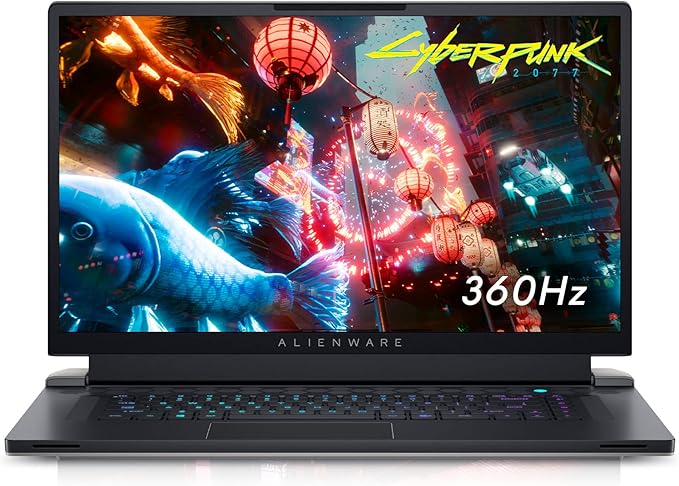
Alienware focuses squarely on ultra-high-performance gaming visuals, prioritizing raw response times, hyper-elevated refresh frequencies, and maximum contrast. Alienware’s premium configurations showcase blistering 360Hz to 480Hz FHD panels engineered specifically for competitive esports, alongside stunning 4K and QHD+ displays with comprehensive DCI-P3 color gamuts and high-peak-brightness HDR capabilities. Dell's integration of ComfortView Plus ensures hardware-level low blue-light emission without distorting color temperature. While Alienware provides a more immersive, edge-to-edge spectacle tailored for cinematic gaming and media consumption, Lenovo’s panels provide greater everyday versatility and practical ergonomics through uniform 16:10 dimensions and anti-reflective finishes.
Performance
In terms of peak performance and sustained computing horsepower, both manufacturers produce engineering marvels, but they diverge in thermal philosophy and acoustic tuning. Lenovo relies on its highly refined Legion Coldfront and ThinkPad thermal architectures, incorporating phase-change thermal compounds, dual liquid-crystal polymer fans, and intelligent multi-channel exhaust designs. This engineering allows machines like the Legion Pro 7i to push modern Intel Core i9 or AMD Ryzen 9 processors and full-wattage NVIDIA RTX GPUs to their absolute hardware TGP limits without excessive thermal throttling. Crucially, Lenovo’s thermal logic balances maximum compute output with reasonable acoustic footprints, maintaining chassis stability without deafening fan noise.
Alienware counters with extreme, boundary-pushing cooling systems that often squeeze out marginal frame-rate advantages at the expense of decibel levels and chassis heat. Implementing patented thermal technologies—such as Element 31 gallium-silicone liquid metal interfaces, quad-fan matrices, and expansive vapor chambers—Alienware's flagship systems sustain aggressive factory overclocks and sky-high combined wattages. This makes them formidable contenders for desktop-grade benchmarking, 3D rendering, and uncompromised AAA gaming. However, while Alienware may capture slight percentage leads in raw enthusiast stress tests, Lenovo delivers a more harmonious, reliably sustained performance envelope that resists thermal saturation over prolonged productivity or gaming sessions.