HP vs Alienware: Overview
Comparing HP and Alienware helps you determine which brand is best suited for your needs in Laptops. Both brands offer strong choices depending on your budget and key feature requirements.
Key Features & Comparison
Evaluate factors such as build quality, warranty, customer satisfaction, and total value before making your final purchase choice between HP and Alienware.
Affordability
When evaluating affordability, HP holds a commanding advantage due to its expansive market footprint and tiered product segmentation. HP provides functional, well-engineered computing options across virtually every budget tier, from entry-level Pavilion and 14-series notebooks under $500 to mid-range Envy models and cost-conscious Victus gaming systems. This tiered approach allows buyers to acquire competent internal hardware—such as current-generation Intel Core or AMD Ryzen architectures—without paying a premium for luxury aesthetics or boutique engineering. Even within HP's flagship lines, such as Spectre and OMEN, the manufacturer consistently offers competitive promotional pricing and frequent sales cycles, maximizing the price-to-performance ratio for everyday consumers, students, and office workers.
In contrast, Alienware operates strictly as a premium enthusiast sub-brand under Dell, which inherently positions its lineup at a much higher price baseline. Alienware laptops, including the m-series and x-series (such as the m16, m18, and x14), incorporate expensive build materials like magnesium alloys, bespoke vapor-chamber cooling arrays, and per-key mechanical AlienFX keyboards that elevate production costs. As a consequence, even the most basic Alienware configuration commands a four-figure price tag that easily exceeds comparable mainstream offerings. While Alienware provides solid residual value retention and top-tier industrial design, budget-conscious consumers will find very little entry-level representation, making HP the definitive winner in overall affordability and accessibility.
Battery Life
Battery longevity represents a fundamental architectural divergence between the generalist designs of HP and the high-output philosophy of Alienware. HP excels significantly in energy-efficient engineering, particularly within its ultraportable Spectre, Envy, and Dragonfly product families. Leveraging low-wattage U-series and P-series processors, intelligent dynamic thermal management, and display panels rated for sub-1-watt power draw, select HP laptops reliably achieve between 10 to 16 hours of continuous real-world use. Even within HP's dedicated gaming lineups like OMEN and Victus, advanced graphics switching via NVIDIA Advanced Optimus ensures that non-taxing desktop workloads offload to integrated graphics, preserving cell life during mixed daily workflows.
Alienware notebooks, conversely, are engineered almost exclusively as desktop replacements prioritizing unconstrained power draw over mobile endurance. Even though Alienware packs large batteries often approaching the legal FAA 99.9Wh flight limit, the combination of high-TDP processors (such as Intel HX-series chips), dedicated high-wattage GPUs, and high-refresh display controllers rapidly drains stored energy. In typical use cases involving web browsing and multimedia playback, most modern Alienware units struggle to exceed 3 to 6 hours of operation away from a wall outlet. For users who prioritize true unplugged mobility, HP provides a vastly superior battery experience, whereas Alienware remains inherently tethered to its bulky power bricks.
Display
The display technologies championed by HP and Alienware reflect their differing target audiences, with HP emphasizing creative accuracy and visual versatility, while Alienware concentrates on extreme gaming speed and motion clarity. HP offers exceptional variety across its portfolio, prominently featuring gorgeous 3K and 4K OLED panels on its Spectre and Envy ultraportables. These screens boast 100% DCI-P3 color gamut coverage, VESA DisplayHDR True Black certifications, and factory color calibrations that appeal to photographers, graphic designers, and media consumers. Furthermore, HP integrates productive 16:10 aspect ratios with optional multi-touch and active stylus digitizers, offering a versatile visual workspace optimized for productivity.
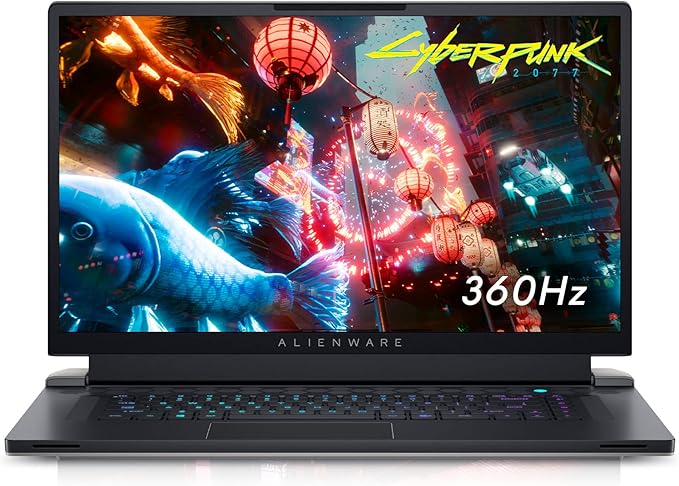
Alienware counters by offering some of the most technologically advanced gaming panels on the market, engineered to eliminate motion blur and minimize input latency. Alienware displays range from high-resolution QHD+ (2560x1600) panels running at 240Hz to blisteringly fast FHD+ screens operating at refresh rates up to 480Hz. These displays feature rapid response times (often 3ms or lower), NVIDIA G-Sync, AMD FreeSync Premium, and integrated ComfortView Plus hardware low-blue-light filters. While Alienware has integrated stunning OLED and mini-LED panels into select top-tier configurations, its core strength remains high-frame-rate fluidity and competitive gaming clarity, whereas HP delivers greater breadth for color-critical creative production and versatile touch workflows.
Performance
Performance metrics reveal a stark contrast in sustained thermal headroom and hardware configuration between the two manufacturers. HP designs its performance spectrum to scale from silent, power-efficient office processing up to robust content creation and high-end gaming. HP's flagship gaming laptops, such as the OMEN Transcend 16, feature top-tier Intel Core i9 or AMD Ryzen 9 silicon paired with NVIDIA GeForce RTX 40-series mobile GPUs. Using HP's Tempest Cooling technology with three-sided venting and five-way airflow, these systems deliver reliable performance for AAA titles and rendering tasks. However, HP typically tunes its performance profiles to strike a balance between thermal efficiency, chassis thickness, and fan noise, occasionally constraining maximum sustained wattage compared to pure enthusiast machines.
Alienware, by contrast, is engineered to push mobile silicon to its absolute thermodynamic limits. Featuring Dell's proprietary Cryo-tech cooling systems—which incorporate quad-fan arrays, advanced gallium-silicone liquid metal thermal interface material (Element 31), and large vapor chambers—Alienware laptops routinely sustain higher Total Graphics Power (TGP) levels than their competitors. An Alienware m16 or m18 can maintain sustained 175W maximum graphics TGP without severe thermal throttling, extracting every possible frame from an RTX 4080 or RTX 4090. For heavy computational engineering, 4K video rendering, and uncompromising enthusiast-level gaming, Alienware represents the superior performance titan, while HP offers a broader, more balanced performance envelope for everyday users.