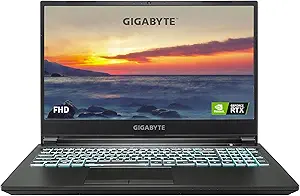
GigaByte vs Apple: Overview
Comparing GigaByte and Apple helps you determine which brand is best suited for your needs in Laptops. Both brands offer strong choices depending on your budget and key feature requirements.
Key Features & Comparison
Evaluate factors such as build quality, warranty, customer satisfaction, and total value before making your final purchase choice between GigaByte and Apple.
Affordability
When evaluating affordability, Gigabyte and Apple occupy fundamentally different segments of the market. Gigabyte primarily caters to price-conscious gamers, engineers, and creators who prioritize raw hardware specifications over premium industrial design. Through lines like the G5, Aorus, and Aero, Gigabyte delivers high-wattage dedicated graphics cards and multi-core desktop-class processors at competitive mid-range price points. Consumers can regularly obtain capable dedicated GPU performance for well under $1,000, making Gigabyte an attractive value proposition for users who need maximum computational compute per dollar spent, even if it requires compromises in chassis rigidity, touchpad materials, and acoustic engineering.
Conversely, Apple operates firmly in the premium ecosystem with an entry threshold that begins substantially higher. While the base MacBook Air offers respectable entry-level luxury, Apple's pricing escalates aggressively once users configure higher unified memory and SSD capacities. Upgrading internal components commands high profit margins, often costing several times the equivalent off-the-shelf component prices found in modular Windows laptops. However, Apple offsets this initial cost disadvantage through industry-leading residual resale value, exceptional long-term build durability, and bundled lifetime operating system updates, shifting the economic argument from short-term purchase price to multi-year total cost of ownership.
Battery Life
Battery performance reveals the stark architectural divergence between x86 architecture and ARM-based custom silicon. Gigabyte laptops, engineered predominantly for heavy-duty gaming and workstation tasks, integrate power-hungry Intel or AMD processors alongside discrete NVIDIA GeForce GPUs. Under typical everyday workloads, these components draw substantial idle wattage, yielding real-world battery endurance that frequently ranges between three to six hours on productivity tasks. When executing demanding 3D rendering or gaming, Gigabyte systems can deplete their batteries in under two hours while suffering severe hardware throttling, effectively requiring constant connection to a bulky AC power brick.
Apple fundamentally revolutionized laptop endurance with the transition to its M-series Apple Silicon. By unifying the CPU, GPU, Neural Engine, and system memory onto a highly optimized system-on-chip (SoC) manufactured on advanced fabrication nodes, MacBooks achieve unmatched thermal and electrical efficiency. Modern MacBook Air and MacBook Pro machines routinely deliver 15 to 22 hours of continuous web browsing, productivity, and media consumption. Crucially, Apple laptops retain their full performance profile whether plugged into wall power or operating strictly on battery, giving mobile professionals true untethered computing without compromise.
Display
Gigabyte targets display technology to align with specific enthusiast use cases, dividing its focus between hyper-fast refresh panels for competitive esports and factory-calibrated panels for digital artists. Its Aorus lineup routinely equips high-refresh IPS displays reaching 165Hz to 360Hz, ensuring buttery-smooth frame rates and minimal input latency. Meanwhile, the creator-centric Aero family frequently features vibrant 4K AMOLED panels boasting 100% DCI-P3 color gamuts and individual X-Rite Pantone color certification. However, display consistency across lower-tier models like the G-series can suffer from muted color coverage and modest peak brightness levels, occasionally falling below 300 nits.
Apple takes a more uniform, top-tier approach across its entire catalog, focusing on visual fidelity, dynamic range, and system-wide color calibration. The Liquid Retina XDR displays found in the MacBook Pro line leverage Mini-LED backlighting with thousands of local dimming zones, delivering up to 1,600 nits of peak HDR brightness, near-infinite contrast ratios, and exceptional black levels. Apple’s ProMotion technology introduces an adaptive 120Hz refresh rate that balances fluid responsiveness with energy conservation. While Apple avoids the ultra-high 240Hz+ panels sought by competitive gamers, its consistent P3 color fidelity, True Tone ambient lighting adjustments, and superior anti-reflective coatings make it the industry benchmark for professional visual work.
Performance
In raw compute potential, Gigabyte relies on raw horsepower, thermal throughput, and high wattage. By coupling high-TDP Intel Core i7/i9 or AMD Ryzen processors with high-wattage NVIDIA RTX graphics processors, Gigabyte machines excel in tasks that demand dedicated CUDA acceleration, high rasterization limits, direct DirectX 12 integration, and hardware-accelerated ray tracing. This architectural brute force makes Gigabyte laptops superior choices for native Windows gaming, VR workflows, and GPU-intensive 3D modeling programs. The trade-off is evident in active cooling demands, as Gigabyte systems generate substantial fan noise and elevated surface temperatures to sustain these thermal limits.
Apple takes an efficiency-first approach to performance via custom-engineered unified memory architecture and specialized hardware media engines. The M-series Pro and Max chips offer extraordinary multi-threaded CPU performance and specialized accelerators for ProRes, HEVC, and AV1 video encoding, often outperforming high-wattage desktop replacement laptops in video editing workflows like Final Cut Pro and DaVinci Resolve while remaining near-silent. While Apple Silicon does not match high-end NVIDIA discrete GPUs in raw gaming performance due to software API fragmentation and thermal design caps, its sustained everyday snappiness, massive memory bandwidth, and whisper-quiet operation create a refined, high-output workstation experience.
Compare current retail pricing, active promotions, and verified stock availability directly from authorized stores:
Compare current retail pricing, active promotions, and verified stock availability directly from authorized stores: