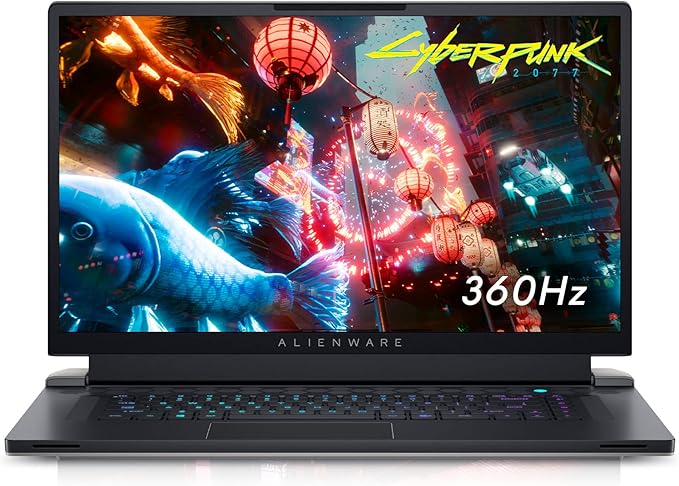
GigaByte vs Alienware: Overview
Comparing GigaByte and Alienware helps you determine which brand is best suited for your needs in Laptops. Both brands offer strong choices depending on your budget and key feature requirements.
Key Features & Comparison
Evaluate factors such as build quality, warranty, customer satisfaction, and total value before making your final purchase choice between GigaByte and Alienware.
Affordability
When evaluating affordability, GigaByte and Alienware occupy distinct tiers of the laptop marketplace, reflecting fundamentally different manufacturing and branding philosophies. GigaByte has built a commanding reputation among budget-conscious gamers and power users by maximizing the price-to-performance ratio, particularly through their entry-to-midrange G-series and Aorus lineups. By prioritizing internal silicon over lavish chassis materials or elaborate industrial design, GigaByte consistently delivers cutting-edge GPUs and CPUs at retail prices hundreds of dollars lower than similarly equipped competitors. This practical engineering approach allows buyers to acquire high-tier graphics architectures and capable thermal assemblies without paying a premium for luxury branding, making GigaByte an accessible gateway for high-fidelity gaming and productivity.
Alienware, operating as Dell's premier luxury gaming brand, adopts a prestige pricing strategy that deliberately trades raw cost efficiency for boutique build quality, proprietary industrial styling, and premium customer ecosystems. The brand's Legend design language involves custom-molded magnesium alloys, intricate RGB micro-lighting arrays, and advanced vapor chamber cooling systems—engineering elements that carry steep manufacturing overheads reflected on the price tag. While an Alienware machine generally retains higher secondary market value and offers robust warranty coverage with on-site service options, it demands a substantial fiscal investment. For value-driven consumers, Alienware often proves difficult to justify against GigaByte's sheer computational value, whereas those prioritizing uncompromising finish and ownership perks view Alienware's steep pricing as an acceptable entry fee into high-end computing.
Battery Life
Battery performance in high-performance computing is notoriously constrained, but GigaByte and Alienware exhibit subtle differences in how they navigate power management constraints. GigaByte designs its laptops predominantly around desktop-replacement utility, often outfitting models with standard-capacity lithium-ion cells ranging between 54Wh and 99Wh, depending on chassis volume. In practical use, GigaByte systems often struggle with idle power draw due to less aggressive firmware-level sleep state optimizations and relatively unrefined companion software. While modern Aorus units utilize NVIDIA Advanced Optimus to bypass the discrete GPU during light productivity tasks, real-world endurance remains modest, typically yielding between three to five hours of moderate office work and necessitating the presence of a proprietary power brick during prolonged excursions.
Alienware generally counters this industry-wide shortfall by integrating maximum-allowable 86Wh to 99.9Wh flight-legal battery packs across its flagship M-Series and X-Series platforms, paired with Dell's sophisticated power management ecosystem. The Alienware Command Center suite offers deeper hardware-level control over display refresh rates, hybrid graphics switching, and processor power ceilings, eking out marginally better runtime during low-intensity media consumption. Furthermore, Alienware has increasingly adopted high-wattage USB-C Power Delivery charging protocols alongside their primary Gallium Nitride (GaN) power bricks, offering superior operational flexibility on the go. Despite these refinements, neither brand completely escapes the massive energy appetites of contemporary silicon, leaving Alienware with only a slight tactical advantage in battery management and travel convenience.
Display
The visual experience presents a fascinating divergence in priority, where GigaByte champions competitive speed and color accuracy, while Alienware aims for cinematic immersion and bleeding-edge panel technology. GigaByte has historically excelled by catering directly to digital creatives and esports athletes; its premium Aorus lines frequently boast factory-calibrated panels with Pantone certification, ensuring exceptionally low Delta-E values straight out of the box. Additionally, GigaByte embraces ultra-high refresh rates—often pushing 240Hz to 360Hz on standard 1080p and 1440p IPS panels. However, GigaByte's more economical models frequently employ lower-tier displays with middling peak brightness around 250 to 300 nits and constrained sRGB color gamuts, representing an overt compromise to keep retail pricing attractive.
Alienware's display philosophy, conversely, is characterized by uncompromising visual spectacle across both entry and flagship configurations. Alienware frequently leads the segment in deploying advanced panel types, including high-luminance QHD+ and 4K displays with mini-LED backlights and deep OLED contrast profiles that achieve over 500 nits of peak brightness and true DCI-P3 wide color coverage. Beyond raw panel specs, Alienware integrates hardware-level ComfortView Plus low-blue-light filters and full G-Sync variable refresh rate capabilities across its entire fleet, minimizing screen tearing without introducing color distortion. While GigaByte retains an edge for color-critical studio professionals who require verified factory calibration, Alienware delivers a visibly superior, more uniform, and immersive visual canvas tailored for high-end multimedia and AAA gaming.
Performance
Performance execution between these two manufacturers highlights a masterclass in thermal dynamics, power allocation, and hardware limits. GigaByte extracts respectable raw performance out of its hardware configurations by implementing clean, unpretentious board layouts that allow core components to operate near their advertised Total Graphics Power (TGP) ratings. Their proprietary Windforce cooling technology uses densely packed heat pipes and dual-fan systems that effectively disperse thermal loads, preventing catastrophic throttling under sustained workloads. However, to maintain these clock speeds within more compact and cost-efficient enclosures, GigaByte fan curves often lean toward aggressive acoustic profiles, producing noticeable high-frequency noise that underscores the brand's function-over-form engineering philosophy.
Alienware approaches the performance envelope with custom-tailored, enthusiast-grade engineering intended to unlock the absolute maximum headroom of modern silicon. Utilizing proprietary Cryo-tech cooling configurations, Alienware incorporates state-of-the-art liquid metal thermal interfaces (Element 31), quad-fan exhaust systems, and expansive vapor chambers that support the highest sustainable TGPs and overclocking profiles permitted by component manufacturers. This extensive engineering ensures that Alienware machines not only match but often exceed peak synthetic benchmarks and real-world framerates while managing heat dissipation with lower acoustic irritation. GigaByte successfully provides virtually all the performance an average enthusiast needs, but Alienware establishes an elite threshold of thermal stability and high-wattage sustain for users demanding bleeding-edge capabilities.
Compare current retail pricing, active promotions, and verified stock availability directly from authorized stores:
Compare current retail pricing, active promotions, and verified stock availability directly from authorized stores: