Dell vs Alienware: Overview & Brand Philosophy
When evaluating the personal computing landscape, Comparing Dell and Alienware presents a unique dynamic: Alienware is not an independent competitor, but rather Dell’s dedicated high-performance gaming subsidiary. Acquired by Dell in 2006, Alienware functions as the company's vanguard for enthusiast-grade hardware, futuristic industrial design, and bleeding-edge thermal innovation. Dell, as the parent umbrella, focuses on mainstream versatility, broad enterprise deployments, and ultra-portable productivity, catering to consumers spanning corporate offices, creative studios, and university lecture halls.
Dell’s foundational philosophy revolves around functional elegance, engineering pragmatism, and wide-spectrum accessibility. Through flagship sub-brands such as XPS, Inspiron, and Latitude, Dell prioritizes battery longevity, display precision, and streamlined portability. In contrast, Alienware's philosophy centers entirely on unapologetic, desktop-replacement power. With lines like the Alienware m-series and x-series, the brand engineers machines specifically for competitive esports players, hardcore gamers, and heavy-duty 3D developers who require maximum frame rates, custom mechanical switch integrations, and aggressive system cooling over battery efficiency.
Understanding this corporate relationship is critical for prospective buyers. Choosing between Dell and Alienware is rarely an adversarial decision between two warring manufacturers; rather, it is an architectural trade-off. Buyers are deciding whether their workflows demand the balanced ergonomics, understated aesthetics, and battery optimization of Dell's primary lineup, or the raw wattage, thermal headroom, and bold identity inherent to Alienware's specialized gaming division.
Key Differences & Technological Comparison
The technical divergence between Dell and Alienware becomes apparent across four primary verticals: thermal management, display technologies, aesthetic architecture, and internal component wattage (TGP/TDP).
In thermal engineering, standard Dell laptops—including the premium XPS line—use compact vapor chambers or dual-heat-pipe solutions calibrated for quiet, office-appropriate operation and ultra-thin chassis profiles. Alienware, conversely, deploys expansive engineering feats like the proprietary "Cryo-tech" cooling architecture. This includes quad-fan designs with opposing airflow, vapor chambers paired with Element 31 (an exclusive gallium-silicone liquid metal thermal interface material), and significantly taller exhaust fins that favor component longevity and sustain peak boost clocks under extreme multi-hour loads.
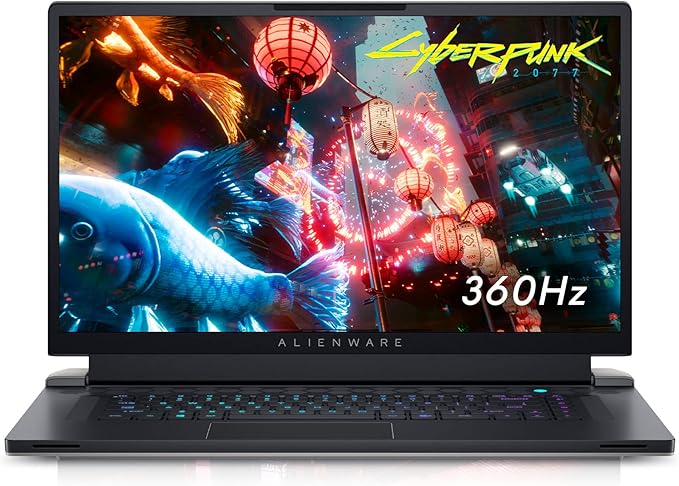
Display configurations also showcase distinct design goals. Dell’s high-end laptops emphasize color accuracy and productivity aspect ratios (predominantly 16:10), frequently offering 3.5K to 4K OLED touchscreens calibrated to 100% DCI-P3 color spaces with high brightness for outdoor readability. Alienware displays shift technological priority toward low latency and refresh speed. Alienware notebooks commonly offer 16:9 or 16:10 panels ranging from 165Hz up to a blistering 480Hz at 1080p or 1440p resolutions, equipped with NVIDIA G-Sync, Advanced Optimus, and ultra-low response times down to 1ms to eliminate motion blur.
Finally, component power delivery separates the two brands. While an XPS 15 or XPS 16 may house an NVIDIA GeForce RTX 40-series GPU, it is typically an energy-optimized, lower Total Graphics Power (TGP) variant throttled between 40W and 80W to prevent thermal saturation in a slim chassis. Alienware models (such as the m16 or x16) feed those same GPUs upwards of 140W to 175W max TGP, unleashing the silicon’s full performance envelope at the expense of a heavier chassis and larger external power bricks.
Pros & Cons Comparison
Dell (Mainstream & Premium Portability)
- Pro: Refined, Understated Design: Premium aluminum and carbon-fiber materials deliver a clean, professional look suitable for any boardroom or client meeting.
- Pro: Exceptional Battery Life: Balanced power profiles and low-power panel options allow notebooks like the XPS and Latitude to run for an entire workday on a single charge.
- Pro: Portability & Form Factor: Slim chassis profiles, thin display bezels, and lighter carrying weights make them vastly superior travel companions.
- Con: Thermal Throttling Under Sustained Loads: Compact enclosures quickly saturate thermally when tackling heavy 3D rendering or prolonged gaming.
- Con: Restricted Graphics Wattage: Internal GPUs receive limited power allocations, leaving substantial performance left on the table compared to full-fat gaming platforms.
Alienware (High-Performance Gaming)
- Pro: Maximum Component Wattage: High-TGP architectures ensure graphics cards and processors achieve their absolute maximum theoretical performance levels.
- Pro: Advanced Cryo-Tech Cooling: Liquid metal thermal pastes, quad-exhaust channels, and large heatsinks prevent thermal degradation during marathon compute sessions.
- Pro: Gamer-Centric Features: Equipped with ultra-high refresh rate displays (up to 480Hz), per-key AlienFX RGB customization, and optional CherryMX ultra-low-profile mechanical keyboards.
- Con: Poor Portability and Weight: Thick profiles, heavy construction, and massive power supplies make Alienware machines burdensome for daily commuting.
- Con: Mediocre Battery Longevity: Despite modern GPU-switching technologies, Alienware systems rarely exceed 2 to 4 hours of off-charger productivity.
Performance, Durability & Value Analysis
From a longevity and reliability perspective, both Dell and Alienware leverage the benefits of Dell's enterprise-grade supply chain, resulting in solid chassis rigidity and structural engineering. Alienware laptops utilize magnesium alloys and anodized aluminum reinforced with high-density plastics to endure the mechanical stress of dynamic hinges and thermal expansion. Dell's premium lines (especially XPS and Latitude) employ CNC-machined aluminum and aerospace-grade carbon fiber palm rests that age gracefully against cosmetic wear. However, internal longevity leans slightly toward Alienware for heavy-compute users: robust cooling systems reduce thermal wear on the motherboard and solder joints over 3-to-5-year cycles, whereas ultra-compact Dell laptops running hot for years may experience accelerated component fatigue.
In terms of pricing and value retention, Dell covers a dramatically wider spectrum. Budget-conscious buyers can enter the ecosystem via an Inspiron for under $600, while executive-level XPS configurations easily surpass $2,500. Alienware is purely a premium tier brand, with price points routinely starting around $1,500 and climbing beyond $3,500 for flagship configurations. In pure performance-per-dollar calculations for gaming and GPU compute, Alienware frequently outvalues equivalent-priced Dell XPS machines because XPS models allocate their manufacturing budget toward miniaturization, high-density batteries, and 4K displays rather than cooling and raw silicon speed. Conversely, if value is defined as an all-day, travel-ready daily driver, Dell offers vastly superior operational utility.
Final Verdict: Which Brand Should You Choose?
Selecting between Dell and Alienware requires identifying your primary computing environment, mobility requirements, and workload intensity:
- Choose Dell if: You are a business professional, student, frequent traveler, or software developer who values all-day battery life, minimalist executive design, and lightweight portability. If you need a device that transitions seamlessly from home to an office boardroom while handling daily productivity, occasional video editing, and light-to-moderate recreational tasks, a Dell XPS or Inspiron is the smarter, more practical investment.
- Choose Alienware if: You are an esports enthusiast, hardcore PC gamer, 3D animator, or data scientist seeking uncompromising performance who rarely works away from an AC outlet. If maximum graphics frame rates, sub-millisecond panel response times, peak wattage, and aggressive futuristic styling are your top priorities—and you view the laptop primarily as a transportable desktop replacement—Alienware is unquestionably the right choice.
Affordability
When evaluating affordability, the contrast between Dell and its high-end subsidiary Alienware represents a classic divide between broad-market accessibility and boutique, premium specialization. Dell commands a massive competitive advantage in baseline pricing through expansive economies of scale and segmented product families like the Inspiron and standard G-Series gaming lineups. Dell designs these laptops with cost-conscious engineering, utilizing cost-effective polycarbonate chassis, balanced mid-range thermal solutions, and a high degree of configuration flexibility. This allows budget-oriented consumers to purchase capable machines starting well under the thousand-dollar mark, offering high compute-per-dollar ratios for daily productivity, light gaming, and office workloads without forcing consumers to pay for unnecessary high-tier features.
Conversely, Alienware operates strictly in the premium and enthusiast tiers, resulting in a significantly higher barrier to entry where introductory pricing frequently starts where mainstream Dell configurations peak. Alienware justifies this high pricing floor through specialized engineering investments: dense magnesium-alloy structural framing, distinctive design aesthetics, per-key mechanical keyboard options, and proprietary high-capacity vapor chambers coupled with advanced thermal compounds like Element 31. These machines prioritize peak component utilization—delivering the highest allowable Total Graphics Power (TGP) to top-tier NVIDIA RTX GPUs—over basic price efficiency. Consequently, Alienware's affordability metrics are undeniably poor for casual users, as consumers pay a steep premium for high-refresh-rate display technologies, bespoke design language, and extreme performance headroom that mainstream users simply do not require.
The ultimate trade-off between the two brands hinges on how a buyer defines value versus raw acquisition cost. Dell easily wins in immediate affordability, offering practical daily durability and essential modern features at price points suited for students and mainstream professionals, though this value proposition sometimes comes at the expense of premium materials and sustained, max-wattage thermal efficiency. Alienware, while categorically expensive, delivers stronger long-term performance retention for competitive gamers and power users who demand unrelenting hardware stability under heavy loads. However, strictly through the lens of affordability, Dell remains the undisputed victor by offering accessible performance across nearly every consumer price bracket, whereas Alienware remains a luxury indulgence with negligible low-budget representation.
Battery Life
When evaluating battery life between Alienware and Dell, the comparison is fundamentally framed by their diverging engineering philosophies and target use cases, despite Alienware being Dell's dedicated high-performance subsidiary. Alienware laptops, designed unapologetically for high-octane gaming and content creation, are constrained by massive thermal dissipation requirements, power-hungry discrete graphics (NVIDIA GeForce RTX series), and desktop-grade multi-core processors. Even with Dell utilizing the maximum allowable legal airline limit for laptop battery capacity (99.9Wh in models like the Alienware m16 and m18), runtime rarely exceeds four to six hours under modest office workloads, plummeting to barely an hour under intensive 3D rendering or gaming. Alienware incorporates technical mitigations such as Advanced Optimus and custom power profiles via the Alienware Command Center, but the baseline architectural load of ultra-bright, high-refresh-rate display panels and persistent system-level lighting fundamentally caps its endurance.
Conversely, the broader Dell portfolio—dominated by the enterprise-focused Latitude and consumer flagship XPS series—delivers a masterclass in power efficiency and mobility-oriented engineering quality. Dell engineers these productivity lines with low-TDP Intel Core Ultra and AMD Ryzen processors, energy-efficient LPDDR5x RAM, and intelligent display technologies like Dell's low-power FHD+ panels and variable refresh rates (VRR). Consequently, ultraportables such as the Dell XPS 13 or modern Latitude models effortlessly achieve 12 to 18 hours of real-world productivity on a single charge. Dell's technical strength lies in aggressive power-state cycling, intelligent background app suspension via Dell Optimizer, and deep integration with modern standby architectures that Alienware’s performance-biased BIOS configurations simply cannot replicate.
The practical trade-off between the two brands highlights a classic divergence between raw performance overhead and battery longevity. Consumers selecting Alienware accept that the battery functions primarily as an integrated uninterruptible power supply (UPS) meant for short transits, accompanied by a heavy, high-wattage GaN charging brick required to sustain the machine's peak potential. Meanwhile, choosing a non-gaming Dell laptop sacrifices top-tier graphical horsepower in exchange for genuine all-day, untethered endurance powered by compact, universal USB-C chargers. For users demanding true autonomy away from wall outlets, standard Dell laptops stand uncontested, while Alienware remains an explicitly mains-dependent desktop replacement.
Display
When evaluating the display technology of Alienware and Dell, it is crucial to recognize that while Alienware is a dedicated high-performance gaming subsidiary of Dell, their respective screen engineering philosophies serve distinctly different end-users. Alienware prioritizes fluid, ultra-responsive visual performance tailored to competitive gaming and immersion. Their panels frequently push the boundaries of high refresh rates—ranging from 165Hz up to blistering 480Hz on select models—paired with sub-millisecond response times, NVIDIA G-Sync, and AMD FreeSync Premium support to eliminate screen tearing. Furthermore, Alienware has heavily embraced cutting-edge OLED and QD-OLED display tech across its flagship m-series and x-series laptops, delivering infinite contrast ratios, deep blacks, and remarkable HDR performance that make gaming worlds visually arresting.
Conversely, Dell’s mainline brand—encompassing the XPS, Inspiron, and Latitude lineups—engineers displays centered around productivity, color critical accuracy, and day-to-day visual ergonomics. The crown jewel of Dell’s display engineering is found in the XPS series, which utilizes stunning 16:10 aspect ratio InfinityEdge displays that minimize bezels to maximize usable screen real estate. Dell excels in professional color science, frequently offering 4K+ (UHD+) resolution panels that boast 100% Adobe RGB and 100% DCI-P3 color gamuts alongside integrated Eyesafe blue-light-filtering hardware. Dell also provides widespread touch-screen functionality and superior anti-reflective, high-nit brightness coatings suitable for varied office environments and outdoor use, areas where Alienware's gaming-focused matte, non-touch panels take a back seat.
Ultimately, the trade-off hinges on your intended workload and visual priorities. Alienware delivers the definitive edge for motion clarity, high frame rates, and low-latency gaming, but users must compromise on battery consumption, as its power-hungry, high-refresh panels rapidly drain reserves. Dell sacrifices the triple-digit refresh rates (usually capping at 60Hz or 120Hz) in favor of pixel density, power efficiency through dynamic variable refresh rates, and unmatched fidelity for video editors, digital creators, and business professionals. Choosing Alienware ensures an elite, tear-free visual playground, while Dell remains the gold standard for high-resolution productivity and color-accurate creative workflows.
Performance
When evaluating performance between Alienware and Dell, it is essential to recognize their shared corporate lineage alongside their radically divergent engineering philosophies. Dell, serving the mainstream consumer and enterprise markets through lines like XPS, Latitude, and Inspiron, engineers for thermal balance, power efficiency, and burst processing. Dell machines prioritize productivity metrics: fast application load times, reliable multitasking via optimized Intel Core or AMD Ryzen U/P-series silicon, and sustained battery longevity. Even performance-forward Dell laptops like the XPS 15 and 17 lean into thin-and-light chassis designs, which inherently throttle sustained clock speeds under heavy, continuous computational loads. In contrast, Alienware is Dell’s uncompromising high-performance gaming division, where thermal mass and raw wattage supersede portability. Built around unconstrained 55W+ HX-series processors and high-TGP (Total Graphics Power) NVIDIA GeForce RTX GPUs, Alienware systems are tuned out of the box to deliver sustained, peak-frequency computing without power-limit throttling.
The technical disparity is most pronounced in their proprietary cooling solutions and hardware provisioning. Dell mainstream laptops utilize compact vapor chambers, localized heat pipes, and slim fan configurations optimized for acoustic discretion in office environments, but this inevitably leads to thermal dissipation caps around 45W to 80W of combined CPU/GPU load. Alienware counters with heavy-duty thermal engineering, including their proprietary Element 31 gallium-silicone liquid metal thermal interface material, quad-fan configurations with multi-directional exhaust, and oversized vapor chambers. This allows Alienware laptops (such as the m-series and x-series) to push combined system power limits well beyond 200W, unlocking high-refresh-rate 4K rendering, seamless ray-tracing, and intensive 3D CAD rendering that would induce severe thermal throttling on a standard Dell machine. Furthermore, Alienware features extensive firmware-level performance tuning through the Alienware Command Center (AWCC), allowing enthusiasts to undervolt, overclock, and implement aggressive custom fan curves.
Ultimately, the practical trade-offs regarding performance dictate distinct use cases for each brand. Dell excels in power-to-weight performance, offering the ideal computational headroom for software developers, business professionals, and casual creators who need brisk single-core responsiveness and rapid rendering without being tethered to a bulky power brick. Alienware, conversely, provides workstation-class sustained performance aimed at competitive gamers, game developers, and intense visual effects artists who require desktop-replacement capabilities. While Alienware undeniably wins in raw graphical throughput and sustained multi-threaded execution, buyers sacrifice battery life, thermal comfort against the chassis, and acoustic stealth, making standard Dell systems the pragmatist's choice for versatile, everyday computing and Alienware the specialist’s choice for maximum, unthrottled compute power.