Asus vs Alienware: Overview
Comparing Asus and Alienware helps you determine which brand is best suited for your needs in Laptops. Both brands offer strong choices depending on your budget and key feature requirements.
Key Features & Comparison
Evaluate factors such as build quality, warranty, customer satisfaction, and total value before making your final purchase choice between Asus and Alienware.
Affordability
When evaluating affordability, Asus provides a far more comprehensive and accessible spectrum of pricing tiers compared to Alienware. Asus targets virtually every consumer demographic through distinct sub-brands: budget-conscious buyers can look to the Vivobook or TUF Gaming lineups, which offer competitive baseline specifications and robust utility without premium price inflation. Even within its high-end Republic of Gamers (ROG) portfolio, Asus frequently introduces mid-range configurations that balance cutting-edge components with cost-effective chassis materials, ensuring high performance-per-dollar ratios across budget, entry-level gaming, and enthusiast categories.
Alienware, operating as Dell's dedicated luxury gaming and enthusiast arm, occupies an exclusively premium pricing segment with virtually no presence in the sub-thousand-dollar category. The brand's pricing structure reflects its bespoke industrial designs, proprietary Cryo-Tech thermal engineering, and high-end magnesium alloy or aluminum constructions. While Alienware laptops occasionally discount during seasonal sales, consumers generally pay a significant brand premium that covers aesthetic customization, premium warranty support, and halo-tier design choices. Consequently, for pure hardware value and entry-level accessibility, Asus decisively outperforms Alienware's luxury-focused price model.
Battery Life
Asus has engineered substantial advances in battery efficiency, particularly through its integration of high-capacity 90Whr batteries and advanced software management like the Armoury Crate platform. In models such as the ROG Zephyrus series and Zenbook line, Asus optimizes power delivery by leveraging hybrid architecture, AMD Ryzen mobile processors with low idle power draw, and automated dynamic display refresh rate switching. The inclusion of hardware MUX switches with NVIDIA Advanced Optimus allows Asus laptops to seamlessly bypass discrete graphics during productivity workloads, resulting in exceptional endurance that can realistically exceed eight to ten hours on ultraportable and slim-gaming configurations.
Alienware laptops, conversely, prioritize uncompromised, constant performance and high-wattage hardware deployment, which traditionally results in mediocre battery longevity. While flagship units like the m-series and x-series integrate high-capacity cells up to 99Whr, their aggressive thermal configurations, intensive RGB lighting ecosystems, and persistent background power draws rapidly deplete the battery. Even under moderate office productivity workflows with battery saver engaged, most Alienware laptops struggle to surpass four to six hours of cord-free operation. Users prioritizing true mobile autonomy will find Asus far more accommodating for unplugged productivity than Alienware's desktop-replacement ethos.
Display
Asus stands at the forefront of display innovation, leading the industry with its aggressive implementation of ROG Nebula and Nebula HDR display standards. These panels encompass a diverse range of configurations, including ultra-vibrant OLED options and advanced Mini-LED panels with thousands of local dimming zones that deliver true-black contrast ratios and peak brightness levels exceeding 1100 nits. Asus also supports wide color gamut coverage (100% DCI-P3) with Pantone validation across both gaming and creator devices, making their displays as functionally capable for color-critical video editing as they are for fast-paced competitive gaming.
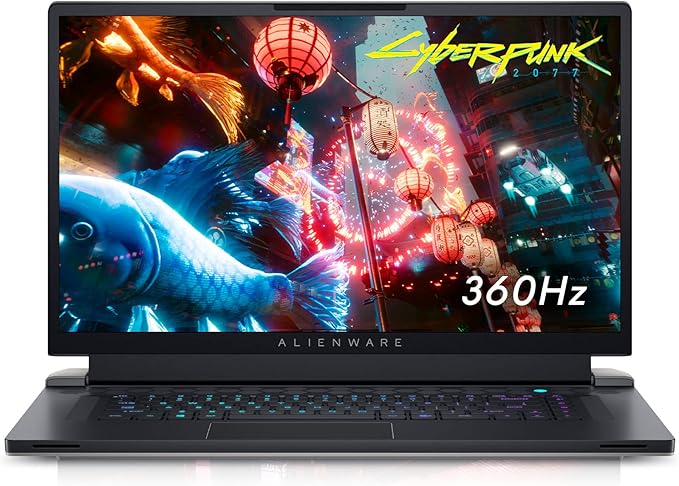
Alienware matches high-end expectations by focusing primarily on bleeding-edge esports refresh rates and high-definition immersive visual fidelity. Alienware configurations frequently offer ultra-fast IPS panels scaling up to 480Hz at 1080p, as well as ultra-crisp 4K panels with exceptionally low response times down to 1ms. Furthermore, Alienware features expansive 16:10 aspect ratio options integrated with proprietary ComfortView Plus low blue light hardware solutions and full NVIDIA G-Sync support. While Alienware delivers exceptional fluid motion and immersion for core gamers, Asus provides a wider variety of panel technologies—particularly via OLED and Mini-LED—catering to both high-framerate gamers and visual fidelity purists.
Performance
Performance execution between both brands highlights distinct approaches to sustained power limits, thermal dynamics, and silicon tuning. Asus demonstrates exceptional engineering flexibility, successfully extracting desktop-class power from compact, thin-and-light form factors like the Zephyrus series while providing immense peak compute power in thick flagships like the ROG Strix SCAR. Utilizing thermal innovations such as Thermal Grizzly liquid metal on both CPU and GPU dies, alongside targeted vapor chambers and triple-fan setups, Asus maintains high clock frequencies without excessive throttling, allowing their machines to excel in both multi-threaded compute workloads and graphics-intensive rendering.
Alienware takes an unapologetically maximalist approach to performance, maximizing total graphics power (TGP) allocations and thermal headroom via substantial chassis engineering. Through its proprietary Element 31 gallium-silicone liquid metal thermal interface and quad-fan configurations on x-series and m-series laptops, Alienware pushes Intel Core HX-series processors and NVIDIA RTX GPUs to their absolute maximum wattage ceilings. The trade-off is often elevated fan noise under full load and higher chassis surface temperatures, but in exchange, Alienware provides rock-solid framerate stability and unthrottled sustained throughput that rivals custom desktop rigs, making it an elite choice for hardcore gaming enthusiasts.