Alienware vs Samsung: Overview
Comparing Alienware and Samsung helps you determine which brand is best suited for your needs in Laptops. Both brands offer strong choices depending on your budget and key feature requirements.
Key Features & Comparison
Evaluate factors such as build quality, warranty, customer satisfaction, and total value before making your final purchase choice between Alienware and Samsung.
Affordability
When evaluating affordability, Alienware and Samsung approach consumer budgets from fundamentally different market positions. Alienware, Dell's dedicated high-performance gaming division, operates strictly in the premium tier. The entry-level price point for an Alienware machine is considerably higher than industry averages, driven by the inclusion of dedicated high-wattage graphics processing units, robust copper-heavy thermal architectures, and specialized mechanical keyboard options. While consumers receive substantial computing horsepower, the engineering overhead and boutique gamer branding create a steep barrier to entry, meaning even their "budget-friendly" configurations, like the m16 series, rarely dip below mid-range pricing thresholds.
Samsung, by contrast, provides a broader spectrum of pricing through its Galaxy Book lineup, spanning accessible entry-level models to premium flagship ultraportables. While Samsung's high-end Galaxy Book Pro and Ultra models reach price tags comparable to Alienware rigs, Samsung leverages its massive vertical integration to deliver better cost-to-feature ratios in productivity segments. Consumers on a budget can access modern processors, quality builds, and ecosystem integrations at prices far more accessible than anything in Alienware's catalog. Consequently, Samsung offers superior overall affordability, while Alienware is strictly an investment for enthusiasts requiring heavy-duty processing power.
Battery Life
Battery life represents one of the starkest contrasts between these two manufacturers due to their divergence in hardware philosophy. Alienware laptops are engineered as desktop replacements designed to draw massive amounts of electrical power. Equipped with power-hungry Intel HX or AMD Ryzen processors paired with high-TGP NVIDIA GeForce RTX graphics cards, Alienware machines rapidly exhaust their onboard batteries, typically yielding only two to four hours of general computing, and frequently less than ninety minutes during intense gaming or rendering tasks. Even with advanced power profiles and NVIDIA Advanced Optimus switching, Alienware systems are inherently tethered to bulky external power adapters for practical operation.
Samsung focuses heavily on mobile efficiency, designing the Galaxy Book series around Intel's efficiency-oriented architectures and integrated or low-TGP discrete graphics. Capitalizing on optimized battery chemistry, aggressive low-power standby states, and power-sipping display panels, Galaxy Book models routinely achieve eight to fourteen hours of real-world productivity on a single charge. Furthermore, Samsung utilizes universal USB-C Power Delivery charging standards, allowing users to replenish battery reserves with compact chargers shared with their smartphones. For mobile professionals, students, and travelers, Samsung's endurance drastically outperforms Alienware's performance-skewed design.
Display
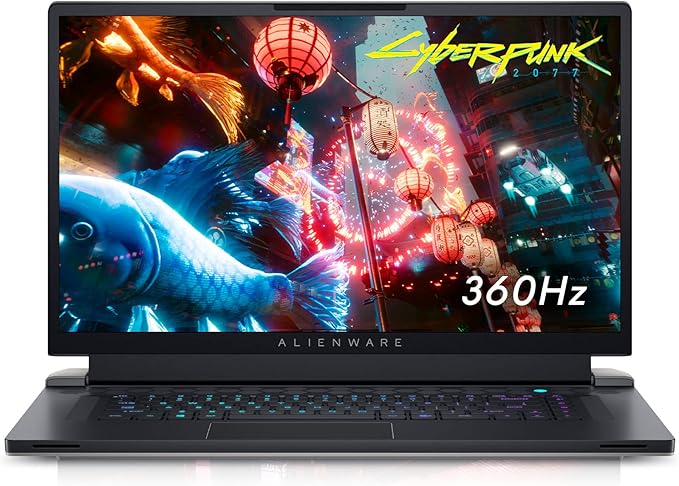
The display technologies championed by Alienware and Samsung reflect their distinct target audiences: competitive gamers versus visual content creators and office professionals. Alienware prioritizes fluid motion and lightning-fast response times. Its display options frequently feature ultra-high refresh rates ranging from 165Hz up to 480Hz, coupled with low millisecond response times and NVIDIA G-Sync or AMD FreeSync support to eliminate screen tearing. While recent Alienware models offer QHD+ and even occasional OLED options with vibrant colors, the fundamental calibration and panel selections are tuned primarily for competitive visual clarity and fast-paced motion fidelity.
Samsung, a global leader in display manufacturing, equips its premier Galaxy Book lineup with industry-leading Dynamic AMOLED 2X displays. These screens deliver near-infinite contrast ratios, true deep blacks, and exceptional color accuracy covering 120% of the DCI-P3 color space. While Samsung incorporates smooth 120Hz refresh rates on higher-end models, its core strength lies in peak HDR brightness, outdoor visibility, and pixel-dense sharpness tailored for creative professionals, photo/video editors, and media consumers. While Alienware wins purely on speed and motion smoothing, Samsung sets the industry benchmark for color fidelity, dynamic range, and overall visual richness.
Performance
Performance benchmarks highlight a distinct separation between sustained raw graphical throughput and ultraportable general productivity. Alienware engineers its laptops with top-tier silicon and aggressive thermal solutions, including proprietary Cryo-Tech cooling, vapor chambers, and gallium-silicone liquid metal thermal interfaces. This allows Alienware to drive CPU and GPU components at their maximum power limits (often exceeding 175W on graphics alone). As a result, Alienware excels effortlessly in demanding compute environments such as 4K gaming, 3D architectural rendering, complex machine learning tasks, and intensive video encoding where sustained hardware performance is non-negotiable.
Samsung's Galaxy Book series approaches performance from a thin-and-light perspective, balancing solid speed with thermal constraint. While high-end models like the Galaxy Book Ultra feature discrete RTX graphics, they are configured at lower wattage envelopes to maintain slim chassis profiles and quiet fan acoustics. Samsung machines deliver snappy everyday multitasking, swift office productivity, and capable lightweight content editing, further enhanced by Samsung's proprietary software integration with Galaxy mobile devices. However, under prolonged, heavy thermal stress, Samsung machines will throttle down performance significantly sooner than Alienware's heavily cooled chassis, making Alienware the decisive winner for heavy workloads.
Compare current retail pricing, active promotions, and verified stock availability directly from authorized stores:
Compare current retail pricing, active promotions, and verified stock availability directly from authorized stores: