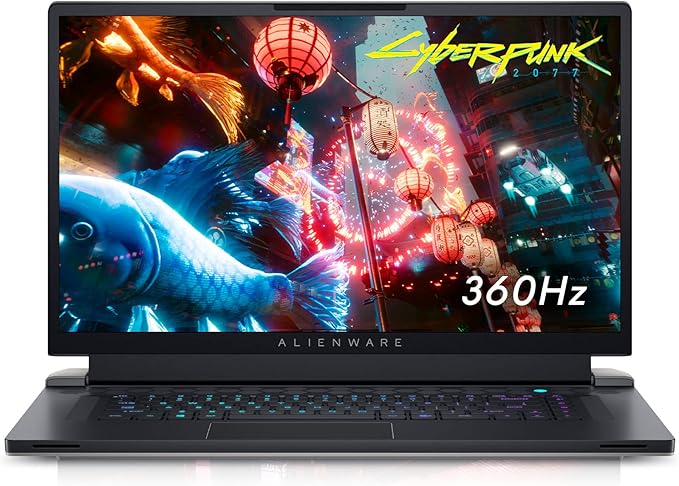
Alienware vs Microsoft: Overview
Comparing Alienware and Microsoft helps you determine which brand is best suited for your needs in Laptops. Both brands offer strong choices depending on your budget and key feature requirements.
Key Features & Comparison
Evaluate factors such as build quality, warranty, customer satisfaction, and total value before making your final purchase choice between Alienware and Microsoft.
Affordability
When evaluating affordability, Alienware and Microsoft approach the market with distinct hardware philosophies, yet both occupy premium pricing tiers. Alienware, Dell's dedicated high-performance gaming division, structures its pricing around enthusiast-grade components, complex thermal architectures, and heavy-duty chassis engineering. Entry-level Alienware machines routinely start well over a thousand dollars, scaling rapidly past several thousand for flagship m-series or x-series configurations. The value proposition here hinges on compute density per dollar: consumers are paying for high-TGP graphics cards, advanced vapor chambers, and mechanical switch keyboards. While rarely described as budget-friendly, Alienware often provides greater raw component value relative to the cost of equivalent desktop-class mobile silicon.
Conversely, Microsoft’s Surface lineup targets executive, creative, and productivity demographics, pricing its devices based on premium fit-and-finish, portability, and bespoke industrial design. While Microsoft offers nominally lower barrier-to-entry devices such as the Surface Laptop Go, standard configurations of the Surface Pro, Surface Laptop, and Surface Laptop Studio command steep premiums, especially when factoring in necessary add-ons like the Surface Pen and Type Cover keyboards. Furthermore, upgrading memory and solid-state storage within the Microsoft ecosystem yields notoriously high price-to-spec margins compared to the wider PC ecosystem. Ultimately, Alienware costs more in absolute terms at the top end due to sheer computing hardware, but Microsoft charges a higher premium for form factor, portability, and design integration relative to base specifications.
Battery Life
Battery longevity represents one of the starkest contrasts between Alienware and Microsoft laptops, dictated entirely by their operational priorities. Alienware laptops are essentially transportable desktop replacements engineered to sustain relentless power delivery to power-hungry Intel or AMD CPUs and high-wattage NVIDIA GeForce RTX graphics modules. Even equipped with large 80Wh to 99Wh battery cells—the maximum legally allowed on commercial flights—Alienware systems rarely survive beyond three to five hours of moderate productivity tasks. Under active gaming or high-load rendering, battery life routinely drops under ninety minutes, accompanied by severe hardware throttling designed to prevent excessive battery drain, meaning these machines are designed to be tethered to hefty AC adapters for full functionality.
In sharp contrast, Microsoft optimizes its Surface portfolio specifically for untethered, all-day mobility and productivity workflows. Leveraging low-to-mid-wattage processors, aggressive system firmware sleep states, and more recently, highly efficient Qualcomm Snapdragon ARM-based processors alongside efficient x86 chips, Surface devices routinely deliver between eight and fifteen hours of real-world use depending on the model. Microsoft’s deep hardware-software synergy ensures that idle states consume negligible power, allowing modern Surface Laptops and Surface Pros to easily outlast standard workdays. For users who prioritize untethered operation, travel-friendly longevity, and consistent performance off the power grid, Microsoft holds a definitive and overwhelming technical advantage.
Display
The display technologies championed by Alienware and Microsoft highlight fundamentally different use cases: rapid motion fidelity versus static visual precision. Alienware panels are engineered primarily for competitive gaming and immersion, prioritizing ultra-high refresh rates ranging from 165Hz up to 480Hz, sub-millisecond response times, and variable refresh rate solutions such as NVIDIA G-Sync and AMD FreeSync. While modern Alienware configurations offer high-resolution QHD and 4K options—and occasionally vibrant OLED panels with deep contrast—their baseline tunings and anti-glare matte coatings prioritize the elimination of motion blur, tearing, and ambient reflections, delivering seamless visuals in dynamic, fast-paced graphical environments.
Microsoft takes an entirely different architectural path with its proprietary PixelSense displays, prioritizing creative fidelity, productivity, and multi-modal input. Surface screens universally adopt taller 3:2 aspect ratios, which maximize vertical screen real estate for documents, coding environments, and web browsing far more effectively than traditional 16:9 or 16:10 widescreen panels. Furthermore, Microsoft screens boast exceptional factory color accuracy, high pixel densities, glossy finishes with deep color saturation, and integrated 10-point multi-touch with active stylus digitizers. Although higher-end Surface models now feature smooth 120Hz dynamic refresh rates, their slower pixel response times introduce ghosting in fast-paced games, making Microsoft displays superior for digital artistry and office productivity, whereas Alienware remains the superior choice for high-frame-rate multimedia.
Performance
Performance benchmarks between these two manufacturers illustrate the divide between sustained, unthrottled graphical compute and thermally constrained, highly efficient daily processing. Alienware machines are purpose-built to extract maximum power output, utilizing large cooling systems with dual or quad fans, inverted motherboards, liquid metal thermal interfaces, and expansive vapor chambers. This thermal headroom enables Alienware to feed continuous high wattage to top-tier multi-core processors and flagship mobile GPUs. As a result, Alienware effortlessly crushes synthetic rendering benchmarks, 4K video encoding pipelines, and demanding AAA gaming workloads, providing sustained performance without aggressive thermal downclocking over long sessions.
Microsoft’s performance profile is engineered around burst compute and silent, cool operation within ultra-thin form factors. While devices like the Surface Laptop Studio integrate discrete NVIDIA mobile graphics capable of handling moderate 3D modeling, photo editing, and software compilation, their lower thermal ceilings and restricted Total Graphics Power (TGP) prevent them from matching the sustained horsepower of an Alienware system. Mainstream Surface Laptops and 2-in-1s prioritize quick responsiveness for productivity software, multitasking, and media consumption over raw graphical muscle. For users needing raw workstation power, 3D simulation rendering, or top-tier gaming, Alienware is in a class of its own; conversely, Microsoft delivers balanced, quiet, and responsive efficiency ideal for general business and creative execution.
Compare current retail pricing, active promotions, and verified stock availability directly from authorized stores:
Compare current retail pricing, active promotions, and verified stock availability directly from authorized stores: