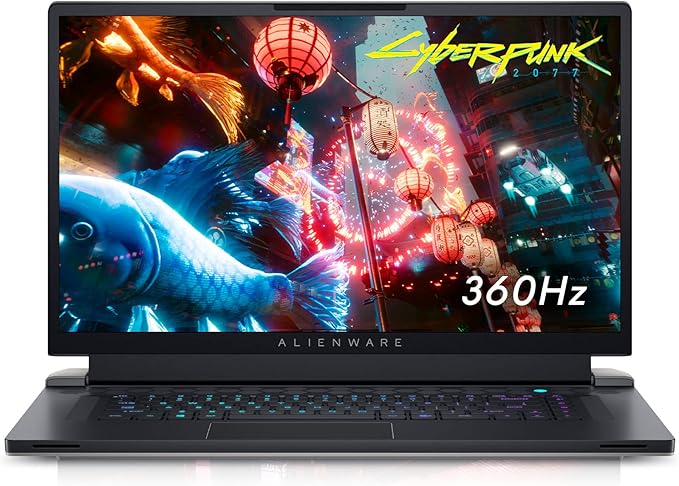
Alienware vs LG: Overview
Comparing Alienware and LG helps you determine which brand is best suited for your needs in Laptops. Both brands offer strong choices depending on your budget and key feature requirements.
Key Features & Comparison
Evaluate factors such as build quality, warranty, customer satisfaction, and total value before making your final purchase choice between Alienware and LG.
Affordability
When analyzing the pricing structures of Alienware and LG, consumers are faced with fundamentally different value propositions rooted in distinct hardware priorities. Alienware, operating as Dell's premier gaming division, commands a premium price tag that reflects its heavy investment in high-wattage silicon, sophisticated vapor-chamber thermal assemblies, and bespoke chassis engineering. Consequently, even entry-level configurations tend to start at high price thresholds, with fully kitted flagship models frequently exceeding several thousand dollars. While the initial financial outlay is steep, buyers are paying for top-tier desktop replacement capabilities, mechanical keyboard switches, and durable magnesium-alloy builds that resist physical wear, making it an investment strictly aimed at power users willing to pay for peak computing throughput.
Conversely, LG focuses its laptop efforts predominantly on the ultraportable segment through its gram series, positioning its pricing around mobility, premium materials, and lightweight engineering rather than raw GPU horsepower. While LG laptops are by no means budget-tier budget machines, their pricing across mid-to-high tiers offers a far more accessible entry point for general productivity, corporate use, and academic tasks. The engineering cost in LG devices is concentrated in specialized magnesium-alloy manufacturing that minimizes weight without sacrificing structural integrity, rather than expensive high-TDP graphics cards and heavy cooling systems. As a result, budget-conscious consumers seeking exceptional everyday usability and longevity will find substantially better value-per-dollar in LG, whereas Alienware’s cost is only justified if continuous graphical crunching is an absolute necessity.
Battery Life
Battery performance reveals one of the starkest contrasts between Alienware and LG, driven by their opposing philosophical designs regarding power draw and system mobility. Alienware laptops are intrinsically engineered for sustained performance, packing power-hungry multi-core processors, high-wattage discrete NVIDIA GeForce RTX graphics cards, and high-refresh displays that rapidly deplete the internal battery. Despite housing capacity-maximizing cells—frequently engineered right up to the 99.9Wh legal limit for air travel—the sheer thermodynamic demand of Alienware systems results in real-world battery runtimes that rarely exceed two to four hours during modest productivity, and often less than an hour under gaming loads, forcing users to treat the power brick as an essential travel companion.
In stark contrast, battery life represents the crowning achievement of LG's laptop portfolio, particularly within the gram lineup. LG pairs energy-efficient low-TDP Intel Core processors with remarkably dense 72Wh to 90Wh batteries embedded inside sub-three-pound chassis. Bolstered by aggressive system-level power management, efficient display backlights, and lack of discrete graphics silicon on base models, an LG gram routinely delivers between 12 to 20 hours of continuous productivity, web browsing, and media consumption on a single charge. For remote professionals, frequent flyers, and students who demand multi-day endurance untethered from AC power outlets, LG easily outclasses Alienware, which remains effectively tethered to the wall.
Display
Alienware prioritizes speed, fluid motion, and immersive visual responsiveness in its display engineering, designing panels that cater extensively to competitive esports athletes and creative professionals requiring high fidelity. Their product lines feature an array of cutting-edge panel technologies ranging from blisteringly fast 480Hz FHD panels to ultra-crisp 4K panels and vibrant QD-OLED (Quantum Dot OLED) variants. These screens emphasize low grey-to-grey response times (often down to 1ms or lower), NVIDIA G-Sync integration, and advanced sRGB and DCI-P3 color gamuts. The result is visual fidelity that eliminates tearing, stuttering, and ghosting, wrapped in bright, anti-glare coatings tailored for indoor gameplay and intensive video editing sessions where micro-second latency is critical.
LG, celebrated globally for its display manufacturing prowess, takes a distinctly different route by optimizing for productivity, color depth, and visual comfort. Most modern LG gram laptops feature modern 16:10 aspect ratio screens, providing vertical screen real estate that drastically improves document editing, programming, and multi-window multitasking. LG often integrates high-resolution IPS and OLED panels boasting up to 99% coverage of the DCI-P3 color space, delivering razor-sharp text, lifelike contrast ratios, and superb color accuracy out of the box. While LG's refresh rates typically standardise around 60Hz or 90Hz—falling far behind Alienware’s hyper-speed metrics—their anti-glare coatings, pixel density, and ergonomic screen-to-body ratios make them visually superior for long workdays and digital media creation.
Performance
In terms of peak computational and graphical throughput, Alienware stands in an elite tier of its own. Engineered around heavy, unrestricted power envelopes, Alienware systems feature Intel HX-series or AMD Ryzen 9 processors alongside high-wattage NVIDIA GeForce RTX laptop GPUs operating at their maximum Total Graphics Power (TGP). To maintain sustained clock speeds without thermal throttling, the brand integrates advanced thermal solutions involving liquid metal compounds, quadruple exhaust channels, and extensive vapor chambers. This allows Alienware laptops to crush extreme workloads, including 3D rendering, AAA ray-traced gaming, machine learning compiles, and complex multi-layer 8K video processing without breaking a sweat, provided the system is plugged into its substantial power supply.
LG approaches performance from a standpoint of thermal efficiency and daily responsiveness rather than sheer computational brute force. Equipped with Intel Core Ultra or standard U/P-series chips and integrated Arc or Iris Xe graphics, LG laptops provide plenty of headroom for smooth multitasking, extensive spreadsheet manipulation, photo editing, and 4K media streaming. However, because these ultra-slim laptops are engineered with minimal chassis volume and lightweight cooling hardware, sustained heavy workloads will inevitably cause thermal constraints, forcing the processor to dial back boost frequencies. For heavy-duty rendering, complex physics simulations, and modern high-end gaming, LG simply cannot compete with the raw engineering horsepower and aggressive hardware profile of an Alienware.
Compare current retail pricing, active promotions, and verified stock availability directly from authorized stores:
Compare current retail pricing, active promotions, and verified stock availability directly from authorized stores: