Alienware vs Apple: Overview
Comparing Alienware and Apple helps you determine which brand is best suited for your needs in Laptops. Both brands offer strong choices depending on your budget and key feature requirements.
Key Features & Comparison
Evaluate factors such as build quality, warranty, customer satisfaction, and total value before making your final purchase choice between Alienware and Apple.
Affordability
When evaluating affordability, Alienware and Apple adopt distinctly different pricing strategies driven by their core engineering priorities and target demographics. Alienware, Dell's premium gaming division, generally offers a more accessible entry-level price point for raw computing power, particularly regarding dedicated graphics processing. While high-end configurations like the Alienware m18 or x16 command steep price tags reaching into thousands of dollars, consumers often receive competitive component-per-dollar ratios, including high-wattage NVIDIA RTX GPUs, upgradable dual-channel DDR5 RAM, and multiple accessible M.2 SSD slots. This modularity extends the machine's functional lifespan, allowing users to defer full replacement costs by performing strategic hardware upgrades down the road.
Apple, by contrast, operates under a luxury, proprietary pricing architecture where base models of the MacBook Air and MacBook Pro can appear reasonably priced, yet scale aggressively with component upgrades. The unified memory architecture and integrated NAND storage on Apple Silicon are non-upgradable after purchase, requiring buyers to pay exorbitant premiums upfront for additional RAM and storage. However, Apple offsets this initial cost disparity through superior long-term value retention; MacBooks routinely maintain higher resale and trade-in values than their PC counterparts over a three-to-five-year period. Consequently, while Alienware provides superior upfront hardware value for gamers and power users on a budget, Apple delivers a more consistent total cost of ownership for creative professionals and general consumers who factor in depreciation.
Battery Life
In the domain of battery life, the architectural divergence between Alienware's x86 platform and Apple's ARM-based Apple Silicon results in an overwhelming advantage for Apple. Alienware laptops are engineered as desktop replacements designed to operate near a wall outlet, housing power-hungry Intel or AMD processors alongside discrete NVIDIA graphics cards that routinely draw between 150 to 250 watts under full load. Even with massive 90Wh+ batteries—the legal limit for air travel—most Alienware machines struggle to surpass two to four hours of light productivity tasks, and resource-intensive gaming can drain a fully charged cell in under an hour. The immense thermal overhead and high-draw cooling systems inherently compromise portable endurance.
Apple has fundamentally transformed portable power efficiency through its M-series system-on-chip (SoC) architecture, seamlessly combining the CPU, GPU, neural engine, and unified memory on a single die with exceptional energy efficiency per watt. Modern MacBook Pro and MacBook Air models regularly achieve 15 to 22 hours of real-world battery life on typical productivity, web browsing, and media consumption workflows. Furthermore, unlike Alienware machines—which severely throttle CPU and GPU clock speeds when disconnected from the AC adapter to prevent immediate battery exhaustion—Apple devices maintain virtually 100% of their compute and graphical performance while on battery power, making them unequivocally superior for users demanding tether-free mobility.
Display
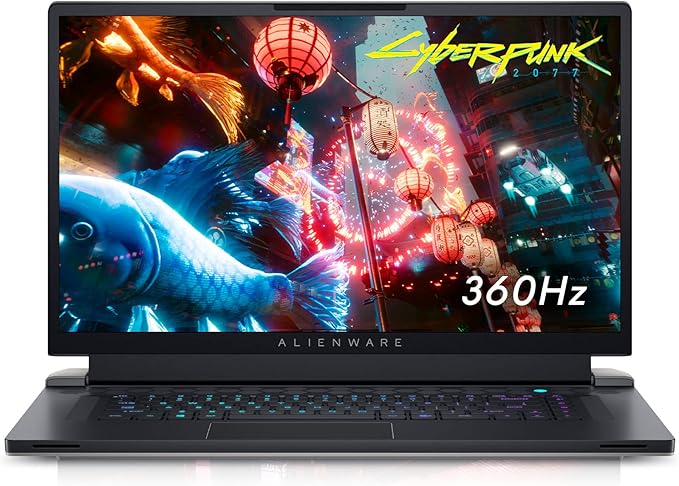
Display engineering between these two brands illustrates divergent design philosophies tailored to specific end-user visual demands. Alienware prioritizes fluid motion, rapid pixel response times, and minimal input latency to satisfy competitive gamers. Their laptops frequently feature high-refresh panels ranging from 165Hz to blistering 480Hz on IPS configurations, with advanced options incorporating vibrant OLED panels boasting sub-millisecond response times. Technologies like NVIDIA G-Sync and Advanced Optimus are standard inclusions, effectively eliminating screen tearing and dynamically switching between integrated and discrete graphics. However, color accuracy out of the box can vary, and maximum sustained brightness typically hovers around 300 to 400 nits, which is sufficient for indoor gaming but less optimal for bright ambient environments.
Apple prioritizes absolute color fidelity, uniform luminance, and visual resolution for creative production and media consumption. The Liquid Retina XDR displays found on the higher-end MacBook Pro lineup employ mini-LED backlighting technology with thousands of local dimming zones, achieving sustained full-screen brightness of 1,000 nits and peak HDR brightness of 1,600 nits alongside a 1,000,000:1 contrast ratio. While Apple integrates its ProMotion variable refresh technology up to 120Hz, it does not reach Alienware's ultra-high refresh ceiling, nor does it support hardware-level anti-tearing standards like G-Sync. Nevertheless, Apple's factory-calibrated DCI-P3 wide color gamut, True Tone adaptive white-balancing, and class-leading pixel density make it the definitive choice for professional photographers, video editors, and colorists.
Performance
Performance metrics between Alienware and Apple are heavily contingent upon workload specialization, API optimization, and software ecosystems. Alienware thrives in raw, sustained parallel computing environments tailored for 3D rendering, engineering simulations, and PC gaming. Leveraging high-TGP (Total Graphics Power) NVIDIA GeForce RTX 40-series mobile GPUs and unlocked Intel Core HX-series processors, Alienware notebooks deliver uncompromised rasterization power, hardware-accelerated ray tracing, and DLSS 3 frame generation. These capabilities make Alienware an unmatched powerhouse for running modern AAA gaming titles, complex CAD models, and Windows-dependent scientific software that demand direct x86 hardware acceleration and extensive multi-threaded throughput under robust vapor-chamber cooling.
Apple's M-series Pro and Max chips approach performance through architectural synergy rather than sheer brute-force wattage. Apple’s unified memory architecture enables the CPU and GPU to share an ultra-wide memory bus (surpassing 400 GB/s on Max-tier chips) without copying data between separate pools, yielding extraordinary speed in video transcode pipelines, audio production, and machine learning inference. Applications optimized for Apple’s Metal API, such as Final Cut Pro, DaVinci Resolve, and Logic Pro, demonstrate compute efficiencies that rival or exceed desktop-class PC hardware while consuming a fraction of the electricity. While Apple remains ill-suited for mainstream gaming due to limited catalog availability and DirectX constraints, its silicon excels in Unix-based software development, creative media production, and steady thermal sustained workloads.
Compare current retail pricing, active promotions, and verified stock availability directly from authorized stores:
Compare current retail pricing, active promotions, and verified stock availability directly from authorized stores: