Viofo vs Rexing: Overview
Comparing Viofo and Rexing helps you determine which brand is best suited for your needs in Dash Cams. Both brands offer strong choices depending on your budget and key feature requirements.
Key Features & Comparison
Evaluate factors such as build quality, warranty, customer satisfaction, and total value before making your final purchase choice between Viofo and Rexing.
Features
In terms of feature architecture, Viofo adopts a technical, high-performance approach that targets the specific mechanics of digital surveillance. Viofo systems are renowned for their advanced buffered parking modes, offering motion detection, time-lapse recording, and low-bitrate continuous capture with precision battery voltage cutoff management via specialized hardwire kits. Their flagship models incorporate state-of-the-art Sony STARVIS 2 sensors, dual-band Wi-Fi (2.4GHz and 5GHz) for high-speed file transfers, support for circular polarizing lens (CPL) filters to minimize dashboard reflection, and optional Bluetooth remote event-locking triggers. This design philosophy emphasizes granular firmware control and the uncompromising reliability of the recorded incident data above novelty functions.
Rexing emphasizes mass-market convenience and versatile cabin monitoring solutions within its feature portfolio. The brand excels in multi-channel ecosystems, frequently offering 3-channel and 4-channel setups designed for 360-degree coverage, complete with infrared cabin illumination tailored for rideshare operations. Rexing also integrates modern consumer conveniences such as integrated GPS logging, voice command recognition, and broad companion-app connectivity for rapid social sharing and cloud backup on select lines. While Rexing’s parking surveillance and menu customization options are less technically nuanced than Viofo's buffered setups, Rexing delivers a streamlined, plug-and-play experience that requires significantly less user calibration and technical expertise to deploy effectively.
Performance
Performance benchmarks heavily favor Viofo, particularly in optical fidelity, low-light legibility, and high-temperature thermal durability. Viofo’s integration of high-bitrate encoding pipelines combined with class-leading Sony STARVIS and STARVIS 2 sensors ensures superior resolving power, enabling drivers to clearly discern license plate alphanumeric characters, street signage, and peripheral road details at highway speeds. Furthermore, Viofo exclusively relies on supercapacitors rather than volatile lithium-ion batteries across its lineup, ensuring flawless operational stability in extreme temperature ranges (from sub-zero freezes to blistering dashboard heat) and eliminating the catastrophic risk of battery swelling or thermal shutdown during critical recording events.
Rexing delivers adequate performance tailored for typical daytime commuting and general liability assessment, but it exhibits clear limitations under challenging environmental conditions. While Rexing markets various "4K" models, many rely on aggressive digital sharpening and software interpolation rather than pure native sensor resolution, resulting in elevated artifacting, blown-out highlights, and crushed shadow details during nighttime driving. While Rexing has transitioned many of its popular models to supercapacitor power, certain entry-level units still employ lithium-ion batteries that present long-term reliability concerns in hot climates. For clear evidentiary capture of moving license plates in rain, dusk, or darkness, Rexing underperforms relative to Viofo's optical mastery, though it remains sufficient for broad accident fault determination.
Design
The industrial design of both brands reflects their divergent engineering priorities and vehicle integration philosophies. Viofo employs a discreet, wedge-shaped form factor pioneered by its iconic A119 and A129 series, which adheres flush against the windshield directly behind the rearview mirror. This minimalist aesthetic significantly reduces windshield clutter, minimizes driver distraction, and maintains a stealthy profile from outside the vehicle to deter theft. The physical construction incorporates robust tactile buttons, an intuitive low-profile LCD screen for immediate playback, and highly heat-dissipating vented enclosures engineered to withstand intense solar exposure without warping or component degradation.
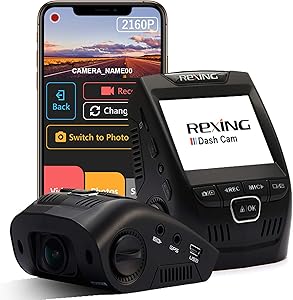
Rexing utilizes a distinctive, wedge-and-chassis aesthetic that emphasizes functional accessibility and expansive physical interfaces. Many Rexing dash cams feature angled, modular camera lenses that can be vertically tilted to accommodate steep truck windshields or sloped sports car glass with equal ease. The brand often integrates larger display screens and prominently placed control buttons, which simplifies manual navigation and review for non-technical drivers, though this results in a noticeably bulkier footprint on the glass. While Rexing’s plastic housings generally lack the premium, heat-resistant density found in Viofo’s builds, their mechanical designs emphasize intuitive mounting systems, quick-release brackets, and flexible lens orientations that facilitate straightforward multi-vehicle portability.