Vantrue vs Rexing: Overview
Comparing Vantrue and Rexing helps you determine which brand is best suited for your needs in Dash Cams. Both brands offer strong choices depending on your budget and key feature requirements.
Key Features & Comparison
Evaluate factors such as build quality, warranty, customer satisfaction, and total value before making your final purchase choice between Vantrue and Rexing.
Features
In terms of feature sets, both Rexing and Vantrue cover the essential bases—loop recording, G-sensor collision detection, GPS logging, and buffered parking monitoring. However, Vantrue frequently pulls ahead in the implementation of advanced surveillance modes. Vantrue specializes in all-encompassing multi-camera systems (such as the Nexus series), which capture the front, cabin, and rear simultaneously, often integrating infrared LEDs for flawless night-time interior recording. This architecture makes Vantrue the preferred choice for Uber, Lyft, and taxi drivers who need verifiable passenger monitoring. Furthermore, Vantrue's parking mode logic is exceptionally sophisticated, offering customizable motion detection, low-bitrate recording, and precise radar-based proximity sensing to minimize false triggers while protecting the vehicle's battery.
Rexing matches this utility by offering versatile multi-channel options, such as its V1P and V3 lines, often incorporating features like modular camera attachments and wide-angle modularity. Rexing’s companion mobile apps, while occasionally criticized for UI simplicity, provide stable Wi-Fi connectivity for transferring clips quickly to a smartphone on the go. Additionally, Rexing incorporates supercapacitors across much of its lineup to ensure operation in extreme heat and cold, matching Vantrue's thermal resilience. Where Rexing trails slightly is in peripheral software customization; Vantrue generally provides deeper on-device menu settings, allowing power users to fine-tune exposure metering, bitrates, audio sensitivity, and voice-command sensitivity, making Vantrue the more feature-dense platform for hardware enthusiasts.
Performance
Optical performance is arguably the most decisive battleground between these two manufacturers, and here Vantrue often holds a technological edge. By frequently deploying premium Sony STARVIS and STARVIS 2 image sensors coupled with wide-aperture lenses (often f/1.8 or lower), Vantrue cameras deliver exceptional dynamic range, true 4K resolution capture, and superior low-light clarity. In critical real-world situations, such as reading high-speed license plates at night or dealing with direct headlight glare, Vantrue's advanced High Dynamic Range (HDR) and Wide Dynamic Range (WDR) processing consistently resolve finer details with less digital noise and chromatic aberration.
Rexing offers respectable video quality that capably fulfills legal and insurance requirements, providing sharp daytime capture and clear daytime plate recognition across its Ultra HD lineup. However, in low-light environments and complex lighting scenarios—such as driving through unevenly lit city streets or unlit highways—Rexing footage can exhibit more sensor noise and slightly narrower dynamic range compared to equivalent Vantrue models. Frame rates on Rexing units are stable, and video compression algorithms are well-tuned to balance file size against visual integrity, but they simply do not match the raw optical acuity, shadow retrieval, and clarity produced by Vantrue’s top-tier image processors.
Design
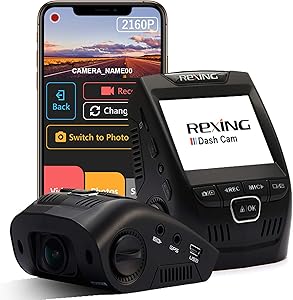
The industrial design philosophies of Rexing and Vantrue diverge significantly in form factor and windshield presence. Rexing is widely celebrated for its signature wedge-shaped design, pioneered in products like the V1 series. This low-profile form factor mounts flush against the windshield, allowing the camera to sit discreetly behind the rearview mirror. By eliminating dangling hanging brackets, Rexing minimizes windshield obstruction, reduces distracting device vibrations, and presents a stealthy, factory-integrated aesthetic that is far less noticeable to potential thieves or outside observers.
Vantrue, by comparison, traditionally favors a more conventional cylindrical or horizontal body mounted via a suction cup or 3M adhesive bracket, though recent models have adopted sleeker profiles. While slightly more conspicuous than Rexing’s flush-mount wedge, Vantrue’s hardware is exceptionally well-engineered, featuring robust magnetic mounting points with integrated power passthrough, allowing the main unit to be quickly detached without unplugging cables. Vantrue units also tend to incorporate larger, higher-resolution IPS preview screens and tactical physical buttons, facilitating easier real-time menu navigation and playback compared to the more compact, tucked-away controls inherent to Rexing's minimalist form factor.