Thinkware vs Rexing: Overview
Comparing Thinkware and Rexing helps you determine which brand is best suited for your needs in Dash Cams. Both brands offer strong choices depending on your budget and key feature requirements.
Key Features & Comparison
Evaluate factors such as build quality, warranty, customer satisfaction, and total value before making your final purchase choice between Thinkware and Rexing.
Features
Thinkware's feature suite is heavily oriented toward proactive vehicle protection and integrated smart assistance. A primary differentiator is Thinkware's market-leading parking surveillance suite, which includes Energy Saving Mode 2.0, radar-assisted motion detection, and low-light Super Night Vision 4.0. These modes allow vehicles to monitor surroundings for weeks on end with minimal battery drain, supplemented by Advanced Driver Assistance Systems (ADAS) that provide lane departure, front collision, and red-light camera warnings. Furthermore, Thinkware’s Cloud connectivity on select flagship models offers geo-fencing, remote live views, and immediate impact notifications directly to a smartphone.
Rexing counters with a feature set prioritized around sheer versatility and accessible modularity. Rexing units frequently pack high-resolution sensors, integrated GPS loggers, cabin-facing infrared cameras, and wide viewing angles into entry-level price brackets. While Rexing provides functional loop recording, G-sensor collision locks, and basic Wi-Fi connectivity for media transfers, its parking modes often rely on basic time-lapse or standard motion detection that consumes vehicle power more aggressively. Rexing delivers the essential high-demand consumer specs out-of-the-box, but Thinkware delivers significantly more intelligent, nuanced software implementation and specialized hardware expansion.
Performance
In terms of optical performance and sensor integration, Thinkware maintains an undeniable edge through the deployment of premium Sony STARVIS and STARVIS 2 image sensors paired with refined image signal processors (ISP). Thinkware cameras excel in wide dynamic range (WDR) processing, effectively balancing stark contrasts such as oncoming high-beam glare or transitioning through dark tunnels without blowing out crucial details like license plates. Moreover, Thinkware devices are engineered with advanced thermal management, utilizing supercapacitors and thermal throttling to ensure flawless operation in scorching summer heat or freezing winters without catastrophic frame drops or corrupted write cycles.
Rexing achieves impressive clarity on paper, frequently advertising native or interpolated 4K recording across popular models like the V1 series, which yields sharp daytime footage with vibrant color reproduction. However, Rexing's video pipeline often struggles in challenging low-light environments, where noise suppression algorithms can smear license plates and fine textures. Additionally, while newer Rexing models incorporate supercapacitors, historical and budget entries utilizing traditional lithium-ion batteries present lower thermal thresholds, resulting in shorter operational lifespans under sustained high temperatures compared to Thinkware's consistently robust mechanical and optical performance.
Design
Design philosophy sharply divides these two brands, visible in both aesthetic form factors and mechanical build quality. Thinkware typically adheres to a sleek, wedge-shaped, or screenless cylindrical design intended to integrate seamlessly into a vehicle’s interior without obstructing the driver's field of view. By omitting large, distracting LCD screens on many flagship models, Thinkware creates an unobtrusive, factory-installed appearance that also enhances thermal dissipation through structural casing vents. The plastics, mounting brackets, and locking mechanisms on Thinkware cameras feel dense, durable, and engineered for permanent integration.
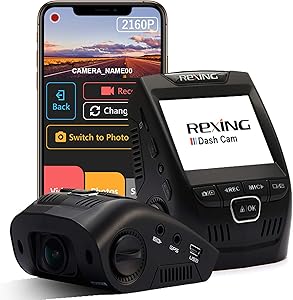
Rexing popularized the wedge-style dash cam design with an integrated, angled LCD display that mounts flush against the windshield, keeping the unit relatively discreet while retaining immediate on-device menu navigation and playback. While functional and convenient for drivers who prefer viewing footage directly on the unit without launching an app, the build quality leans heavily toward lighter, consumer-grade plastics. Rexing's button layouts and tactile feedback are utilitarian rather than refined, prioritizing rapid manufacturing economics over the structural elegance and acoustic dampening found across Thinkware's product portfolio.