Rexing vs Car & Driver: Overview
Comparing Rexing and Car & Driver helps you determine which brand is best suited for your needs in Dash Cams. Both brands offer strong choices depending on your budget and key feature requirements.
Key Features & Comparison
Evaluate factors such as build quality, warranty, customer satisfaction, and total value before making your final purchase choice between Rexing and Car & Driver.
Features
In terms of feature sets, Rexing consistently pushes the envelope by integrating premium safety and fleet-oriented capabilities. Many of Rexing’s core models, such as the V1 and V3 series, boast multi-channel systems (front, cabin, and rear recording) capable of capturing simultaneous angles—an indispensable feature for Uber, Lyft, and commercial operators. Additionally, Rexing incorporates built-in GPS logging to document speed and coordinates, integrated Wi-Fi for streamlined smartphone offloading, and intelligent parking surveillance enabled by hardwire kits. Their widespread use of internal supercapacitors instead of standard lithium-ion batteries also ensures greater longevity and thermal resilience in extreme summer and winter climates.
Car & Driver, by comparison, delivers a more streamlined, fundamental suite of features tailored for standard point-to-point commuting. Typical models include standard G-sensor impact detection, automated loop recording, basic driver assistance alerts (such as lane departure warnings), and intuitive on-device menu navigation. While some Car & Driver units offer GPS or smart display compatibility, the feature architecture is generally kept modest to maintain budget-friendly price points and avoid configuration complexity. For consumers wanting advanced telematics, wireless file syncing, and comprehensive multi-lens coverage, Rexing offers far deeper functionality, whereas Car & Driver caters to those seeking standard recording without the digital clutter.
Performance
Video fidelity and operational reliability represent critical metrics where Rexing often takes a decisive lead. Rexing cameras frequently employ advanced Sony Starvis sensors, wide dynamic range (WDR) processing, and resolutions ranging from crisp 1080p up to true 4K Ultra HD. This optical baseline delivers superior dynamic range, ensuring license plates, street signs, and low-light street hazards remain legible during night driving or in harsh direct sunlight. Furthermore, high frame-rate options (up to 60fps) provide smoother motion capture, which is essential for accurate forensic evidence during high-speed traffic incidents.
Car & Driver dash cams deliver solid, dependable performance for day-to-day traffic documentation, primarily operating in 1080p full HD with decent color accuracy and acceptable daytime clarity. However, their budget-focused sensor packages can struggle in challenging lighting scenarios, such as sudden transitions into dark tunnels or rural night driving, where high-contrast glare or noise can obscure fine details like plate numbers. While Car & Driver fulfills the baseline evidentiary need for proving fault in standard collisions, Rexing delivers the forensic clarity and high-bitrate video stability demanded by discerning drivers.
Design
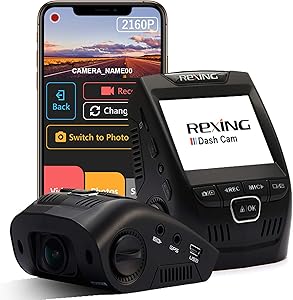
Aesthetic and physical engineering approaches between the two brands reflect their divergent functional priorities. Rexing is widely recognized for its signature wedge-shaped design, pioneered on flagship models like the V1. This low-profile chassis sits flush against the windshield, minimizing driver visual obstruction and maintaining a stealthy footprint that reduces the risk of vehicular break-ins. The angled button layout and robust mounting plates ensure structural stability, significantly reducing video vibration over uneven pavement while seamlessly integrating into the vehicle's interior trim line.
Conversely, Car & Driver frequently utilizes a more conventional, digital camera-inspired form factor, often pairing rectangular housings with suction cup or adhesive ball mounts and prominent rear LCD screens. While this traditional design facilitates quick angle adjustments and makes on-device playback easy via large, accessible displays, it tends to be more conspicuous from the exterior and occupies more windshield real estate. Car & Driver prioritizes approachable ergonomics and visible interface interaction, whereas Rexing excels in discreet, aerodynamically integrated hardware built for unobtrusive daily use.