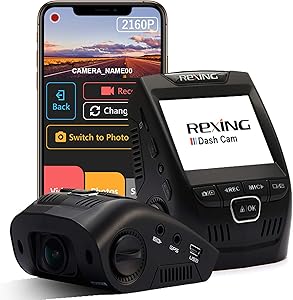
Nextbase vs Rexing: Overview
Comparing Nextbase and Rexing helps you determine which brand is best suited for your needs in Dash Cams. Both brands offer strong choices depending on your budget and key feature requirements.
Key Features & Comparison
Evaluate factors such as build quality, warranty, customer satisfaction, and total value before making your final purchase choice between Nextbase and Rexing.
Features
In terms of intelligent feature sets, Nextbase holds a decisive lead with proprietary, real-world utility functions like Emergency SOS and Alexa integration. Their higher-end models, such as the 522GW and 622GW, utilize What3Words geolocation data to dispatch emergency services with pinpoint accuracy if a driver is incapacitated—a patented safety measure Rexing does not match. Additionally, Nextbase’s modular ecosystem allows users to snap on cabin-view or rear-window modules directly onto the main camera body via an intelligent magnetic linkage, creating seamless multi-view recording without cumbersome secondary power runs.
Rexing counters Nextbase not through software elegance, but through sheer multi-channel capability and raw hardware inclusion. Many Rexing packages come standard with front, inside-cabin, and rear cameras in an all-in-one bundle, providing full 360-degree coverage that rideshare drivers require immediately out of the box. Rexing units frequently feature built-in GPS loggers, Wi-Fi connectivity, and wide dynamic range (WDR) processing. However, Rexing’s companion mobile application is frequently criticized for inconsistent transfer speeds and occasional firmware clunkiness, whereas the Nextbase MyNextbase suite provides a more consistent, legally compliant video editing and insurance-sharing experience.
Performance
Performance benchmarks reveal distinct operational priorities between the two manufacturers, particularly in low-light environments and thermal resilience. Nextbase models often feature specialized Sony STARVIS image sensors paired with custom-tuned f/1.3 to f/1.6 lenses and integrated polarizing filters. This hardware setup dramatically reduces windshield glare and produces high dynamic range footage with superior license-plate legibility at speed and at night. Furthermore, top-tier Nextbase units feature image stabilization, smoothing out harsh road vibrations that might otherwise blur critical frame details during a collision.
Rexing delivers impressive daytime clarity, often utilizing high native resolutions up to 4K on models like the V1P Pro and V3. Daytime video is sharp with broad viewing angles up to 170 degrees, though this ultra-wide angle can cause minor fisheye distortion that slightly obscures distant plate numbers. Low-light performance on Rexing is adequate, aided by infrared interior LEDs for cabin monitoring, but lacks the contrast precision and glare management of Nextbase's optics. Notably, both brands have embraced supercapacitors over traditional lithium-ion batteries in many models, giving them similar operational tolerance to extreme heat and freezing vehicle cabins.
Design
The industrial design of these two brands represents a fundamental divergence in form factor and windshield presence. Nextbase adopts a traditional digital camera silhouette that relies heavily on their patented Click&Go PRO powered magnetic mount. This mounting design routes the power cable directly into the windshield cradle rather than the camera itself, enabling effortless single-handed removal of the device when parked. Nextbase units also feature vibrant, high-responsiveness IPS touchscreens that simplify on-the-fly settings configuration and immediate playback review.
Rexing favors a wedge-shaped, low-profile design that adheres flush against the windshield, mimicking a factory-installed component. This stealthy aesthetic ensures the camera remains largely hidden behind the rearview mirror, significantly reducing driver distraction and minimizing the risk of break-ins compared to the more conspicuous Nextbase cameras. The trade-off is that Rexing devices rely primarily on small, physical tactile buttons and compact, non-touch LCD screens, making menu navigation and initial alignment somewhat more tedious than Nextbase’s intuitive touch interface.