Ramblewood vs Summit: Overview
Comparing Ramblewood and Summit helps you determine which brand is best suited for your needs in Cooktops. Both brands offer strong choices depending on your budget and key feature requirements.
Key Features & Comparison
Evaluate factors such as build quality, warranty, customer satisfaction, and total value before making your final purchase choice between Ramblewood and Summit.
Features
Feature implementation between the two brands highlights a divergence between strict essentials and modern appliance innovation. Ramblewood cooktops are deliberately analog in their feature architecture; their gas models employ standard electronic pulse ignition and thermocouple flame-failure safety valves, while their electric and induction counterparts lean on simple digital touch sliders or mechanical rotary dials. While this simplicity reduces potential failure points and keeps repair complexity low, it also means Ramblewood models lack advanced cooking telemetry, bridge zones, or programmable smart timers that modern culinary enthusiasts often seek.
Summit, conversely, provides a significantly more expansive and technically sophisticated feature palette. Across their electric radiant and induction lines, Summit frequently incorporates advanced safety and convenience functions, such as automatic pan recognition, residual heat indicators, child lockout systems, and multi-stage power boost settings. In their gas portfolio, Summit often integrates sealed cast-iron grates and dual-ring burners capable of variable outputs. Additionally, Summit's intentional engineering for ADA compliance across numerous SKUs means controls are intuitively placed at the front edge with low-effort actuation, providing superior accessibility features compared to Ramblewood's more basic layouts.
Performance
From a raw thermal performance standpoint, Ramblewood punches well above its weight class, particularly in its high-output gas and dual-zone induction models. Ramblewood's gas burners frequently feature high-output configurations that exceed typical compact cooktop expectations, allowing for rapid boiling and effective wok-style cooking in tight spaces. However, their lower-end thermal modulation can be less refined; users often note that achieving an ultra-low, gentle simmer requires vigilant monitoring or aftermarket diffuser plates, as the valve gating is tuned heavily toward the middle and upper heat registers.
Summit delivers a more balanced, laboratory-grade cooking performance across the full thermal spectrum. Their induction cooktops boast sophisticated pulse-width modulation and magnetic coil arrays that ensure smooth, continuous low-temperature heating, virtually eliminating the scorch risk for delicate sauces and chocolates. In gas configurations, Summit matches durable brass or alloy burners with precision valves that permit genuine low-BTU simmering alongside vigorous high-heat searing. This wider operational dynamic range and precise thermal consistency give Summit the edge in technical cooking performance, even if Ramblewood rivals it in raw maximum heat output.
Design
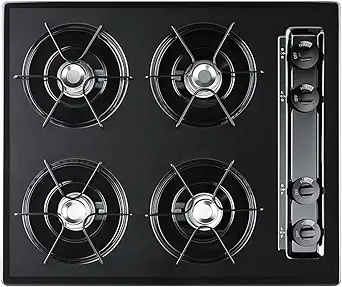
Aesthetic and industrial design considerations further delineate these two brands, reflecting their targeted end-users. Ramblewood designs adhere to a utilitarian, functionalist template, typically combining brushed stainless steel or standard black tempered ceramic glass with utilitarian plastic or basic alloy knobs. The structural chassis is sturdy yet plain, engineered primarily to slide securely into cutouts with minimal visual fanfare. While their compact two- and four-burner layouts integrate neatly into modern minimalist cabinetry, the overall finish of the bezels, trim, and graphics leans purely industrial rather than upscale.
Summit places significantly higher emphasis on architectural integration and premium tactile finishes. Many Summit cooktops feature frameless ceramic EuroKera glass surfaces, seamless laser-welded stainless steel perimeters, and weighted metal control knobs that provide satisfying tactile resistance. Furthermore, Summit excels in offering specialized form factors—including slim 12-inch, 20-inch, and 24-inch profiles with unique vertical or horizontal orientations—that allow interior designers and cabinetmakers to maximize counter space without aesthetic compromise. The resulting fit and finish of a Summit unit creates a distinctly integrated, upscale presentation that easily complements high-end contemporary kitchen aesthetics.