KitchenAid vs Summit: Overview
Comparing KitchenAid and Summit helps you determine which brand is best suited for your needs in Cooktops. Both brands offer strong choices depending on your budget and key feature requirements.
Key Features & Comparison
Evaluate factors such as build quality, warranty, customer satisfaction, and total value before making your final purchase choice between KitchenAid and Summit.
Features
KitchenAid cooktops are engineered with consumer-centric features designed to elevate home culinary technique. Across their gas, radiant electric, and induction lineups, KitchenAid incorporates sophisticated feature sets such as Even-Heat™ technology, dual-ring or multi-tier burners, dedicated melt caps, and integrated downdraft ventilation options on select models. Their induction cooktops boast automated sensor functions, pan-detection sensors, and bridge elements that connect heating zones for griddles. Furthermore, KitchenAid's gas appliances routinely offer scratch-resistant CookShield finishes and dishwasher-safe cast-iron grates that simplify maintenance while enhancing longevity.
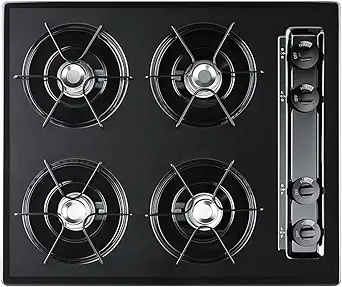
Summit approaches features with a focus on code compliance, safety, and flexible installation rather than gourmet frills. While their catalog covers gas, radiant, solid disk, and induction, the feature sets are fundamentally utilitarian. Summit models frequently highlight push-to-turn safety knobs, thermocouple flame failure protection (vital for multi-family housing), digital timers, and ADA-compliant front-mounted controls across standard, 12-inch, and 24-inch chassis. While you will rarely find smart connectivity or advanced multi-ring power burners on a Summit, you will find practical capabilities like low-amperage 115V operations and smooth ceramic glass tops engineered to withstand rigorous tenant or institutional use.
Performance
In terms of thermal performance, KitchenAid stands out with wider dynamic ranges in both high-heat searing and delicate simmering. KitchenAid gas cooktops frequently deliver power burners rated up to 20,000 BTUs, capable of rapid boiling and high-heat wok cooking, paired with precise low-output simmer burners rated down to 5,000 BTUs with diffusion caps that prevent delicate sauces from scorching. Their induction models utilize responsive electromagnetic coils that provide instantaneous temperature adjustments, high-output boost settings, and continuous low-frequency output that eliminates the cycling on and off common in lower-tier units.
Summit cooktops prioritize steady, reliable thermal delivery calibrated to lower power envelopes. Gas burners on Summit units generally peak between 9,000 and 12,000 BTUs, which is sufficient for daily home cooking but falls short for heavy-duty searing or high-volume boiling. On their electric and induction models, heating elements deliver consistent baseline temperatures, though rapid-boil capabilities lag behind KitchenAid. Where Summit’s performance shines is in its electrical tolerance and efficiency; their induction units offer impressive thermal conversion rates within restricted electrical service limits, making them formidable performers in studio apartments or off-grid builds where high-draw appliances cannot be accommodated.
Design
KitchenAid adopts a professional, architectural design language characterized by substantial physical presence. Their cooktops showcase brushed stainless steel surfaces, heavy cast-metal knobs with etched cross-hatch texturing, and full-width, low-profile continuous grates that allow heavy cookware to slide effortlessly between burners. Glass cooktops from KitchenAid feature beveled edges or stainless trim accents, reflecting an aesthetic meant to seamlessly harmonize with other high-end kitchen appliances. The overarching build quality conveys mass, durability, and a restaurant-inspired aesthetic tailored for the domestic showcase kitchen.
Summit prioritizes functional minimalism, compact geometry, and installation versatility. Their product lineup includes an unmatched array of widths—from ultra-narrow 12-inch and 15-inch domino units to 20-inch, 24-inch, and standard sizes—often with shallow chassis depths designed to fit over under-counter refrigerators or European-style cabinetry. Aesthetically, Summit favors utilitarian brushed stainless or basic black and white tempered glass, paired with plastic or lightweight metal controls. While Summit lacks the heavy-gauge luxury feel and seamless continuous grates of KitchenAid, its clean, space-maximizing silhouettes and ADA-friendly form factors solve architectural constraints that KitchenAid simply cannot address.