Nanit vs HelloBaby: Overview
Comparing Nanit and HelloBaby helps you determine which brand is best suited for your needs in Baby Monitors. Both brands offer strong choices depending on your budget and key feature requirements.
Key Features & Comparison
Evaluate factors such as build quality, warranty, customer satisfaction, and total value before making your final purchase choice between Nanit and HelloBaby.
Features
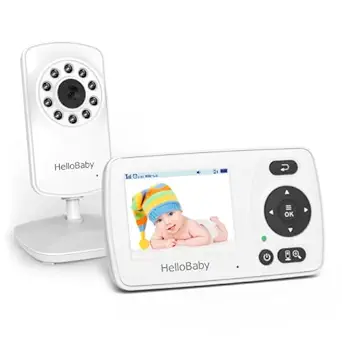
HelloBaby's feature suite is intentionally utilitarian, focusing on the fundamental requirements of nursery oversight. Across popular models like the HB65 or HB6550, users receive essential functions such as remote pan-tilt-zoom (PTZ), two-way audio talkback, pre-programmed lullabies, and ambient room temperature alerts. The feature set is strictly hardware-bound and localized; what you see on the dedicated parent unit is the entirety of the experience. It does not archive footage, track sleep trends, or integrate with smart home platforms, which minimizes cognitive load and technical friction for parents who just want to keep an eye on their sleeping child.
In stark contrast, Nanit boasts one of the most sophisticated feature profiles in consumer nursery electronics, headlined by sensor-free Breathing Motion Monitoring. By pairing specialized fabric patterns on swaddles and sleep sacks with its overhead optical camera, Nanit tracks respiratory movement without wearable electronics touching the infant. Beyond real-time video, the Nanit ecosystem generates detailed sleep hygiene reports, automated milestone time-lapse videos, temperature and humidity tracking, and customizable alerts based on whether an adult is attending to the crib. This feature disparity underscores the core divergence: HelloBaby offers functional real-time surveillance, whereas Nanit delivers predictive and analytical health metrics.
Performance
From a transmission and latency perspective, HelloBaby demonstrates remarkable reliability within its operational constraints. Utilizing frequency-hopping spread spectrum (FHSS) technology, it delivers a virtually lag-free video and audio feed to the handheld monitor with zero reliance on broadband speed or home router stability. However, its visual fidelity is standard definition or modest high definition, with night vision that is effective for basic posture checks but lacks the crisp edge-detection needed for subtle infant cues. Range can also be limited by thick structural walls, sometimes resulting in signal degradation or dropouts across large, multi-story residences.
Nanit’s performance is anchored in high-definition optics and modern wireless networking, streaming crisp 1080p video with exceptional daylight clarity and infrared night performance that illuminates the entire crib floor evenly. Because Nanit streams via local Wi-Fi when your smartphone is on the same network, internal latency is minimal, but remote streaming depends heavily on cloud infrastructure and your internet service provider's upload bandwidth. In scenarios where internet service fails, Nanit can maintain a local Wi-Fi stream, but parents without a dedicated handheld monitor must rely on their smartphones, meaning background audio and app management can drain mobile device battery life faster than HelloBaby's self-contained system.
Design
HelloBaby's industrial design is straightforward, functional, and durable, constructed predominantly from impact-resistant matte and gloss plastics. The camera units are compact and typically designed for tabletop placement or standard screw-in wall mounting, while the parent units prioritize physical tactile controls—buttons for volume, menu navigation, and camera adjustment that are easy to operate in a pitch-black room by muscle memory alone. While the aesthetics lean somewhat dated and toy-like compared to modern smart home gear, the robust physical construction ensures both the camera and the portable receiver can withstand everyday drops and nursery wear-and-tear.
Nanit, on the other hand, exhibits an ultra-modern, minimalist design language that blends seamlessly into high-end nursery decor. Its signature overhead bird's-eye view is achieved through meticulously engineered mounting hardware, including an integrated wall-mount with hidden cable-management channels or a multi-stand floor system with an impact-absorbing base. The camera itself—the Nanit Pro—features a sleek, puck-like chassis with an integrated ambient nightlight directed toward the ceiling to avoid shining in the baby's eyes. Nanit’s design is an exercise in premium architectural integration, contrasting sharply with HelloBaby's utilitarian, portable-appliance approach.