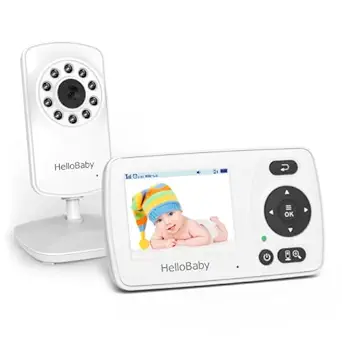








BabySense vs HelloBaby: Overview & Brand Philosophy
In the non-Wi-Fi baby monitor landscape, BabySense and HelloBaby stand as two of the most popular and trusted brands. As consumer awareness around digital privacy has surged, both manufacturers have capitalized on the demand for closed-circuit, Frequency-Hopping Spread Spectrum (FHSS) technology. This wireless protocol ensures that video feeds remain entirely secure from external internet threats, providing parents with immediate, zero-lag peace of mind without reliance on home Wi-Fi networks.
BabySense (developed by Hisense Ltd.) possesses an extensive heritage steeped in medically oriented infant care. The company first rose to prominence through its clinically tested under-mattress breathing movement monitors, bringing a distinctly medical and safety-first philosophy to the commercial baby monitor market. BabySense positions itself as a higher-tier innovator, focusing on high-definition video clarity, split-screen multi-camera functionality, integrated night lights, and robust hardware designed to withstand several years of developmental transitions.
Conversely, HelloBaby built its reputation as an agile, value-forward direct-to-consumer brand. HelloBaby's mission revolves around removing cost barriers while maintaining essential safety features. Rather than competing directly with luxury features or high-end aesthetic designs, HelloBaby optimizes the core basics: rapid plug-and-play setup, respectable video feeds, reliable signal range, and durable, drop-resistant parent units. For budget-conscious parents, HelloBaby represents an accessible entry point into dedicated video monitoring.
Key Differences & Technological Comparison
While both brands operate predominantly on 2.4GHz FHSS wireless transmission, their architectural executions and user experiences diverge significantly across display hardware, camera mechanics, and audio monitoring.
Display and Resolution: BabySense typically leads in display quality, with flagship models (such as the V43 and MaxView) featuring larger screens ranging from 4.3 to 5.5 inches in crisp 720p or 1080p Full HD resolutions. Their displays offer superior color accuracy during daytime use and high-contrast infrared capture at night. HelloBaby monitors (such as the popular HB65 and HB6550) favor more compact forms, generally offering 3.2 to 5.0-inch LCD screens running at standard definition (480p) or entry-level HD. While HelloBaby provides adequate detail to verify if a child's eyes are open or closed, BabySense delivers significantly sharper visual fidelity with less digital noise in low light.
Camera Articulation and Motorization: Both manufacturers feature motorized Pan-Tilt-Zoom (PTZ) cameras in their mid-to-high tiers, yet the mechanical performance differs. BabySense utilizes quiet, micro-stepper motors that minimize audible mechanical humming during movement, which prevents waking light sleepers. HelloBaby's motorized adjustments are responsive but produce a slightly higher acoustic profile. Additionally, BabySense models often feature an ultra-wide pan angle (up to 360 degrees) and wider-angle lenses, requiring less physical repositioning compared to HelloBaby's narrower field of view.
Audio Architecture & Sound Activation (VOX): Sound detection and battery conservation are central to non-Wi-Fi units. HelloBaby utilizes a straightforward Sound-Activated (VOX) system with adjustable sensitivity; however, users frequently note that the threshold can occasionally trigger false alarms from ambient white noise machines. BabySense employs a more refined audio filtering protocol that better isolates sudden, sharp infant cries from steady background static, ensuring the parent unit display only wakes when legitimate attention is needed.
Pros & Cons Comparison
BabySense Pros
- Superior display quality with high-definition panels (up to 1080p) and wide viewing angles.
- Advanced split-screen and quad-screen monitoring capabilities with seamless audio cycling.
- Refined pan/tilt motors operate almost silently inside the nursery.
- High-capacity batteries in parent units ensure longer operation in continuous-video mode.
- Enhanced ambient features, including multi-color night lights and pre-loaded lullabies.
BabySense Cons
- Higher upfront price point across all model tiers.
- Parent units are slightly bulkier, making them less pocket-friendly.
HelloBaby Pros
- Exceptional price-to-performance ratio, making it an affordable primary or travel monitor.
- Compact, lightweight parent units that are easy to carry around the home.
- Intuitive, streamlined button layouts requiring practically zero learning curve.
- Strong, stable 2.4GHz transmission range that penetrates drywall effectively.
HelloBaby Cons
- Lower native screen resolutions result in pixelation when using digital zoom.
- Night vision feeds can appear washed out or grainy compared to premium rivals.
- VOX mode sensitivity can struggle to differentiate between ambient white noise and quiet fussing.
Performance, Durability & Value Analysis
From an operational standpoint, both brands offer reliable hardware capable of surviving standard household wear. BabySense's build quality feels distinctly denser, utilizing thicker ABS plastics and reinforced kickstands on the parent unit. Its internal rechargeable batteries typically maintain operational integrity through extended charge cycles, retaining viable wireless use for two to three years. HelloBaby uses lighter-weight enclosures that, while surprisingly resilient against accidental drops, feel less premium to the touch. HelloBaby units can also experience faster battery degradation over time, often requiring parents to keep the monitor plugged into its AC adapter after 12 to 18 months of rigorous daily use.
When assessing overall consumer value, HelloBaby wins decisively for those looking strictly at functional utility per dollar spent. It reliably delivers two-way talk, temperature readouts, and night vision at nearly half the cost of flagship BabySense configurations. However, BabySense provides greater experiential value. Its smoother user interface, expansive screen real estate, split-screen multi-room scaling, and superior visual clarity mitigate the daily frustrations of visual artifacts and false audio alerts, justifying its premium pricing for long-term use.
Final Verdict: Which Brand Should You Choose?
The choice between BabySense and HelloBaby comes down to budget constraints versus visual fidelity and multi-room longevity.
Choose BabySense if: You prioritize crystal-clear HD video quality, intend to monitor multiple rooms or siblings on a single split-screen parent display, or demand virtually silent camera articulation that won't disrupt a light-sleeping infant. It is the superior long-term investment for growing families willing to pay for premium build quality and advanced feature integration.
Choose HelloBaby if: You are seeking a dependable, budget-conscious monitor that covers every functional essential without breaking the bank. It is the ideal choice for parents seeking an affordable, secure non-Wi-Fi monitor for everyday home use, travel, or placement in a caregiver or grandparent's home.
Features
When evaluating the functional landscape of non-Wi-Fi baby monitors, BabySense and HelloBaby approach feature integration from distinct operational philosophies. BabySense engineers its systems with a clinical, safety-first mindset, prioritizing robust hardware capabilities designed for high-stress monitoring environments. Its flagship models, such as the V43 and MaxView, frequently incorporate dual-camera split-screen functionality, expansive 1080p pan-tilt-zoom (PTZ) optics, and an ecosystem that natively integrates with medical-grade sensor pads for movement tracking. Conversely, HelloBaby focuses on high-utility consumer convenience, packing essential monitoring elements into compact, accessible hardware. HelloBaby units typically excel in everyday baseline features—featuring responsive two-way audio, ambient temperature detection, and automated infrared night vision—delivering an agile feature set that eliminates configuration friction for parents seeking straightforward plug-and-play operation.
The technical trade-offs between the two brands become apparent when scrutinizing advanced monitoring tools, user customizability, and processing overhead. BabySense holds a decided advantage in video flexibility, offering micro-level adjustments such as 4x digital zoom, wide-angle lens attachments, and intelligent VOX (Voice Operated Exchange) sensitivity controls with distinct audio-only sleep modes that preserve battery without sacrificing alert thresholds. In contrast, HelloBaby simplifies its signal processing, resulting in lower power draw and reliable, instantaneous latency over proprietary 2.4GHz FHSS frequencies, though this comes at the expense of optical fidelity and screen real estate. While HelloBaby's motorized PTZ models like the HB6550 provide generous tilt axes and automated lullabies, their digital zoom tends to introduce noticeable pixelation and their temperature sensors often lack the granular calibration margins found in BabySense units.
Ultimately, the practical choice regarding feature sets depends on the user's demand for advanced environmental awareness versus streamlined, utilitarian dependability. BabySense represents the superior technical solution for multi-child nurseries or parents requiring expansive viewing angles, split-screen concurrency, and breathing-movement integration, justifying its steeper learning curve and higher battery consumption. HelloBaby remains the pragmatic choice for single-room coverage, offering a reliable, highly optimized core toolset—reliable thermal alerts, functional pan-and-tilt, and crisp two-way talkback—without overloading the user interface with clinical-grade redundancies.
Performance
When evaluating core performance in the baby monitor category, BabySense and HelloBaby diverge noticeably in signal stability, audio fidelity, and video processing. BabySense typically targets the premium-to-mid tier with superior RF engineering, utilizing advanced 2.4GHz FHSS (Frequency Hopping Spread Spectrum) technology that provides a remarkably resilient, hack-free connection through dense walls and multiple levels of a home. In real-world performance metrics, BabySense monitors exhibit virtually imperceptible latency and maintain an uninterrupted link with minimal frame-rate drops. HelloBaby, while also relying on 2.4GHz FHSS wireless transmission, is optimized for budget-conscious parents. Its hardware is engineered for practicality, but it operates with a narrower signal margin; it can be more susceptible to RF interference from household Wi-Fi routers and microwaves, which periodically manifests as micro-stutters or brief signal dropouts at maximum ranges.
The disparity in performance extends decisively to sensory capabilities—specifically optical clarity and low-light rendering. BabySense models generally incorporate higher-grade CMOS image sensors paired with adaptive infrared arrays, delivering exceptional night vision that balances contrast and eliminates the common "whiteout" glare on a child’s face. Furthermore, BabySense excels in its audio responsiveness, featuring sensitive microphones backed by intelligent ambient noise suppression that filters out background white noise (such as humidifiers or sleep sound machines) while instantly alerting parents to vocal distress. Conversely, HelloBaby delivers a respectable yet visibly more compressed video feed. Its daytime dynamic range is solid, but the infrared night vision lacks depth of field and sharpness in larger nurseries, frequently resulting in a grainier image. Its microphones are capable but lack refined filtering, meaning high-frequency background hums are often transmitted continuously along with the baby's cries.
From a practical trade-off perspective, BabySense delivers high-reliability performance and robust technical execution at the cost of higher battery consumption and a steeper retail price point. The monitor units often feature split-screen or multi-camera cycling that stresses system memory, occasionally leading to shorter parent-unit battery life during continuous streaming. HelloBaby compromises on raw audiovisual refinement and extreme-range signal resilience, but compensates with remarkable operational efficiency. Because its underlying processing demands are lower, HelloBaby parent units routinely offer exceptional battery longevity and straightforward, low-heat performance. Ultimately, for parents demanding uncompromised video resolution, sophisticated audio thresholding, and bulletproof connectivity across sprawling floor plans, BabySense is the superior technical performer, whereas HelloBaby remains a competent, high-value alternative suited for smaller living spaces.
Design
When evaluating the design philosophy of BabySense versus HelloBaby, the divergence in engineering quality and aesthetic intention is immediately apparent. BabySense adopts a modern, high-tier consumer electronics approach, featuring nursery units and parent monitors characterized by sleek silhouettes, premium matte plastics, and minimalist profiles. Their parent units frequently feature oversized screens—often reaching five to five-and-a-half inches—integrated into slim, pocket-friendly chassis with intuitive tactile buttons and balanced kickstands. In contrast, HelloBaby leans into utilitarian durability and budget-conscious pragmatism. Its hardware typically features smaller, chunkier form factors with pronounced rubberized grips and raised physical buttons designed for rapid, muscle-memory navigation in dark rooms. While HelloBaby units lack the contemporary, polished elegance of BabySense, they exhibit an exceptionally rugged, drop-resistant build that appeals to parents prioritizing physical resilience over high-end aesthetics.
From an architectural and functional design standpoint, both brands navigate the technical integration of non-Wi-Fi, 2.4GHz FHSS wireless hardware effectively, though with distinct operational trade-offs. BabySense excels in its pan-tilt-zoom (PTZ) motor engineering, delivering whisper-quiet articulation that minimizes the risk of waking light-sleeping infants during camera adjustments. Furthermore, BabySense often incorporates multi-color adjustable nightlights and white-noise sound modules directly into the base of the camera unit, consolidating multiple nursery devices into a single streamlined footprint. HelloBaby opts for mechanical simplicity; while its flagship models offer motorized PTZ, the movement can be slightly more audible, and budget variants often rely on manual adjustment hinges. However, HelloBaby designs prioritize thermal efficiency and battery optimization, keeping the parent unit cooler during prolonged continuous transmission and enabling simpler, direct-access interface designs that eliminate nested menu navigation.
Ultimately, the practical trade-offs regarding design center on the balance between modern sophistication and no-frills dependability. BabySense designs cater to the contemporary parent who values large, high-definition display acreage, unobtrusive camera aesthetics that blend seamlessly into modern nursery decor, and advanced ergonomic features like split-screen multi-camera monitoring. HelloBaby targets parents seeking uncomplicated ergonomics, featuring compact parent units that are easily portable throughout the house, highly visible LED-based sound alerts, and an uncomplicated button-forward interface. While BabySense wins on engineering finesse, visual appeal, and display real estate, HelloBaby offers a hard-wearing, straightforward design that excels in raw practicality and unpretentious durability.