Arlo vs Papalook: Overview
Comparing Arlo and Papalook helps you determine which brand is best suited for your needs in Baby Monitors. Both brands offer strong choices depending on your budget and key feature requirements.
Key Features & Comparison
Evaluate factors such as build quality, warranty, customer satisfaction, and total value before making your final purchase choice between Arlo and Papalook.
Features
From a feature architecture standpoint, Arlo leads in intelligent computational analysis and cross-platform flexibility. The ecosystem provides high-resolution imaging often exceeding standard 1080p, complemented by granular motion and audio detection algorithms that can distinguish between a crying infant and ambient household sounds. Advanced telemetry includes integrated environmental sensors measuring ambient room temperature, volatile organic compounds (VOCs), and humidity levels. Furthermore, features such as customized night-lights, lullaby scheduling, geofencing, and multi-user remote access through native mobile apps transform the camera into a holistic nursery management hub rather than a simple visual feed.
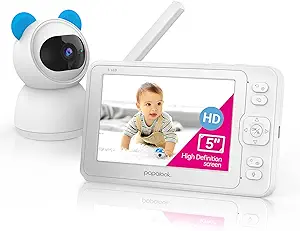
Papalook focuses on practical, dedicated hardware utilities that streamline immediate bedside interactions. Rather than relying on smartphone notifications, Papalook incorporates a dedicated parent unit with a physical LCD screen, tactile pan-tilt-zoom (PTZ) directional controls, and instantaneous physical volume toggles. Standard functionality centers around automated infrared night vision, bidirectional push-to-talk audio, basic temperature threshold alarms, and internal lullaby loops stored locally on the camera hardware. While it lacks the cloud recording history, smart-home routines, and AI classification found in Arlo's suite, Papalook eliminates notification fatigue and app dependency through rapid, unmediated physical access to essential nursery data.
Performance
Performance metrics reveal distinct operational strengths between the two brands. Arlo delivers market-leading optical fidelity, characterized by wide dynamic range (WDR), superior low-light color rendition, and expansive fields of view that minimize optical blind spots. However, its overall performance is inextricably linked to local network health; external internet outages, Wi-Fi latency, or bandwidth throttling can result in dropped connections, buffering, or delayed push notifications to smartphones. For users with enterprise-grade mesh Wi-Fi setups, Arlo offers unprecedented clarity and seamless off-site streaming, but network volatility remains an inherent vulnerability.
Papalook, on the other hand, excels in raw connectivity stability and real-time responsiveness within the home. Utilizing direct 2.4GHz FHSS radio frequency bands, the dedicated parent monitor experiences near-zero audio and video latency, ensuring that cries and distress calls are transmitted instantaneously without digital lag. The dedicated monitor provides continuous, always-on audio streaming that does not time out like mobile operating systems often do to preserve battery. While the physical range is bounded by home structural obstacles and lacks out-of-home accessibility, Papalook delivers an uncompromised, localized link that remains functional regardless of broadband ISP failures or wireless router resets.
Design
The industrial design of Arlo products reflects modern, minimalist consumer electronics conventions. Featuring smooth, curvilinear enclosures with premium matte or gloss polymers, Arlo cameras blend seamlessly into contemporary home decor. Many units, such as the classic Arlo Baby, included playful modular silicone covers like bunny or puppy ears, allowing parents to soften the aesthetic impact of a security camera in a nursery. Internally, the engineering emphasizes robust heat dissipation for continuous high-resolution processing, alongside versatile magnetic mounting systems and multi-axis articulation that allow for precise, non-invasive placement on walls, shelves, or crib perimeters.
Papalook adopts a utilitarian, child-centric form factor engineered for physical durability and parental ergonomics. The camera units are typically bulbous and robust, designed with mechanical motorized pan-tilt bases that physically traverse horizontal and vertical planes to follow an active toddler. The handheld parent receiver prioritizes utility over sheer slimness, featuring tactile buttons, high-visibility LED noise indicators, kickstands, and drop-resistant casing designed to withstand the inevitable accidents of daily nursery use. While Papalook's aesthetic lacks the refined minimalism of Arlo's connected hardware, its ergonomic design is tailored directly to sleep-deprived navigation in low-light environments.