Yamaha vs Pyle: Overview
Comparing Yamaha and Pyle helps you determine which brand is best suited for your needs in AV Receivers. Both brands offer strong choices depending on your budget and key feature requirements.
Key Features & Comparison
Evaluate factors such as build quality, warranty, customer satisfaction, and total value before making your final purchase choice between Yamaha and Pyle.
Product Selection
Yamaha boasts an extensive, meticulously tiered product lineup that spans from entry-level surround systems to ultra-high-end audiophile architectures. Their catalog is organized into dedicated families, primarily the mainstream RX-V series and the premium Aventage RX-A series. Within these lines, buyers can find 5.2-channel basic configurations all the way up to complex 11.2-channel flagship processors equipped with XLR balanced pre-outs, advanced multi-zone capabilities, and the latest HDMI 2.1 specifications supporting 8K/60Hz and 4K/120Hz pass-through. This broad segmentation allows Yamaha to address casual living room setups, dedicated home theaters, and custom-installed smart home ecosystems with tailored software integration like their MusicCast wireless multi-room platform.
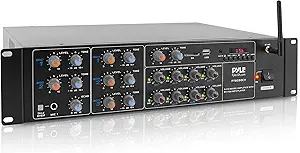
In contrast, Pyle approaches product selection with a broad, utility-focused assortment that targets budget-conscious consumers, small commercial spaces, and mobile or garage setups. Pyle’s catalog consists largely of compact stereo amplifiers, karaoke-oriented multi-channel receivers, and basic surround processors. While Pyle offers a high quantity of model variants, these units often repackage similar fundamental circuit boards and internal amplifier topologies with minor cosmetic or feature tweaks, such as varying front-panel microphone inputs, integrated FM tuners, or Bluetooth versions. Pyle lacks modern immersive audio processing options such as Dolby Atmos or DTS:X, making their lineup diverse in terms of utilitarian and PA-hybrid applications, but fundamentally absent from modern, high-spec home theater spaces.
Affordability
Most affordable brands





Pyle is virtually unrivaled when it comes to raw, entry-level affordability, serving an audience for whom low price is the driving purchasing criteria. A multi-channel Pyle receiver with integrated Bluetooth, digital inputs, and high-wattage claims can often be acquired for a fraction of the cost of a basic brand-name unit. For consumers looking to power secondary zones, patio speakers, or simple karaoke rigs without investing hundreds of dollars, Pyle provides a fully functional, self-contained solution. However, this aggressive cost reduction is achieved through the use of inexpensive power transformers, basic operational amplifiers, thin-gauge sheet metal, and minimal licensing of proprietary audio decoders.
Yamaha operates at a significantly higher initial price point, reflecting the substantial engineering overhead, proprietary software development, and formal industry licensing fees associated with modern AV standards. Even Yamaha’s most accessible entry-level models retail well above Pyle’s standard pricing ceiling. Despite this higher upfront cost, Yamaha offers strong value retention and cost-per-feature efficiency when viewed through an authentic home cinema lens. Consumers are paying for discrete amplification, calibrated dynamic headroom, ongoing firmware maintenance, and certified compliance with copy-protection standards like HDCP 2.3, which are critical for longevity and long-term hardware compatibility.
Quality/Durability
Yamaha’s engineering ethos emphasizes structural rigidity, thermal efficiency, and component-level reliability across its entire AV receiver family. In their mid-to-high-end Aventage series, this philosophy culminates in specialized resonance-control measures, such as an Anti-Resonance Technology (A.R.T.) wedge centered beneath the chassis to dampen mechanical vibrations from the power transformer and cooling fins. Yamaha relies on custom-designed toroidal or heavy-duty EI power transformers, oversized reservoir capacitors, and discrete output transistors mounted to extruded aluminum heatsinks. This rigorous electrical engineering ensures that Yamaha receivers can handle prolonged thermal stress and dynamic impedance drops down to 4 ohms with minimal risk of premature failure or thermal shutdown.
Pyle, by comparison, utilizes lightweight, mass-produced chassis builds with generic internal topologies that often cut corners on thermal management and component tolerance. Many Pyle units rely on passive cooling stamped from low-grade metals or loud, low-cost internal fans that can introduce audible noise into the listening environment. Solder joints, potentiometer tactile feel, and speaker binding posts—frequently using spring clips rather than heavy five-way posts—reflect standard budget manufacturing. While a Pyle receiver can provide dependable service when operated well within its continuous limits, running these units near their advertised maximum capabilities frequently leads to thermal distress, elevated noise floors, and higher rates of early component failure.
Reputation
Yamaha holds a venerable, top-tier reputation in the consumer and professional audio industries, established through decades of high-fidelity acoustic design, instrument manufacturing, and continuous DSP innovation. Revered alongside traditional hi-fi titans, Yamaha is known for engineering rock-solid network stability, reliable hardware interfaces, and sophisticated room calibration protocols. Audiophiles, custom installers, and home theater enthusiasts view Yamaha as a gold-standard benchmark for reliability and high-value performance, frequently citing its transparent, low-distortion presentation and reliable after-sale customer support as reasons for brand loyalty.
Pyle operates with a distinctly utilitarian reputation within the marketplace, regarded primarily as an accessible brand for budget-friendly pro-audio, public address, and rudimentary home audio equipment. Connoisseurs and home theater installers do not typically consider Pyle when building dedicated audio-video systems, largely due to the brand's practice of marketing inflated peak wattage ratings (PMPO) rather than verified RMS power into rated loads. While Pyle enjoys praise among everyday consumers who need simple, affordable amplification for a basement, warehouse, or recreational gathering, its brand identity does not carry prestige among discerning audiophiles or AV enthusiasts.
Sound Quality
Yamaha's sound signature is celebrated for its acoustic clarity, neutrality, and expansive spatial reproduction. Leveraging high-grade digital-to-analog converters from ESS Sabre or Burr-Brown, Yamaha receivers achieve exceptional signal-to-noise ratios, deep channel separation, and remarkably low total harmonic distortion across the entire audible spectrum. The company’s proprietary YPAO (Yamaha Parametric Room Acoustic Optimizer) calibration system actively measures listening environments to correct for standing waves, reflections, and phase anomalies. Furthermore, Yamaha's proprietary Cinema DSP algorithms realistically model the sonic architecture of famous concert halls and theaters, delivering an immersive, three-dimensional soundstage with authoritative bass control and articulate high-frequency detail.
Pyle delivers a functional acoustic experience that struggles to compete with modern high-fidelity standards. Its amplifier circuits exhibit noticeably higher total harmonic distortion (THD) and an audible background noise floor, often manifesting as low-level hum or hiss at elevated volumes. The overall frequency response is comparatively flat and unrefined, with less separation between midrange instruments and a tendency for high frequencies to sound harsh or compressed during complex musical passages. Lacking sophisticated digital acoustic calibration, a Pyle receiver cannot adapt to room dynamics, resulting in an uncorrected soundstage that works well for casual background audio or vocal projection, but lacks the nuanced dynamics and micro-detail essential for immersive cinematic playback.
Compare current retail pricing, active promotions, and verified stock availability directly from authorized stores:
Compare current retail pricing, active promotions, and verified stock availability directly from authorized stores: