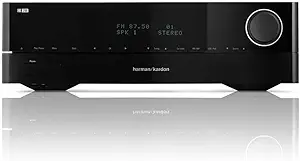
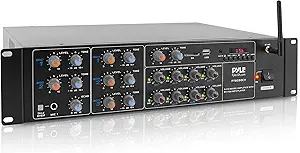
Pyle vs Harman Kardon: Overview
Comparing Pyle and Harman Kardon helps you determine which brand is best suited for your needs in AV Receivers. Both brands offer strong choices depending on your budget and key feature requirements.
Key Features & Comparison
Evaluate factors such as build quality, warranty, customer satisfaction, and total value before making your final purchase choice between Pyle and Harman Kardon.
Product Selection
When examining product selection, Pyle and Harman Kardon adopt radically different portfolio strategies tailored to distinct market segments. Pyle offers an extensive, highly diversified catalog of budget-friendly AV receivers and multi-zone hybrid amplifiers. Their lineup is packed with practical features aimed at entry-level home theater enthusiasts, commercial installations, and hobbyists. Pyle's units frequently integrate functional extras that traditional audiophile brands overlook, such as dual 1/4-inch microphone inputs with independent echo controls for karaoke, integrated front-panel USB/SD card readers, and basic FM tuners alongside multichannel switching. This shotgun approach ensures that consumers seeking a swiss-army-knife device for casual living rooms, workshops, or light commercial settings have an abundance of hybrid form factors and channel configurations to choose from.
Conversely, Harman Kardon maintains a focused, boutique-style product lineup that prioritizes specialized, high-fidelity performance over sheer SKU volume. Historically celebrated for classic multichannel powerhouse AVRs, Harman Kardon's modern selection has pivoted primarily toward high-end, elegant stereo networked receivers and minimalist, digital-first surround platforms like the Citation series. Rather than cluttering their units with utilitarian add-ons, Harman Kardon curates hardware around seamless streaming ecosystems, integrating technologies like Apple AirPlay, Chromecast built-in, and multi-room networked audio. While Harman Kardon offers substantially fewer discrete AV receiver models than Pyle, their catalog represents a deliberate, design-forward offering engineered for audiophiles and premium home cinema environments where cohesive industrial design and state-of-the-art digital audio processing are paramount.
Affordability
Most affordable brands





In terms of affordability, Pyle represents the absolute entry point of the home audio and multi-channel amplifier market. The brand's design ethos centers on driving down the cost-of-entry, delivering AV receivers and multi-zone units at a fraction of the cost commanded by legacy hi-fi manufacturers. Budget-conscious consumers can acquire high-channel-count hardware, Bluetooth connectivity, and multiple HDMI pass-through inputs for low three-figure price tags. However, this extreme affordability comes with calculated engineering compromises: Pyle relies on cost-efficient Class D or basic linear topologies, off-the-shelf digital-to-analog converters, and utilitarian internal components that minimize retail pricing while maximizing advertised wattage and feature checklists.
Harman Kardon occupies a decidedly premium tier, commanding significantly higher price points that reflect its luxury audio pedigree. While an investment in a Harman Kardon receiver is substantially steeper than a Pyle alternative, the capital expenditure is tied directly to superior internal engineering. Consumers are paying for discrete high-current amplifier stages, heavy-duty toroidal transformers, premium multichannel DACs, and precision-engineered chassis designed to suppress electromagnetic interference. While Pyle wins unequivocally on pure cost-to-feature metrics, Harman Kardon delivers value through acoustic fidelity, refined industrial aesthetics, and platform longevity, representing a luxury purchase rather than an impulse buy for budget-constrained installations.
Quality/Durability
The mechanical build quality and long-term durability of Pyle AV receivers clearly reflect their budget-focused manufacturing parameters. Pyle chassis are generally constructed from lighter gauge stamped sheet metal, accompanied by high-density plastic faceplates and control potentiometers that exhibit noticeable play and lighter resistance. Internally, thermal management relies on budget-tier aluminum heat sinks and aggressive cooling fans that can generate ambient noise during low-volume listening sessions. Component life cycles are built for standard residential duty cycles, meaning intensive continuous operation under high thermal loads can expose the vulnerabilities of lower-cost capacitors and solder joints over extended periods.
In stark contrast, Harman Kardon employs rigorous industrial design standards focused on robust thermal performance and long-term mechanical integrity. Harman Kardon receivers are constructed from heavy-gauge aluminum and steel, offering exceptional structural rigidity and advanced resonance damping. Internally, their high-current capability (HCC) architecture utilizes oversized heat sinks, high-capacity filter capacitors, and meticulously shielded power stages that efficiently dissipate heat without relying on noisy mechanical fans. The tactile feel of Harman Kardon's precision volume encoders, gold-plated speaker binding posts, and premium chassis components conveys durability, ensuring that the receiver can withstand years of demanding high-current dynamic playback without performance degradation.
Reputation
Pyle has forged a reputation among consumer circles as an accessible, high-utility gateway brand that delivers functional, versatile hardware at unbeatable prices. Within the broader consumer electronics and commercial audio market, Pyle is recognized as a dependable problem-solver for budget-conscious projects, school auditoriums, home karaoke setups, and garage systems. However, within dedicated audiophile and high-end home theater communities, Pyle is often perceived critically due to its reliance on peak power ratings rather than conservative continuous RMS metrics, as well as its prioritization of baseline utility over acoustic nuance and premium software support.
Harman Kardon, by comparison, carries legendary prestige backed by over half a century of audio engineering innovation. Founded by Sidney Harman and Bernard Kardon, the brand pioneered iconic high-fidelity milestones, including the world's first integrated high-fidelity receiver. Consequently, Harman Kardon enjoys immense goodwill and respect among seasoned audio enthusiasts, industrial designers, and high-end consumers. The brand is globally renowned for sophisticated Scandinavian-influenced industrial minimalism, honest amplifier wattage ratings backed by high-current delivery, and a legacy tied to the broader Harman International family (now a subsidiary of Samsung), firmly cementing its reputation as a premier audio marque.
Sound Quality
When evaluating acoustic performance, Pyle provides adequate, energetic sound reinforcement that is well-suited for casual media consumption, background music, and vocal amplification. However, from a critical listening perspective, Pyle receivers reveal the limits of budget-tier operational amplifiers and digital signal paths. The overall sound signature tends to lean forward and bright, with a tendency toward audible total harmonic distortion (THD) and thermal compression when driven into higher volume bands. Dynamic headroom is limited, meaning complex musical passages or high-octane cinematic transients can sound somewhat congested, lacking the nuanced separation, soundstage depth, and low-end authority desired by discerning listeners.
Harman Kardon delivers an entirely different acoustic experience defined by wide-bandwidth fidelity, natural instrument timbre, and authoritative low-end control. Thanks to high-current amplification circuitry, Harman Kardon receivers effortlessly drive low-impedance loudspeaker loads with ultra-low distortion, preserving micro-dynamics even at whisper-level volumes. The soundstage is expansively broad, displaying precise instrumental placement, crystalline high frequencies free of harsh sibilance, and tight, articulate bass impact. For high-resolution audio formats and dynamic Hollywood cinematic mixes, Harman Kardon's clean amplification path and sophisticated digital signal processing provide an immersive, reference-grade acoustic environment that Pyle is simply not engineered to achieve.