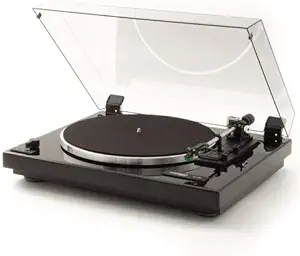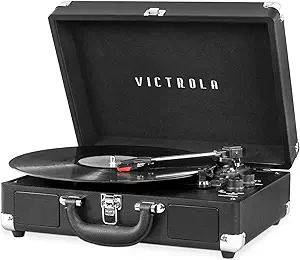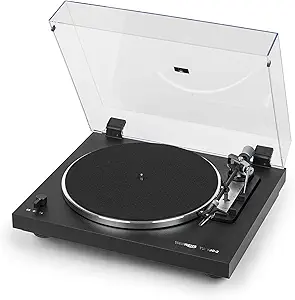






Thorens vs Victrola: Overview
Comparing Thorens and Victrola helps you determine which brand is best suited for your needs in Turntables. Both brands offer strong choices depending on your budget and key feature requirements.
Key Features & Comparison
Evaluate factors such as build quality, warranty, customer satisfaction, and total value before making your final purchase choice between Thorens and Victrola.
Affordability
When examining affordability, Thorens and Victrola occupy polar opposite ends of the audio marketplace. Victrola has built its brand identity around extreme cost accessibility, offering entry-level suitcase models and budget modern decks that often retail for well under one hundred to a few hundred dollars. This low barrier to entry makes Victrola the go-to option for casual listeners, teenagers, and newcomers who want to explore vinyl without making a substantial financial commitment. However, this aggressive pricing strategy relies heavily on mass-produced plastic assemblies, ceramic cartridges, and lightweight components, meaning long-term value is often offset by limited durability and an inevitable upgrade cycle.
In stark contrast, Thorens is a venerable high-end heritage brand whose products represent a serious financial investment. Starting in the upper-hundreds and rapidly ascending into several thousands of dollars, Thorens turntables are engineered for serious audiophiles and connoisseurs. While the initial capital outlay is steep, Thorens justifies its price point through precision Swiss and German engineering, heavyweight non-resonant chassis, solid timber or aluminum plinths, and robust electronic speed controls. Consequently, while Victrola decisively wins on raw, upfront affordability, Thorens delivers far superior long-term asset value, longevity, and heirloom-tier construction that amortizes its high cost over decades of use.
Sound Quality
Sound quality illustrates the clearest technical divergence between these two manufacturers. Victrola turntables, particularly their popular all-in-one and suitcase variants, struggle with fundamental acoustic limitations. Equipped with inexpensive ceramic cartridges, high-tracking-force tonearms, and small integrated speakers housed in the same resonant enclosure as the platter, they are prone to significant wow and flutter, acoustic feedback, and distortion. While Victrola's higher-tier 'Stream' series incorporates higher-grade moving magnet cartridges that dramatically improve performance, the brand's baseline sound remains thin, mid-forward, and acoustically compromised compared to dedicated hi-fi equipment.
Thorens, on the other hand, is an iconic pillar in analog playback renown for near-flawless sonic fidelity. Utilizing precision-machined tonearms, suspended sub-chassis designs, heavy balanced platters, and premium moving-magnet or moving-coil cartridges from manufacturers like Ortofon and Audio-Technica, Thorens decks eliminate mechanical resonance and motor rumble. The resulting sound signature is characterized by profound dynamic range, expansive spatial imaging, deep articulate bass, and pristine high-frequency extension. For listeners prioritizing micro-detail retrieval, pitch stability, and pure analog warmth, Thorens operates in an entirely different acoustic tier than Victrola.
Features & Functionality
In terms of features and modern functionality, Victrola prioritizes digital integration, multi-format versatility, and lifestyle convenience. Many of Victrola's units feature built-in Bluetooth receivers and transmitters, integrated headphone jacks, built-in stereo speakers, and USB encoding capabilities for digitizing vinyl collections. Notably, their modern 'Stream' lineup integrates native 'Works with Sonos' Wi-Fi connectivity, allowing users to stream vinyl wirelessly throughout a multi-room ecosystem without external preamps or messy cabling. This focus on modern connectivity makes Victrola an exceptionally versatile choice for multi-room smart homes and minimalist living spaces.
Conversely, Thorens focuses heavily on purist analog engineering and mechanical functionality rather than digital lifestyle add-ons. The functional architecture of a Thorens deck revolves around mechanical vibration isolation, electronic speed switching (33 1/3, 45, and occasionally 78 RPM), precision anti-skating mechanisms, and dampened tonearm lift controls. While select Thorens models do incorporate high-grade integrated phono preamplifiers or modern electronic auto-shutoff features, the brand intentionally eschews wireless streaming, Bluetooth, or onboard speakers to preserve signal purity and avoid electromagnetic interference. Thus, Victrola wins on lifestyle convenience features, while Thorens excels in purist mechanical functionality.
Ease of Use & Setup Processes
Victrola is virtually unmatched when it comes to out-of-the-box simplicity and plug-and-play operation. The majority of Victrola products require practically zero technical calibration; users simply unbox the unit, plug in the power adapter, release the tonearm transit latch, and drop the stylus onto a record. Because tracking force, anti-skate, and cartridge alignment are permanently pre-set at the factory, novices are spared the intimidating mechanics of analog setup. Even their advanced Wi-Fi-enabled models streamline setup through intuitive companion smartphone apps, making system integration effortless for non-technical users.
Thorens, however, mandates a meticulous, deliberate setup procedure that reflects its high-precision heritage. Operating a Thorens turntable often requires assembling the sub-platter, carefully seating the ground drive belt, adjusting suspended suspension springs, manually balancing counterweights, aligning the phono cartridge using protractors, and dialing in anti-skate bias. Furthermore, Thorens units usually require integration with discrete external phono stages, amplifiers, and dedicated hi-fi speakers. While this demands a steeper learning curve and audio literacy, it also rewards the enthusiast with complete mechanical transparency, modular serviceability, and the ability to fine-tune playback parameters to an exacting degree.