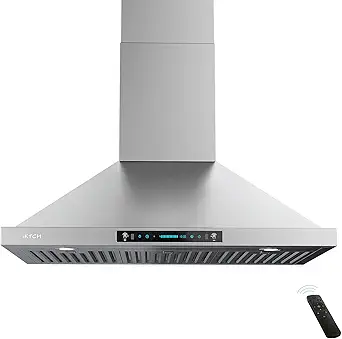
IKTCH vs Zephyr: Overview
Comparing IKTCH and Zephyr helps you determine which brand is best suited for your needs in Range Hoods. Both brands offer strong choices depending on your budget and key feature requirements.
Key Features & Comparison
Evaluate factors such as build quality, warranty, customer satisfaction, and total value before making your final purchase choice between IKTCH and Zephyr.
Features
The technological approach to everyday features highlights the distinct market segments of both manufacturers. IKTCH hoods stand out for their crowd-pleasing, tech-forward feature sets, notably incorporating gesture-sensing controls, high-contrast digital displays, and multi-speed electronic touch panels alongside remote-control functionality. The gesture control allows home cooks to adjust airflow or toggle illumination with a simple wave, effectively keeping messy cooking residue off the stainless-steel surfaces. Combined with energy-efficient LED modules and dishwasher-safe stainless steel baffle filters, IKTCH provides a contemporary, modern user experience that punches above its price class in consumer-facing convenience.
Zephyr approaches features with an emphasis on professional culinary utility, subtle automation, and refined precision rather than digital novelty. Many Zephyr models feature proprietary technologies such as the PowerWave blower system, ACT (Airflow Control Technology) to comply with stringent local makeup air codes, and capacitive touch controls seamlessly integrated into black glass or stainless fascia. Zephyr’s lighting packages often utilize custom dual-level or tri-level LumiLight LEDs, which provide superior color rendering index (CRI) values to illuminate food accurately. While Zephyr may omit gimmicky controls like infrared gesture sensors, its feature architecture focuses heavily on functional longevity, advanced code compliance, and integrated ambient illumination.
Performance
Performance metrics reveal a stark contrast in how air displacement and acoustics are managed between the two brands. IKTCH relies on high-output dual-rotor blowers that frequently post CFM ratings ranging from 900 to over 1000 CFM, providing massive extraction capability capable of handling high-heat searing, wok cooking, and heavy grease production. However, achieving these high CFM thresholds in standard housing configurations often introduces considerable noise, with maximum fan settings generating noticeable sones. While IKTCH undoubtedly moves vast volumes of air to keep smoke and grease particles at bay, the trade-off is often higher operational vibration and noise resonance during prolonged heavy-duty venting.
Zephyr excels in the nuanced balance of aerodynamic efficiency, static pressure management, and acoustic control. Utilizing specialized engineering like the DCBL Suppression System—which employs brushless DC motors—Zephyr achieves powerful air capture while operating at whisper-quiet sound levels that rarely disrupt kitchen conversations. The aerodynamic ducting channels and precision-balanced impellers ensure stable airflow even across complex duct runs, capturing grease and volatile organic compounds (VOCs) with minimal backdraft. For home chefs who prioritize high extraction efficiency without deafening acoustic intrusion, Zephyr’s refined engineering easily justifies its higher price point over IKTCH’s high-power, high-noise output.
Design
Aesthetic refinement and construction integrity define the final visual contrast between IKTCH and Zephyr. IKTCH models adhere to a clean, utilitarian aesthetic that favors commercial-style elements, characterized by brushed 430-grade stainless steel, visible baffle handle assemblies, and prominent front-facing digital control panels. The styling blends effortlessly into most transitional and modern kitchen layouts. However, close inspection reveals thinner gauge steel construction and less aggressive internal edge-smoothing, which reflect the brand’s value-oriented production techniques and cost-effective assembly protocols.
Zephyr treats ventilation hoods as focal architectural elements, collaborating with renowned industrial designers like Robert Cheng to craft sculptural statement pieces across island, wall-mount, and insert configurations. Utilizing heavier-gauge stainless steel, hand-finished seams, and elegant materials such as titanium coatings, hand-blown Italian glass, and invisible seam welding, Zephyr hoods exude luxury craftsmanship. The structural rigidity not only eliminates visual imperfections and rattles but also resists thermal warping over decades of heavy culinary exposure. While IKTCH provides a clean and modern utility hood, Zephyr transforms functional ventilation into elevated kitchen art.