GE vs IKTCH: Overview
Comparing GE and IKTCH helps you determine which brand is best suited for your needs in Range Hoods. Both brands offer strong choices depending on your budget and key feature requirements.
Key Features & Comparison
Evaluate factors such as build quality, warranty, customer satisfaction, and total value before making your final purchase choice between GE and IKTCH.
Features
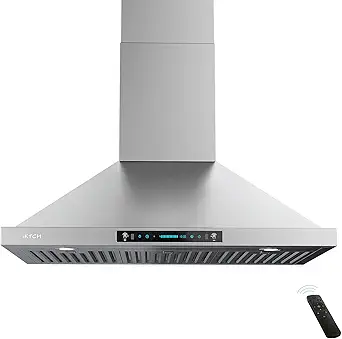
When evaluating the functional capabilities of range hoods, GE and IKTCH represent two distinct approaches to kitchen ventilation engineering: GE prioritizes smart ecosystem integration and proven operational reliability, whereas IKTCH concentrates on high-spec hardware and modern touchless ergonomics at an accessible price point. GE distinguishes itself primarily through its Chef Connect technology and SmartHQ platform, which allow the range hood to sync automatically with compatible cooktops via Bluetooth—activating illumination and exhaust fans the moment a burner is ignited. In contrast, IKTCH foregoes smart-home network integration in favor of immediate, interactive convenience features, most notably its four-speed gesture-sensing activation system and included infrared remote control. This allows home chefs to modulate airflow and lighting with a simple hand wave, preventing grease transfers onto the control panel during messy cooking sessions.
In terms of core extraction mechanics and filtration features, the brands exhibit significant divergence in pneumatic strategy. IKTCH heavily markets raw extraction volume, outfitting many of its residential units with dual-rotor motors capable of generating up to 900 CFM, paired with heavy-gauge, dishwasher-safe stainless steel baffle filters designed to capture heavy grease from high-heat searing and wok cooking. These units also feature a flexible delayed shut-off timer (ranging from 1 to 15 minutes) to clear residual fumes post-cooking. GE takes a more acoustically balanced, nuanced engineering approach. While GE's standard CFM ratings typically hover in the 300 to 600 CFM range—sufficient for the vast majority of residential building codes without requiring costly make-up air dampers—their blowers are calibrated for superior sound dampening across multi-speed configurations. GE also excels in optical versatility, offering dual-level halogen or dimmable LED cooktop lighting and indicator lights that signal exactly when grease filters require cleaning.
The practical trade-offs between the two feature profiles hinge on long-term dependability versus feature density per dollar. IKTCH packs an impressive array of modern conveniences into its units—delivering gesture sensors, digital touch displays, digital clocks, and commercial-grade baffle systems that cater to performance-driven, budget-conscious consumers. However, its gesture sensors can occasionally suffer from hyper-sensitivity or latency, and the brand lacks the interconnected ecosystem maturity of legacy manufacturers. GE, conversely, presents a more polished, durable suite of features backed by rigorous quality control and nationwide service support. While you will pay a premium for GE and sacrifice hands-free gesture control and extreme CFM ceilings, you gain seamless cooktop-sync capabilities, refined acoustic isolation, and superior integration into modern smart kitchens.
Performance
When evaluating performance, GE and IKTCH represent fundamentally divergent philosophies in airflow dynamics and motor engineering. GE approaches ventilation with a focus on balanced volumetric flow and acoustic refinement, generally engineering its mainstream and Profile models around calibrated 250 to 600 CFM blowers. Rather than chasing inflated raw metrics, GE designs its centrifugal blowers to maintain stable static pressure against common duct friction and complex elbow configurations. In contrast, IKTCH prioritizes sheer, brute-force extraction capacity, frequently equipping its residential units with dual-rotor motors delivering up to 900 CFM. For high-heat culinary methods such as stir-frying, wok cooking, or cast-iron searing, IKTCH creates a noticeably stronger negative pressure zone above the cooking surface, evacuating heavy plumes of grease, smoke, and volatile organic compounds with exceptional rapid-capture capability.
The trade-offs of these contrasting technical philosophies become apparent in noise mitigation, filtration design, and control precision. IKTCH utilizes commercial-style, angled stainless steel baffle filters paired with heavy-duty grease collection trays, which excel at separating heavy grease particulates during high-velocity airflow; however, operating these blowers at full throttle inevitably yields substantial acoustic output, often climbing past 65 to 70 decibels (roughly 6 to 8 sones). GE counters this raw approach with heavily dampened internal housing, precision-balanced fan wheels, and superior acoustic tuning that keeps lower and intermediate speeds remarkably quiet for daily simmering. Furthermore, GE integrates performance-enhancing automation into select tiers—such as Chef Connect, which syncs fan speeds via Bluetooth to compatible cooktop heat levels—ensuring extraction is continuously optimized without manual intervention.
Ultimately, your performance preference hinges on specific cooking styles versus everyday livability. IKTCH offers an undeniably powerful extraction envelope at its price point, delivering the aggressive capture rate necessary to protect open-concept floor plans from pervasive odors and grease deposits, albeit with higher auditory fatigue and a reliance on rigid, larger-diameter ducting to realize its full 900 CFM potential. GE delivers a more refined, consistent operational profile backed by decades of thermal management engineering, offering higher motor longevity, superior ductwork adaptability, and quieter operation, making it the more balanced choice for conventional residential kitchens that prioritize acoustic comfort over extreme high-CFM evacuation.
Design
GE approaches range hood design through the lens of cohesive kitchen integration and ergonomic subtlety, whereas IKTCH embraces an unapologetically modern, commercial-industrial aesthetic. GE models—spanning under-cabinet profiles, custom canopy inserts, and sleek glass canopy chimneys—are engineered to blend seamlessly with broader appliance suites. They feature restrained lines, standardized cabinet-depth footprints, and finish options like fingerprint-resistant stainless, slate, and matte black that align with transitional or traditional American cabinetry. Conversely, IKTCH prioritizes high-impact visual drama, emphasizing heavy-gauge brushed stainless steel, sharp architectural angles, and prominent baffle filtration systems that visually evoke a professional culinary workspace, making their units ideal focal points for open-concept, modern kitchen layouts.
The divergence in technical design becomes pronounced in their user interfaces and ambient technologies. IKTCH distinguishes itself with forward-thinking digital integration, outfitting many of its hoods with infrared gesture-sensing controls and four-speed digital touch panels alongside variable-tone LED lighting systems. This touch-free interaction design allows users to adjust airflow or illumination with a hand wave, preventing grease transfer onto the stainless chassis during heavy cooking. GE, conversely, opts for pragmatic ergonomics, relying on flush-mounted mechanical buttons, tactile rotary knobs, or minimalist capacitive glass touchbars depending on the tier. While GE's control systems lack the futuristic novelty of IKTCH’s gesture tech, they provide foolproof mechanical feedback and a cleaner, less visually cluttered control console that avoids the tech-heavy look of digital readouts.
From an engineering execution standpoint, both brands present clear practical trade-offs regarding fit, finish, and maintenance. GE leverages decades of mass-production tooling, resulting in tighter seam tolerances, rolled safety edges on interior sheet metal to prevent lacerations during cleaning, and specialized sound-deadening duct transitions. However, GE’s standard-tier designs frequently employ hybrid aluminum mesh filters that, while dishwasher safe, lack the premium durability of commercial components. IKTCH counters by standardizing heavy-duty stainless steel baffle filters with integrated grease collectors across nearly its entire catalog, enhancing both durability and filtration performance. The trade-off for IKTCH lies in its bold industrial styling and utilitarian sharp lines, which can feel visually aggressive in classic kitchens and occasionally feature intensely bright digital displays that contrast with low-profile ambient lighting schemes.