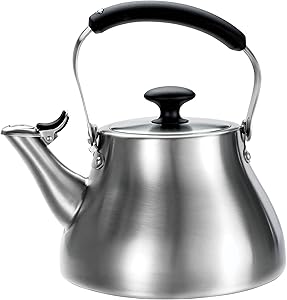
OXO vs Willow & Everett: Overview
Comparing OXO and Willow & Everett helps you determine which brand is best suited for your needs in Kettles. Both brands offer strong choices depending on your budget and key feature requirements.
Key Features & Comparison
Evaluate factors such as build quality, warranty, customer satisfaction, and total value before making your final purchase choice between OXO and Willow & Everett.
Features
From a feature perspective, OXO excels by integrating high-utility, precision-driven components into both its standard and gooseneck electric kettles. Flagship models, such as the OXO Brew Adjustable Temperature Pour-Over Kettle, boast granular single-degree temperature settings ranging from 170°F to 212°F, a responsive digital display with an integrated brew timer, and a dependable 30-minute keep-warm function. Furthermore, OXO integrates thoughtful tactile features, including non-slip silicone bases, counterbalanced handles for strain-free pouring, and built-in cord storage wraps. Even their stovetop whistles are engineered with intuitive, heat-resistant lever systems that allow for one-handed operation, demonstrating the brand's signature ergonomic philosophy.
Willow & Everett offers a more simplified, streamlined feature set focused largely on the fundamental requirements of pour-over brewing. Their electric gooseneck models typically feature preset temperatures or single-switch boiling mechanisms rather than granular, degree-by-degree digital controls, though some modern iterations include basic LED base panels. A signature element found in many Willow & Everett stovetop models is the lid-integrated analog bimetal thermometer, which provides a charming, battery-free way to monitor water temperature, albeit with slower response times and less precision than digital thermistors. While Willow & Everett supplies adequate features for casual brewing, it lacks the advanced programmable automation, rapid memory recall, and specialized pour-spout geometry found throughout OXO's lineup.
Performance
Performance benchmarks reveal distinct mechanical divergences between the heating elements, thermal retention, and flow dynamics of the two brands. OXO's electric kettles typically harness 1500-watt heating elements that bring a full carafe to a rapid boil with minimal noise and exceptional thermal efficiency. In gooseneck applications, OXO is celebrated for its fluid dynamics; the spout geometry is engineered to deliver a steady, vertical laminar flow without splashing or sputtering, granting baristas absolute control over extraction rates. Furthermore, the microprocessor in OXO’s temperature-controlled units actively prevents temperature overshoot, maintaining heat within a narrow margin of error that meets specialty coffee and delicate tea standards.
Willow & Everett delivers respectable, everyday boiling performance, but it exhibits minor inconsistencies under technical scrutiny. Many of their electric units utilize 1000 to 1200-watt heating elements, which result in noticeably longer boil times compared to OXO's higher-wattage systems. While their gooseneck spouts provide a vast improvement over standard wide-mouth spouts for pour-over coffee, the flow rate can be slightly erratic at lower tilt angles, occasionally suffering from minor dribbling down the spout neck. Heat retention on their non-insulated single-wall bodies is standard, but without the precise algorithmic heating profiles of OXO, users may find that water temperatures fluctuate more broadly during multi-stage manual pour-overs.
Design
The design ethos of OXO is anchored in the principles of Universal Design, resulting in appliances that emphasize functionality, tactile comfort, and minimalist modernism. OXO kettles utilize brushed, commercial-grade 304 stainless steel paired with impact-resistant, BPA-free plastics and soft, non-slip Santoprene rubber touchpoints. The handles are strategically balanced to offset the weight of the water, dramatically reducing wrist torque during slow pours. The visual profile is understated and clean, marked by intuitive dial-and-button interfaces and crisp digital displays that blend seamlessly into contemporary, high-end kitchens where equipment is meant to perform seamlessly without drawing excessive visual attention.
Willow & Everett takes an almost diametrically opposed design direction, treating the kettle as a visually decorative centerpiece. Their products feature mirror-polished finishes, ornate sweeping curves, and distinctive wood-grain pattern finishes on handles and lid knobs. This produces an inviting, Scandinavian-meets-retro farmhouse aesthetic that looks stunning on open shelving and social media feeds. However, the materials prioritize form over heavy-duty resilience; the wood-finish elements are typically heat-transfer coated plastic rather than genuine hardwoods, and the lighter-gauge stainless steel construction feels less substantial in hand than OXO’s robust shells. Consequently, while Willow & Everett wins on romantic shelf appeal, OXO leads in industrial integrity and functional ergonomics.
Compare current retail pricing, active promotions, and verified stock availability directly from authorized stores: