Breville vs OXO: Overview
Comparing Breville and OXO helps you determine which brand is best suited for your needs in Kettles. Both brands offer strong choices depending on your budget and key feature requirements.
Key Features & Comparison
Evaluate factors such as build quality, warranty, customer satisfaction, and total value before making your final purchase choice between Breville and OXO.
Features
In terms of feature sets, Breville leans into precise culinary customization with a suite of pre-programmed and manually adjustable settings engineered for specialty beverage extraction. Flagship Breville kettles frequently feature five to six pre-set temperature profiles calibrated for delicate white, green, oolong, and black teas, as well as French press coffee. Furthermore, high-end variations integrate internal steeping baskets—such as in the Tea Maker series—that automate the basket's descent and ascent based on brew time and water temperature. Additional advanced capabilities include specialized boil-dry protection circuits, 20- to 60-minute automated keep-warm cycles, and an internal thermal sensor array that continually monitors water temp to prevent overshoot.
OXO, while equally competent in temperature control, streamlines its feature architecture to reduce friction in daily operation. Its variable-temperature units typically utilize a singular, tactile digital control knob to select temperatures in one-degree increments from 104°F to 212°F, complemented by a built-in count-up timer tailored specifically for pour-over coffee extraction. OXO avoids multi-button clutter, favoring minimalistic digital displays that give clear, real-time temperature readouts alongside simple 30-minute keep-warm functionality. Where Breville excels in high-touch automation and multi-stage extraction profiles, OXO shines in intuitive manual control, offering users immediate, granular temperature selection paired with thoughtful pour-over aids.
Performance
Evaluating heating performance reveals competitive heating elements across both brands, though subtle differences emerge in thermal consistency and pour dynamics. Breville kettles typically house robust 1500- to 1800-watt concealed heating elements that bring full volumes of water to a boil rapidly and quietly. The brand's sophisticated PID-style thermal monitoring algorithms prevent water from surging past delicate temperature targets, a critical factor when brewing sensitive green or white teas. Pouring performance with Breville standard spouts is generally fast and turbulent-free due to integrated water filters and wide-mouthed spout geometry, though their gooseneck counterparts offer calibrated flow rates suitable for precise manual extraction.
OXO matches Breville with powerful 1500-watt heating bases that deliver rapid boil times with remarkable thermal accuracy. The standout performance metric for OXO, particularly in its pour-over and gooseneck models, is flow control; the engineering of OXO’s gooseneck spout facilitates a steady, 90-degree laminar water flow that gives home baristas exceptional precision over agitation and saturation during extraction. Standard OXO kettles also exhibit rapid auto-shutoff sensors that trigger instantaneously upon reaching the set threshold, preventing excess steam generation and minimizing energy waste. Breville edges out OXO slightly in temperature holding consistency across long durations, but OXO delivers an exceptionally smooth, predictable pour that many coffee enthusiasts prefer.
Design
The aesthetic and physical design language represents the clearest distinction between these two brands. Breville favors an architectural, industrial-modern aesthetic dominated by heavy-gauge brushed stainless steel, clear borosilicate glass carafes, and die-cast metal bases. Every interface element—from the soft-opening cushioned lid that slowly vents steam away from the user to the weighted base—feels intentionally weighted and durable. The visual presence of a Breville kettle commands attention on a kitchen counter, functioning as much as a luxury decor piece as a functional boiling vessel, though this metal-heavy construction inevitably results in a heavier overall unit that can cause minor wrist fatigue when fully filled.
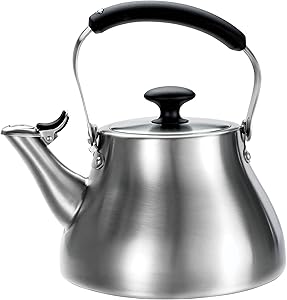
OXO focuses fundamentally on the physical interaction between the user and the appliance, utilizing a design language defined by clean lines, matte black accents, and soft, non-slip silicone contact surfaces. The signature OXO handle is an ergonomic triumph, engineered with counterbalanced weight distribution and a slip-resistant grip that significantly reduces strain when lifting and tipping a full kettle of boiling water. The lids on OXO kettles are designed for straightforward, single-hand opening, and their water windows feature high-contrast measurement markings that are easy to read from any angle. While OXO may not offer the all-metal prestige of Breville, its human-centric ergonomics and lightweight maneuverability make it uniquely comfortable for everyday, repetitive use.