
Honeywell vs Vornado: Overview
Comparing Honeywell and Vornado helps you determine which brand is best suited for your needs in Heaters. Both brands offer strong choices depending on your budget and key feature requirements.
Key Features & Comparison
Evaluate factors such as build quality, warranty, customer satisfaction, and total value before making your final purchase choice between Honeywell and Vornado.
Features
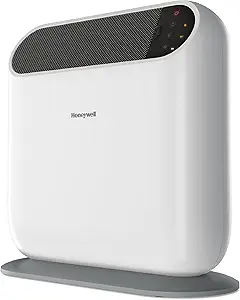
Honeywell takes a feature-dense, convenience-first approach that directly caters to modern consumer expectations on modern controls. Across its digital ceramic and tower models, Honeywell regularly equips units with programmable electronic thermostats, multi-stage auto-off countdown timers, wide-angle motorized oscillation, and digital LED readouts. Many midrange Honeywell units also integrate distinct multi-tier heating levels—such as dual or triple wattage steps—and occasionally proprietary safety interfaces like the SafeGuard alert system or insulated cool-touch housings, providing tangible user control and instant visual feedback.
Vornado adopts a more purist, performance-oriented feature architecture that prioritizes internal thermostatic efficiency over superficial digital novelty. While modern Vornado models like the AVH or Velocity series offer digital touch controls and precise climate presets, the brand relies fundamentally on its signature vortex airflow guides and aerodynamic fan blades rather than motorized oscillation to disperse warmth. Vornado heaters often incorporate continuous, multi-stage thermostatic sensing that actively adjusts heating elements to maintain a set room temperature rather than abruptly cycling on and off. While you may find fewer superficial extras like remote controls on base Vornado models compared to identically priced Honeywell units, Vornado’s feature set is tuned specifically for sustained thermal equilibrium and whisper-quiet operation.
Performance
Performance differentiation between the two brands boils down to the mechanics of heat distribution: directional forced-air convection versus whole-room air circulation. Honeywell heaters, typically utilizing conventional PTC ceramic elements paired with standard axial or cross-flow fans, excel at immediate, directional spot heating. When sitting a few feet away from a Honeywell tower or compact ceramic cube, users experience swift, intense thermal feedback. However, because standard Honeywell units rely heavily on oscillation to sweep air around a room, the warmth tends to stratify near the ceiling, leaving peripheral areas or lower floor zones cooler.
Vornado fundamentally redefines space heater performance by treating warmth as a fluid dynamic challenge. Utilizing deeply pitched aerodynamic blades and a specialized helical grill, Vornado units propel hot air long distances across a room, reflecting off walls to establish a continuous convective loop that circulates the entire volume of air. This prevents thermal stratification and creates a remarkably even ambient room temperature from floor to ceiling. In direct benchmark tests, while a Honeywell unit will register high localized heat directly in front of the exhaust, a Vornado will raise the mean temperature of an entire enclosed room more rapidly and maintain that warmth with significantly higher thermal efficiency and less localized scorching.
Design
From an industrial design standpoint, Honeywell prioritizes functional modularity and cost-effective construction. The aesthetic leans heavily into utilitarian consumer electronics, characterized by lightweight plastic enclosures, glossy or matte neutral finishes, and vertical tower forms optimized for narrow floor footprints. Honeywell handles portability effectively, engineering recessed carry handles and stable pedestal bases. However, the reliance on high-impact polystyrene plastics and lighter mechanical components can make some lower-tier Honeywell units feel somewhat hollow or susceptible to minor housing rattles under high-fan operation over extended lifespans.
Vornado emphasizes robust industrial durability and aerodynamic form factors, crafting heaters that visually echo vintage aircraft engines or mid-century functionalism. Utilizing premium, dense thermoplastics, Vornado units exhibit minimal chassis flex and superior vibration dampening, resulting in exceptionally low acoustic output during prolonged use. The signature deep-set vortex louvers and rounded silhouettes serve explicit thermodynamic purposes rather than purely decorative ones. Furthermore, Vornado offers sophisticated aesthetic variants like the VHEAT metal series, which delivers genuine stamped-steel vintage construction that doubles as an interior design statement—an upscale, architecturally conscious approach entirely absent from Honeywell’s strictly utilitarian product catalog.