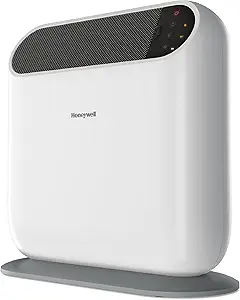
Honeywell vs Dyson: Overview & Brand Philosophy
When selecting a supplemental space heater, consumers frequently find themselves weighing the pragmatic, utility-driven heritage of Honeywell against the design-forward, high-tech engineering of Dyson. Honeywell, licensed largely through Helen of Troy for home environment products, has spent decades establishing a reputation built on dependable, utilitarian, and accessible climate control. Their heaters are engineered primarily for single-task efficiency: to deliver cost-effective, rapid, and straightforward warmth to a room without unnecessary complexity or exorbitant manufacturing costs.
In contrast, Dyson approaches the space heater market from an entirely different philosophy, treating home climate appliances as luxury design pieces and engineering masterclasses. Dyson integrates heating capabilities into multi-functional units that routinely incorporate intelligent air purification, blade-free airflow projection, and advanced internet-of-things (IoT) connectivity. Rather than simply warming a space, Dyson aims to regulate the complete environmental quality of an interior room using proprietary fluid dynamics and high-end sensors, demanding a significant price premium for the privilege.
This fundamental divide shapes the consumer decision. Honeywell addresses the customer who prioritizes direct function, proven safety mechanics, and high thermal output per dollar spent. Dyson caters to modern, tech-forward households looking for aesthetic elegance, year-round multi-functionality, precision smart-home automation, and cutting-edge safety features that integrate seamlessly into high-end living spaces.
Key Differences & Technological Comparison
The core technological distinction lies in the heat generation and air delivery mechanics. Honeywell relies primarily on traditional, proven heating elements: positive temperature coefficient (PTC) ceramics, radiant ribbons, and quartz infrared elements, often paired with standard axial fans to push air across the hot elements. Their heating profiles are aggressive and direct, making them exceptionally capable of spot-heating immediate zones or quickly elevating the ambient temperature of a cold bedroom. Controls on most Honeywell units range from basic mechanical dials to simple digital thermostats, focusing on ease of use and immediate thermal feedback.
Dyson utilizes proprietary Air Multiplier technology alongside self-regulating ceramic plates concealed entirely within an enclosed loop amplifier. Rather than pushing air with an exposed, spinning fan blade, Dyson accelerates air through an annular aperture, drawing in surrounding air to project smooth, high-velocity heat across long distances. This airflow can be focused for personal heating or diffused across an entire room. Furthermore, Dyson’s thermostatic monitoring is exceptionally precise, measuring ambient room temperature thousands of times per second to prevent overshooting the target temperature and wasting energy.
Feature distribution is another critical point of divergence. Dyson units—such as the Hot+Cool series—are engineered for 365-day utility. When the heating element is deactivated, the device functions as an effective cooling fan, and higher-tier models incorporate sealed HEPA H13 filtration systems that capture microscopic particulates, VOCs, and allergens while heating. Honeywell units are largely single-purpose heating appliances intended for seasonal storage, though they provide diverse form factors including compact desk wedges, 360-degree surround towers, and rugged workshop heaters designed to withstand demanding environments.
Pros & Cons Comparison
Honeywell Heaters
- Pro: Exceptional Value for Money: Honeywell units deliver substantial heating performance at an accessible price point, often costing a fraction of premium alternatives.
- Pro: High Thermal Output: Many models generate immediate, high-intensity heat, making them ideal for drafty, uninsulated, or high-loss spaces.
- Pro: Varied Form Factors: The lineup includes specialized designs such as 360-degree surround radiators, compact personal blowers, and floor-level baseboard alternatives.
- Pro: Simple Maintenance: With few complex electronics or filters to replace, maintenance is limited to occasional dust removal from exterior grilles.
- Con: Basic Aesthetics: Most models feature utilitarian plastic housings that emphasize function over modern interior styling.
- Con: Louder Operation: Conventional fan motors and blade designs often create higher operational noise (dB levels) on maximum output settings.
- Con: Seasonal Limitation: Units do not offer air purification or high-efficiency cooling, meaning they generally sit idle in storage through spring and summer.
Dyson Heaters
- Pro: Multi-Season Versatility: Combines precision ceramic space heating, cooling airflow, and medical-grade air purification within a single unit.
- Pro: Advanced Airflow Mechanics: Air Multiplier technology delivers quiet, widespread heat distribution without buffeting or exposed hot surfaces.
- Pro: Superior Safety Profile: The bladeless, fully enclosed design prevents accidental burns from exposed elements, remaining cool to the touch and safe around pets and children.
- Pro: Smart Home Integration: Many models feature Wi-Fi app control, voice assistant integration (Alexa, Siri, Google Assistant), and real-time indoor air quality reporting.
- Con: Prohibitive Cost: Purchase prices are substantially higher than conventional heaters, representing a major financial commitment.
- Con: Ongoing Ownership Costs: Models featuring HEPA and carbon filtration require recurring filter replacements to maintain purification performance.
- Con: Slower Spot-Heating: The diffused airflow can take longer to provide intense, direct localized warmth compared to concentrated, traditional ceramic blowers.
Performance, Durability & Value Analysis
From an objective performance standpoint, both brands adhere to the standard 1,500-watt maximum limit imposed on 120-volt household electrical circuits in North America, meaning both can produce roughly the same theoretical maximum of 5,118 BTUs of thermal energy. However, how that heat is distributed differs markedly. Honeywell leverages higher thermal density at the exhaust point, making it feel warmer in the immediate radius and achieving faster localized relief. Dyson relies on balanced convection currents and sustained air circulation, resulting in a more even room-wide temperature profile without noticeable cold spots, albeit with a perceived slower warm-up time directly in front of the device.
When assessing long-term reliability and value, Honeywell represents unmatched utility value. Their internal mechanics are straightforward, featuring heavy-duty switches, analog thermal cutoffs, and durable ceramic blocks that frequently last for years with negligible failure rates. If a Honeywell unit fails after five or six winters, the replacement cost is low. Dyson, however, represents a long-term capital investment in home infrastructure. While built from high-grade ABS polycarbonate with robust brushless motors, the sheer density of electronics—digital sensors, motorized oscillation bases, Wi-Fi modules, and particulate counters—introduces more potential failure points over an extended lifespan. Dyson’s value proposition rests entirely on whether the consumer fully utilizes the purification, smart scheduling, and year-round fan features.
Final Verdict: Which Brand Should You Choose?
Choose Honeywell if your primary objective is straightforward, cost-effective space heating. It is the superior choice for students, renters, workshops, home offices, and budget-conscious homeowners who simply need reliable, supplemental warmth during the coldest months of the year. If you want a no-nonsense heater that can be tucked under a desk, stored in a closet during the summer, and replaced without financial strain, Honeywell remains the practical benchmark.
Choose Dyson if you desire a permanent, all-in-one climate control appliance that prioritizes cutting-edge safety, air purification, and sleek modern design. It is particularly well-suited for households with small children or curious pets where exposed heating grilles pose a hazard, as well as allergy sufferers who benefit from continuous HEPA filtration. If your budget accommodates the premium entry price and you value smart home automation and multi-season utility, Dyson provides an elevated user experience that goes well beyond conventional heating.
Features
When evaluating the feature ecosystems of Honeywell and Dyson space heaters, consumers are faced with a stark contrast between utilitarian pragmatism and high-end technological convergence. Honeywell takes a functional, mission-driven approach to engineering, equipping its units with workhorse features focused strictly on dependable warmth and essential safety. Most Honeywell models feature standard ceramic or digital oscillating mechanisms, manual or digital thermostats, 360-degree tip-over switches, and basic programmable timers. Higher-tier models integrate proprietary technologies like ThermaWave or 360 Surround Heat to optimize directional airflow. These features are designed for direct, intuitive operation without a steep learning curve, prioritizing high-draw electrical safety, cool-touch housings, and thermal cutoff fuses that deliver reliable baseline performance at an accessible price point.
Conversely, Dyson fundamentally re-engineers the space heater into a multifunctional, year-round environmental control hub using advanced aerodynamics and digital sensor arrays. Powered by Dyson’s signature Air Multiplier technology and high-efficiency ceramic plates, devices like the Purifier Hot+Cool series do not simply warm a room; they simultaneously provide certified HEPA air filtration and cooling fan capabilities. The technical sophistication of Dyson’s feature set is expansive: intelligent PTC ceramic stones prevent overheating, automated ambient temperature sensors continuously throttle power draw to maintain exact setpoints, and motorized oscillation spans up to 350 degrees. Furthermore, Dyson integrates cutting-edge smart connectivity through the MyDyson app and voice assistants, yielding real-time air quality metrics, remote scheduling, and granular target-temperature controls that far exceed traditional space heater capabilities.
The practical trade-offs regarding features ultimately align with user lifestyle demands and cost-to-benefit expectations. Honeywell's feature architecture avoids complex digital points of failure, meaning their heaters are rugged, plug-and-play, and easily repaired or replaced if components fail. However, Honeywell lacks advanced remote management, true climate automation, and acoustic optimization, often running louder due to conventional fan assemblies. Dyson offers an unmatched, whisper-quiet luxury feature suite that justifies its multi-season footprint, but it comes at a steep premium and relies heavily on digital interfaces and proprietary filter replacements. For consumers seeking precise, connected, whole-room air management, Dyson is technologically superior, whereas Honeywell remains the undisputed benchmark for straightforward, no-nonsense thermal utility.
Performance
When evaluating thermal performance, Honeywell and Dyson approach heat generation and distribution from fundamentally different engineering philosophies. Honeywell relies on time-tested, utilitarian heating mechanisms—primarily robust positive temperature coefficient (PTC) ceramic elements and heavy-duty wire-coil configurations combined with conventional motorized fan impellers. In terms of raw, immediate heat output, Honeywell units are formidable performers. Models such as the Honeywell TurboForce and 360 Degree Surround deliver high British Thermal Unit (BTU) equivalents for their class, rapidly saturating smaller to mid-sized rooms with concentrated directional heat. Dyson, on the other hand, utilizes proprietary Air Multiplier technology alongside intelligent ceramic PTC stones. Instead of simply blasting air through a standard baffle, Dyson amplifies airflow up to ten times through an aerodynamic aperture, creating a continuous, smooth stream of long-range, high-velocity ambient heat. While Dyson heaters rarely feel as intensely hot directly at the grille as a Honeywell, their ability to project heat evenly across large living spaces without creating localized cold spots represents superior thermal fluid dynamics.
The technical divergence is most pronounced in thermostatic regulation, precision control, and multi-functional performance. Dyson models, such as the Purifier Hot+Cool series, incorporate hyper-sensitive onboard digital thermostats that monitor ambient room temperature multiple times per second, dynamically modulating power to sustain an exact target degree rather than relying on broad-temperature cycling. Furthermore, Dyson’s performance is compounded by ultra-wide oscillation (up to 350 degrees) and dual-functionality, seamlessly integrating high-efficiency particulate air (HEPA) filtration that continuously scrubs airborne allergens while maintaining steady thermal distribution. Conversely, Honeywell adopts a far more rudimentary approach. Many of its standard units utilize analog or basic digital bi-metallic thermostats, which frequently result in noticeable ambient temperature fluctuations as the heater cycles hard on and completely off. Even Honeywell’s programmable digital models lack the precise airflow tuning of Dyson, offering only discrete low/high fan speeds with considerably louder acoustic footprints as output scales.
Ultimately, the performance trade-off centers on brute-force thermal efficiency versus refined, whole-room atmospheric control. For consumers prioritizing aggressive, rapid localized heating—such as quickly warming an uninsulated home office, a cold basement corner, or a specific draft zone—Honeywell offers raw, reliable mechanical performance with minimal mechanical complexity. However, its performance ceiling is limited by loud fan noise, uneven directional hot spots, and inefficient thermal overshoot. Dyson commands a luxury performance tier, excelling in sustained, whisper-quiet whole-room equilibrium, surgical temperature consistency, and year-round air management. While a Honeywell heater delivers more direct heat per dollar spent, Dyson provides an objectively superior, technologically sophisticated climate-control performance for discerning users willing to invest in premium engineering.
Design
When evaluating the design philosophy of space heaters, Honeywell and Dyson represent opposite ends of the engineering spectrum: utilitarian pragmatism versus cutting-edge architectural luxury. Honeywell focuses on functional, robust, and accessible industrial design. Their units typically feature flame-resistant, heavy-duty molded plastics, compact footprint profiles, and intuitive analog or basic digital controls. Built with mechanical reliability in mind, Honeywell heaters—such as their popular ceramic towers and 360-degree surround models—incorporate pragmatic physical elements like deeply recessed carry handles, wide, tip-resistant bases, and simple mechanical toggle or dial interfaces that can be operated without consulting a manual. While they prioritize durability and budget-conscious manufacturing over aesthetic appeal, their straightforward, unobtrusive enclosures blend easily into workshops, home offices, and standard domestic spaces without drawing attention.
Conversely, Dyson approaches heating through a lens of high-concept industrial engineering and modern interior aesthetics. Utilizing their patented Air Multiplier technology, Dyson eliminates exposed heating elements and visible fan blades entirely, housing their PTC ceramic plates within an aerodynamic, bladeless loop. The engineering quality is distinctly premium, characterized by high-grade ABS polycarbonate shells, sleek metallic finishes, and a minimalist silhouette that doubles as contemporary home decor. Dyson’s feature set is far more technologically sophisticated, integrating precision digital thermostats, intelligent ambient sensors, magnetized remote controls that dock directly to the unit, and smooth motorized oscillation up to 350 degrees. Many models also feature dual-season hybrid functionality, combining high-velocity projection cooling and HEPA-grade air purification into a single, cohesive vertical footprint.
The practical trade-offs between these design paradigms center on cost, maintenance, and spatial footprint. Dyson's bladeless architecture offers unmatched safety benefits for households with small children or pets, alongside effortless wipe-clean maintenance, eliminating the common issue of dust burning on internal coils. However, this high-end engineering comes at an exponential price premium, and the units are significantly taller, requiring dedicated floor space and reliance on remote controls or smartphone apps for full functionality. Honeywell’s traditional, grille-based designs are inherently more susceptible to dust accumulation and are bulkier relative to their heat projection, but they deliver exceptional thermal efficiency per dollar, easier manual portability, and a rugged, low-maintenance design that forgives accidental knocks and rough daily use.
Compare current retail pricing, active promotions, and verified stock availability directly from authorized stores: