
Honeywell vs Duraflame: Overview
Comparing Honeywell and Duraflame helps you determine which brand is best suited for your needs in Heaters. Both brands offer strong choices depending on your budget and key feature requirements.
Key Features & Comparison
Evaluate factors such as build quality, warranty, customer satisfaction, and total value before making your final purchase choice between Honeywell and Duraflame.
Features
Honeywell outfits its space heaters with a modern suite of electronic controls focused on precision, safety, and energy stewardship. Typical Honeywell models feature digital thermostats, programmable timers, auto-off functions, and their proprietary EnergySmart technology, which automatically adjusts power consumption based on ambient temperature to sustain target comfort levels efficiently. Safety integration is exceptionally robust, standardly including 360-degree tip-over switches, dual overheat shutoff sensors, and cool-touch plastic housings that meet rigorous UL safety standards. These technical features cater directly to safety-conscious consumers seeking precise automation and worry-free operation in bedrooms, nurseries, or home offices.
Duraflame approaches feature engineering with an emphasis on ambiance and physiological comfort, spearheaded by their advanced 3D flame effect technology. Most Duraflame units feature multi-level brightness controls, operable with or without heat, allowing for year-round atmospheric use. Beyond aesthetics, Duraflame incorporates patent-pending Safer Plug fire-prevention technology, which actively monitors the wall outlet temperature and shuts down the unit if overheating is detected—a sophisticated layer of electrical safety often omitted in budget heaters. Additionally, Duraflame's infrared quartz elements maintain natural humidity levels, pairing technical moisture retention with remote control operation and digital sleep timers to provide a luxurious heating experience.
Performance
In terms of raw thermal delivery, Honeywell relies primarily on ceramic heating blocks combined with forced-air blowers or classic oil-filled radiant fins. Ceramic-fan configurations provide rapid, directional heat that quickly elevates the temperature of a localized zone, making them exceptionally effective for quick personal warmth. However, forced-air convection has distinct operational limitations: it can be noisy due to fan hum, often creates noticeable hot and cold stratification within larger rooms, and tends to rapidly deplete ambient room humidity, which can cause dry sinuses and skin during extended winter operation.
Duraflame outperforms in comfort and coverage by utilizing high-capacity infrared quartz tubes rated to warm spaces up to 1,000 square feet, compared to Honeywell's typical 150- to 250-square-foot task limit. Infrared heating operates by emitting electromagnetic waves that directly warm solid objects and people rather than merely blowing heated air, resulting in a deeper, more uniform thermal soak across large living rooms. Crucially, this radiant method does not reduce relative humidity, ensuring an inherently more comfortable living environment. While Duraflame units take longer to bring an entire room up to temperature from a cold start, their heat distribution is far more consistent, gentle, and quiet than Honeywell's fan-driven alternatives.
Design
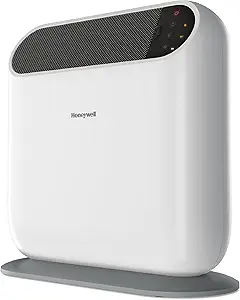
The industrial design of Honeywell heaters is clean, modern, and unapologetically utilitarian. Constructed predominantly from high-grade, heat-resistant polymers, their product line emphasizes compact footprints, integrated carry handles, and lightweight form factors that facilitate effortless movement between rooms. From minimalist ceramic towers to discreet under-desk pucks, Honeywell units are engineered to blend unobtrusively into modern office decor or contemporary bedrooms. The aesthetic is strictly function-forward; controls are intuitive and visible, prioritize ergonomic accessibility, and minimize spatial displacement in high-traffic zones.
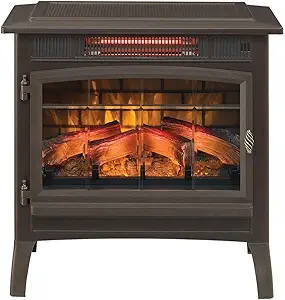
Conversely, Duraflame designs are architectural and centerpiece-oriented, drawing inspiration from rustic wood stoves, mid-century consoles, and classic hearthside fireplaces. Featuring heavy metal cabinetry, operable beveled glass doors, molded log sets, and simulated brick interiors, a Duraflame heater is deliberately crafted to be seen and admired. The trade-off is significant: these units are heavy, occupy substantial floor or wall space, and lack the portability of a traditional portable heater. However, for consumers who want to introduce the visual warmth of a flickering hearth into a room lacking a chimney, Duraflame’s craftsmanship and decorative appeal are vastly superior to Honeywell's sterile, appliance-grade presentation.
Compare current retail pricing, active promotions, and verified stock availability directly from authorized stores: