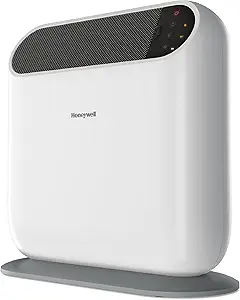

Honeywell vs Dr Infrared: Overview
Comparing Honeywell and Dr Infrared helps you determine which brand is best suited for your needs in Heaters. Both brands offer strong choices depending on your budget and key feature requirements.
Key Features & Comparison
Evaluate factors such as build quality, warranty, customer satisfaction, and total value before making your final purchase choice between Honeywell and Dr Infrared.
Features
From a feature and functional architecture perspective, Honeywell champions user accessibility and digital precision across its modern lineup. Many flagship Honeywell units come equipped with digital thermostats featuring LED displays, programmable timers ranging up to eight hours, multi-stage oscillation, and proprietary energy-saving modes like EnergySmart, which self-regulates power draw based on ambient room thresholds. Honeywell also heavily standardizes safety components through its 360-degree tip-over switches, dual-stage overheat protection, and cool-to-the-touch composite outer housings, ensuring their units satisfy rigorous household safety standards out of the box.
Dr Infrared counters not with flashy digital interfaces, but with heavy-duty thermal components and specialized climate-control engineering. Flagship models, such as the Portable Space Heater series, integrate dual heating systems featuring both infrared quartz tubes and PTC ceramic elements, a high-efficiency 7-inch blower, and built-in humidifiers or air-filtration features on advanced SKUs. Remote control operation is standard on nearly all Dr Infrared units, and their electronic thermostats are paired with a precise ambient temperature sensor that prevents short-cycling. While Honeywell provides broader control over oscillation and directional output, Dr Infrared excels in integrating heavy-duty components that maintain systemic thermal efficiency over hours of continuous duty.
Performance
In quantitative thermal output and runtime performance, Dr Infrared holds a distinct technical advantage, particularly for medium-to-large floor plans up to 1,000 square feet. Because infrared energy transfers directly to solid masses, Dr Infrared units avoid the aggressive convective thermal loss typical of ceiling-bound hot air. The result is a remarkably steady, even heat signature that does not deplete ambient humidity or trigger significant static electricity. The high-volume, low-speed squirrel-cage blowers utilized by Dr Infrared produce exceptional airflow while registering whisper-quiet noise levels (often under 39 dB), making them premier performers for living rooms and bedrooms requiring sustained overnight operation.
Honeywell models generally deliver rapid, intense localized heat, making them superior for spot-warming cold offices, desks, and small bedrooms in rapid succession. Utilizing ceramic elements paired with directional fans, a Honeywell heater can elevate the immediate vicinity's temperature within seconds of engagement. However, in larger spaces or poorly insulated drafty environments, Honeywell convection models must run continuously at their maximum 1500-watt draw to overcome rapid air cooling, leading to higher electricity consumption and noticeable fan noise. Honeywell provides instant gratification and targeted thermal relief, but Dr Infrared offers significantly better long-term heating stability, thermal mass retention, and whole-room comfort.
Design
The aesthetic and physical design philosophies of these two manufacturers reflect fundamentally divergent target environments. Honeywell embraces a contemporary, utilitarian design language dominated by lightweight polymer enclosures, sleek tower silhouettes, and compact, minimalist forms that easily tuck away in tight spaces. Weight management is a priority for Honeywell, with many units weighing under five pounds and incorporating integrated carry handles for effortless room-to-room transit. This modern, unobtrusive industrial aesthetic integrates seamlessly into contemporary apartments, home offices, and modern dorms, though the reliance on plastic outer components can make lower-tier units feel less premium.
Dr Infrared adopts a radically different, furniture-grade form factor characterized by vintage-inspired, retro wooden cabinetry or rugged, heavy-gauge steel shells. Units like the DR-968 resemble high-end audio equipment or side tables, deliberately crafted to sit visibly as a permanent fixture within classic living rooms and family dens. The trade-off is substantial physical mass: Dr Infrared units often weigh between 15 and 25 pounds, though they typically include heavy-duty rolling casters to aid portability. While Honeywell aims for discreet, space-saving practicality, Dr Infrared embraces a robust, durable, and retro architectural presence engineered to withstand decades of intensive seasonal deployment.
Compare current retail pricing, active promotions, and verified stock availability directly from authorized stores:
Compare current retail pricing, active promotions, and verified stock availability directly from authorized stores: