
Dr Infrared vs Duraflame: Overview
Comparing Dr Infrared and Duraflame helps you determine which brand is best suited for your needs in Heaters. Both brands offer strong choices depending on your budget and key feature requirements.
Key Features & Comparison
Evaluate factors such as build quality, warranty, customer satisfaction, and total value before making your final purchase choice between Dr Infrared and Duraflame.
Features
From a feature and control standpoint, Dr Infrared approaches engineering with a focus on precision and automated efficiency. Most flagship models, such as the DR-968, incorporate proprietary dual-heating systems paired with high-accuracy electronic thermostats that dynamically modulate power between low and high settings (typically 1000W to 1500W) to sustain a strict target temperature. Dr Infrared also integrates solid-state controls, comprehensive timer configurations, and a robust suite of safety mechanisms, including dual-stage overheating sensors and tip-over shutoff switches. Remote controls are standard, focusing on functional calibration, while advanced models offer integration with humidifiers or smart-home ecosystems. The internal components feature larger, high-surface-area quartz tubes wrapped in stainless steel baffles to optimize latent heat retention.
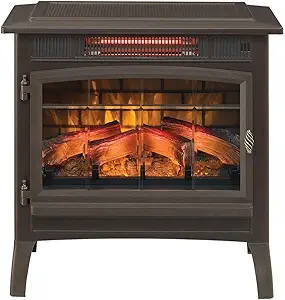
Duraflame’s feature set is heavily skewed toward atmospheric customization and intuitive, user-friendly operation. Its patent-pending 3D Flame Effect technology allows users to toggle between varying brightness levels, speeds, and color spectrums of simulated fire, delivering an industry-leading visual simulation. Functionally, Duraflame units frequently employ quartz infrared elements rated up to 5,200 BTUs, managed via digital touch controls or multi-function remotes. Duraflame also leads the charge in consumer safety innovations with its proprietary Safer Plug technology, which continuously monitors plug temperature to prevent electrical wall-outlet overheating—a common hazard in 1,500-watt continuous-draw space heaters. However, Dr Infrared edges ahead in terms of thermal automation and precise temperature maintenance, whereas Duraflame dominates in cosmetic customization and plug-level safety monitoring.
Performance
Thermal performance metrics reveal significant differences in how each brand conditions an indoor atmosphere. Dr Infrared relies heavily on low-noise, high-volume cross-flow blowers that propel warmed air further into a room, generating steady convection currents without scorching the air. Because the unit utilizes far-infrared radiation, it heats dense physical objects and human tissue directly rather than merely superheating the localized air around the chassis. This engineering design prevents the uncomfortable thermal stratification often seen in lower-tier heaters and ensures that relative humidity remains intact, avoiding the dry eyes and sinuses associated with open-coil radiant heaters. Dr Infrared models generally demonstrate faster recovery times when doors open and close, making them more resilient in drafty or high-ceilinged environments.
Duraflame provides respectable, soft heating performance that is best described as gentle and localized. Many of their quartz units produce up to 5,200 BTUs of infrared heat, which is scientifically rated to cover areas up to 1,000 square feet under optimal insulation conditions. Duraflame's infrared heat also preserves natural air moisture, ensuring comfortable respiration. However, the airflow rate on typical Duraflame stove and mantel units is noticeably lower and gentler than that of Dr Infrared, resulting in slower room-wide thermal saturation. While a Duraflame unit will effortlessly warm the immediate seating perimeter around the fireplace mantel, Dr Infrared consistently outperforms it in empirical heat distribution, achieving a more uniform temperature gradient across larger square footages in shorter timeframes.
Design
Aesthetic and physical design philosophies represent the starkest divergence between these two manufacturers. Dr Infrared adheres to a decidedly industrial and utilitarian design language. The classic DR-968 features an unpretentious wooden veneer wrapped over a galvanized steel frame with a utilitarian front grille, while its newer models utilize matte black plastics and minimalist digital readouts. Mobility is heavily prioritized, with multi-directional caster wheels integrated directly into the base of most units, making them easy to relocate between home offices, bedrooms, and workshops. The form factor is compact and boxy, engineered to take up minimal floor space rather than serve as ornamental furniture. Build quality is robust, with durable internal mounting plates designed to survive seasonal storage and transit.
Duraflame treats heater design as an intrinsic component of home decor and interior styling. Their product line is defined by classic cast-iron stove aesthetics, mid-century modern credenzas, and ornate fireplace mantels complete with beveled glass panels, realistic ember beds, and decorative molding. These units are intended to anchor a room visually, mimicking traditional hearths without the mess or masonry costs of wood-burning installations. While certain Duraflame stove models offer integrated carry handles, they lack the effortless roll-away mobility of Dr Infrared's caster-mounted cabinets and frequently carry a significantly heavier footprint. If your objective is seamlessly integrating a heater into a cohesive living room motif, Duraflame's design is vastly superior, whereas Dr Infrared is clearly the superior choice for compact, functional deployment.
Compare current retail pricing, active promotions, and verified stock availability directly from authorized stores: