Garmin vs Rexing: Overview
Comparing Garmin and Rexing helps you determine which brand is best suited for your needs in Dash Cams. Both brands offer strong choices depending on your budget and key feature requirements.
Key Features & Comparison
Evaluate factors such as build quality, warranty, customer satisfaction, and total value before making your final purchase choice between Garmin and Rexing.
Features
Garmin’s feature set is distinguished by sophisticated driver-assist technologies (ADAS) and high-level software integration. Many Garmin models incorporate forward collision warnings, lane departure alerts, and 'Go' alerts when stopped traffic begins moving, alongside intuitive voice control that allows drivers to save clips or start audio recording hands-free. Additionally, Garmin offers features like Garmin Vault, which automatically uploads secured incident footage to cloud storage via Wi-Fi, and Garmin Dash Cam Auto Sync, enabling synchronized network control for up to four distinct cameras through the Garmin Drive app.
Rexing focuses its technical feature matrix on hardwired multi-channel recording, wide dynamic range exposure, and comprehensive power delivery options. Most Rexing units come bundled with, or explicitly support, modular rear and interior infrared cabin cameras, built-in supercapacitors for extreme temperature resistance, and flexible 24-hour parking surveillance kits. While Rexing’s advanced driver assistance systems are more rudimentary and prone to false alerts compared to Garmin’s algorithmic processing, Rexing compensates with practical hardware additions like integrated GPS logging modules, wide-angle auxiliary cameras, and physical buttons that simplify manual operation on the road.
Performance
In terms of imaging performance, Garmin emphasizes software-driven picture optimization, high dynamic range (HDR), and color fidelity across challenging lighting conditions. Leveraging Garmin Clarity HDR optics, units like the Dash Cam 57 and 67W excel at resolving contrast in direct sunlight and extracting critical details such as license plates and street signs at dusk. Even though Garmin frequently caps video resolution at 1440p (with select 4K variants), the superior bitrate encoding and intelligent color grading yield sharp, artifact-free footage that performs reliably in real-world legal and insurance scenarios.
Rexing takes a raw-specifications approach, frequently offering native 4K UHD front-facing sensors paired with Sony STARVIS optical processors across accessible price tiers. Under daylight conditions, Rexing’s ultra-high-resolution sensors capture impressive structural detail and broad environmental context across ultra-wide 170-degree viewing angles. However, Rexing's performance can struggle in extreme nighttime scenarios, where digital noise and glare from headlights occasionally wash out reflective license plates. Garmin provides more consistent white balance and shadow recovery, whereas Rexing wins on pixel density and multi-lens coverage efficiency.
Design
Design is arguably the sharpest differentiator between the two manufacturers, with Garmin championing an ultra-compact, covert philosophy. Garmin dash cams are notoriously tiny—often no larger than a standard automotive key fob—which allows them to hide completely behind a vehicle's rearview mirror. They utilize low-profile magnetic adhesive mounts that make detaching the unit effortless while maintaining absolute stability against road vibrations. The minimalist physical footprint prevents driver distraction and preserves the clean aesthetic of modern vehicle interiors.
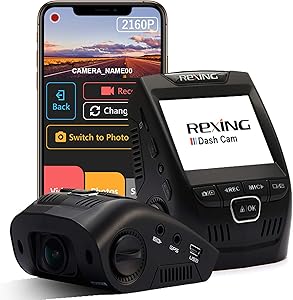
Rexing adopts a completely different industrial design signature, utilizing a wedge-shaped body that mounts flush against the windshield. This angled form factor allows the camera lens to sit flat against the glass, virtually eliminating windshield glare and reflections while keeping cables tightly routed along the headliner. While the wedge design is discreet from the vehicle's exterior, Rexing units occupy significantly more interior glass real estate than Garmin’s micro-chassis and typically incorporate larger, traditional LCD screens, appealing to users who prefer immediate on-device playback over smartphone-dependent management.
Compare current retail pricing, active promotions, and verified stock availability directly from authorized stores: