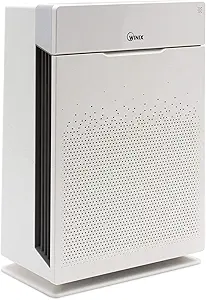







Winix vs Blueair: Overview
Comparing Winix and Blueair helps you determine which brand is best suited for your needs in Air Purifiers. Both brands offer strong choices depending on your budget and key feature requirements.
Key Features & Comparison
Evaluate factors such as build quality, warranty, customer satisfaction, and total value before making your final purchase choice between Winix and Blueair.
Features
Winix purifiers are engineered with a strong emphasis on practical, daily automation. Most models, such as the popular 5500-2 and AM90, come standard with Smart Sensors that continuously monitor indoor ambient air quality and dynamically adjust fan speeds via Auto Mode. The defining proprietary feature for Winix is PlasmaWave technology, which generates positive and negative ions to neutralize airborne viruses, chemical vapors, and bacteria without generating harmful levels of ozone. Additionally, Winix models often include physical remote controls, intuitive sleep modes with light sensors, and washable pre-filters that extend the lifespan of the interior carbon and HEPA stages.
Blueair takes a more sophisticated, tech-centric approach to its feature ecosystem, particularly within its DustMagnet, Protect, and classic Blue Pure lines. While some entry-level Blue Pure units adopt an ultra-minimalist single-button interface, higher-tier Blueair models integrate GermShield technology, which proactively monitors room conditions to kill bacteria on the filter even when on standby. Blueair’s smart offerings boast advanced Wi-Fi connectivity via the Blueair app, providing real-time VOC tracking, particulate matter readings (PM1, PM2.5, and PM10), filter degradation algorithms, and geofencing capabilities that activate purification before you arrive home, clearly outpacing Winix's relatively basic app interface.
Performance
From a mechanical performance standpoint, Winix relies on traditional, dense True HEPA media that physically captures 99.97% of airborne particles down to 0.3 microns. This is reinforced by substantial activated carbon stages—frequently featuring granular carbon pellets rather than carbon-coated sheets—which excel at adsorbing volatile organic compounds (VOCs), cooking fumes, and pet odors. The combination of dense physical barriers and plasma ionization makes Winix exceptionally proficient at treating localized biological contaminants and dense smoke, although higher fan speeds can introduce noticeable motor noise and draftiness.
Blueair achieves equal or superior particulate capture through its HEPASilent technology, which mechanically traps 99.97% of particles down to 0.1 microns while using less dense filter fibers. By electrostatically charging incoming particles, the filter captures microscopic debris with lower air resistance, enabling Blueair units to deliver exceptionally high CADR ratings with significantly lower acoustic profiles than equivalent Winix machines. The trade-off lies in chemical and odor filtration: many entry-to-mid-tier Blueair units use relatively thin carbon mesh sheets that saturate faster than Winix’s pelletized carbon beds, meaning Winix often holds the edge for heavy odor removal, while Blueair reigns supreme in continuous dust, pollen, and micro-particulate clearance.
Design
The aesthetic approach of Winix leans heavily into utilitarian consumer electronics. Constructed predominantly from matte white or dark grey plastics, Winix units feature upright tower or boxy console chassis that prioritize frontal intake and top-vent exhaust. While structurally durable and stable, they are inherently functional appliances that do not attempt to blend seamlessly into luxury decor. Front panel grilles, physical membrane or touch buttons, and prominent LED indicator bars are standard, presenting an interface that is immediately understandable but undeniably appliance-centric.
Blueair, in contrast, treats industrial design as a core value proposition, prioritizing Scandinavian minimalism and architectural elegance. From the fabric-wrapped pre-filters of the Blue Pure series—which double as customizable color accents—to the clean lines and hidden air channels of the Protect and DustMagnet models, Blueair purifiers are designed to complement contemporary interior spaces. Their top exhausts often utilize 360-degree or dual-exit diffusers that eliminate harsh drafts, and their hidden display panels wake only when approached, giving Blueair a distinct advantage for style-conscious consumers seeking unobtrusive integration into their living spaces.
Compare current retail pricing, active promotions, and verified stock availability directly from authorized stores: