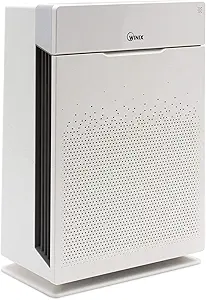
Winix vs Aeris: Overview
Comparing Winix and Aeris helps you determine which brand is best suited for your needs in Air Purifiers. Both brands offer strong choices depending on your budget and key feature requirements.
Key Features & Comparison
Evaluate factors such as build quality, warranty, customer satisfaction, and total value before making your final purchase choice between Winix and Aeris.
Features
In terms of feature sets, Winix leans into pragmatic, automated convenience tailored for effortless operation. Most Winix models are equipped with smart particle sensors that drive an intuitive Auto Mode, automatically modulating fan speeds based on real-time ambient particulate counts. A standout proprietary feature is their PlasmaWave technology, which generates positive and negative ions to neutralize airborne pollutants, odors, and molecular contaminants at a microbial level. While newer Winix iterations offer Wi-Fi connectivity and basic app integration, the interface remains straightforward and utilitarian, focused on day-to-day functionality like sleep timers, filter life indicators, and light-sensitive ambient sensors.
Aeris approaches features through an advanced technological and computational lens. The brand's units incorporate enterprise-grade sensor arrays capable of tracking PM2.5, PM10, and specific gas concentrations with laboratory-level precision, visualised directly through a minimalist digital display or a sophisticated mobile application. Aeris purifiers employ proprietary anti-microbial coatings across their filter media and chassis to prevent bacterial colonization within the machine. Furthermore, their machine learning software learns user habits and environmental cycles to preemptively boost filtration before indoor air quality degrades, outclassing Winix in software sophistication and granular analytical reporting.
Performance
Evaluating raw filtration performance reveals a distinct operational division between the two manufacturers. Winix utilizes a standard three-to-four stage filtration method, pairing a washable fine mesh pre-filter and activated carbon sheet with a True HEPA filter rated to capture 99.97% of airborne particles down to 0.3 microns. In typical domestic settings dealing with common dust, pet dander, and seasonal pollen, Winix punches significantly above its weight class, delivering rapid Clean Air Delivery Rates (CADR) that easily satisfy mid-to-large residential living spaces at very modest electrical wattages.
Aeris, however, operates on a much higher technical threshold by engineering its systems with higher-grade True HEPA (often H13 or H14 medical-grade) filters capable of trapping particles down to 0.1 microns with up to 99.95% to 99.995% efficiency. Where Aeris particularly eclipses Winix is in gas-phase remediation; Aeris integrates dense beds of virgin activated carbon mixed with zeolite or alumina, designed to adsorb massive volumes of formaldehyde, smoke, and industrial VOCs that simply overwhelm the thin carbon sheets used in standard Winix models. Aeris air purifiers maintain higher static pressure and superior airflow dynamics, ensuring peak filtration integrity even under heavy contaminant loads.
Design
Design and material quality mark the most visible divergence between these two brands. Winix units are constructed primarily from molded thermoplastics, featuring conventional upright tower or boxy console aesthetics with front or lateral intake grilles. While cleanly styled and built to blend inconspicuously into the background, the physical materials reflect their budget-friendly nature. The tactile feedback of the controls, the lightweight plastic housing, and the utilitarian exterior make it clear that Winix prioritizes mass-production efficiency and lightweight maneuverability over architectural prestige.
In contrast, Aeris treats the air purifier as a statement piece of modern industrial design, employing high-density polymers, seamless enclosures, and bespoke fabric wraps treated with zinc pyrithione. The cylindrical and monolithic forms created by Swiss designers integrate effortlessly into minimalist, Scandinavian, or upscale contemporary interiors. Beyond visual elegance, Aeris's physical architecture is engineered with superior acoustic dampening and tightly sealed zero-bypass gaskets, preventing contaminated air from leaking around the filter media—a structural refinement that highlights the vast gap in physical craftsmanship compared to Winix.