Honeywell vs Winix: Overview
Comparing Honeywell and Winix helps you determine which brand is best suited for your needs in Air Purifiers. Both brands offer strong choices depending on your budget and key feature requirements.
Key Features & Comparison
Evaluate factors such as build quality, warranty, customer satisfaction, and total value before making your final purchase choice between Honeywell and Winix.
Features
In terms of feature sets, Honeywell generally adheres to an analog, utilitarian approach, with controls focusing on discrete fan speeds, simple timer settings, and manual filter-replacement indicators. While modern iterations include Bluetooth or Wi-Fi on select top-tier models, the core of Honeywell's catalog relies on manual user intervention and continuous-run settings. This minimalism translates to high operational reliability and low electronic failure rates, though it lacks the dynamic adaptability expected in modern smart homes. Honeywell units rarely incorporate onboard real-time air quality metrics, relying instead on scheduled runtimes to maintain ambient cleanliness.
Winix takes a substantially more automated and technologically advanced approach to air treatment. Most Winix models feature integrated infrared or particle sensors that continuously evaluate ambient air conditions, automatically adjusting fan speeds in real time via an intuitive Auto Mode. Winix also distinguishes itself with PlasmaWave technology, a bipolar ionization system that neutralizes airborne viruses, bacteria, and chemical vapors without producing harmful levels of ozone. Coupled with light-sensing Sleep Modes and seamless Wi-Fi smart app integration on many entry-to-midrange units, Winix offers a comprehensive, 'set-it-and-forget-it' convenience that Honeywell's standard lineup does not match.
Performance
Performance benchmarks reveal notable divergences in how each brand cleans indoor environments. Honeywell excels at volumetric air processing, utilizing powerful, high-torque centrifugal fans combined with thick, medical-grade True HEPA filters. This allows Honeywell purifiers—such as the HPA300 series—to achieve exceptionally high CADR ratings for smoke, dust, and pollen, often outperforming competitors in cycling air rapidly through large, open-concept spaces. However, this brute-force mechanical filtration comes at the cost of elevated noise levels at peak output and higher continuous power draw, which may deter users seeking silent bedroom operation.
Winix purifiers demonstrate exceptional nuance in mid-sized spaces, leveraging a balanced synergy between high-efficiency True HEPA media, activated carbon sheets or pellets, and electronic ionization. While their absolute CADR numbers on paper may fall slightly below Honeywell’s largest commercial-style units, Winix excels in perceived indoor air quality by rapidly eliminating stubborn household odors, pet dander, and chemical pollutants that standard HEPA filters cannot trap alone. Furthermore, Winix models are engineered for ultra-quiet operation at low and medium speeds, delivering superior acoustic comfort and energy efficiency during overnight cycles.
Design
From an aesthetic and structural perspective, Honeywell purifiers prioritize rugged durability and maximum intake efficiency over interior decor harmony. Built with heavy-duty plastics and perforated intake grilles that span broad surface areas, Honeywell designs are fundamentally utilitarian. Their bulkier, boxy footprints and visible seams clearly communicate a focus on airflow dynamics rather than living room aesthetics. Filter access is typically straightforward, facilitating fast maintenance, but these units demand deliberate placement away from walls to avoid obstructing their wrap-around or dual-sided air intakes.
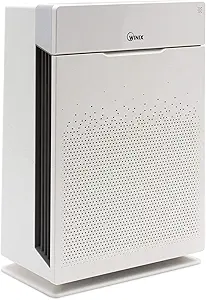
Winix, conversely, invests heavily in modern industrial design, crafting sleek, minimalist appliances with subtle curves, integrated hidden grilles, and contemporary matte finishes that blend seamlessly into modern living spaces. Winix units generally utilize front-facing intake architectures with top-firing exhausts, enabling placement closer to walls without severely choking system airflow. The integration of ambient color-coded LED rings indicating real-time air quality adds both functional value and refined visual polish, ensuring that Winix purifiers look like sophisticated home electronics rather than purely utilitarian appliances.